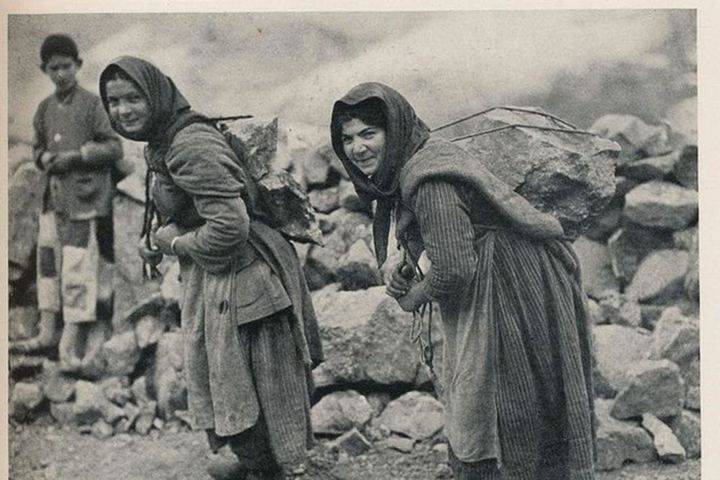
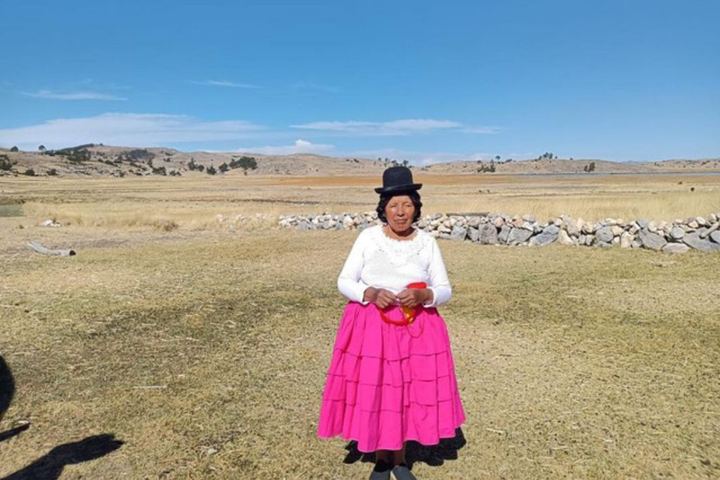
Femmene minute cu' 'a forza 'e 'nu gigante (little women with a giant's power) in the terraced landscape of Amalfi Coast.
Affiliations
- 1 Department of Architecture, University Roma Tre
International Terraced Landscapes Alliance Journal volume 2, issue 1, pp. 16–31 (2021) · Cite this article
- 243 views
- 282 downloads
- DOI10.5281/zenodo.7306802
Abstract
Women have always had a fundamental role in taking care of the terraced landscape in Amalfi Coast.
The ancestral relationship between women and their landscape has ancient origins and it is based on the fact that, while activities at sea, since the times of the Maritime Republic, were exclusive to the male world, on land women played all the roles, acquiring a very high knowledge of the territory and a high degree of independence thanks to the prolonged absence of men. «Furmechelle» (= little ants) was the name the Amalfitan community called rural women, because of their hard and endlessly work.
Little ants with a giant strength carried during centuries lemons, food, soil, and everything connected with the rural life from terraced gardens as far as the sea.
This article traces the symbiotic relationship between the female body and everyday vertical places of the terraced landscape in Amalfi Coast. Older women proudly remember: «Avimmo faticato sempre» (= we strongly worked all day in agriculture). A form of pride and care that is still present among women and that can be the fundamental key to the new processes of protection of the landscape of the Amalfi Coast.
Keywords
- Terraced landscape
- Amalfi Coast
- Agriculture
- Rural Spaces
- Mediterranean architecture
1.1. The construction of a landscape
Landscape in Amalfi Coast is formed by the juxtaposition of terraced agricultural patches overlooking the sea and superimposed in an urban micro plot of small hamlets and scattered houses.
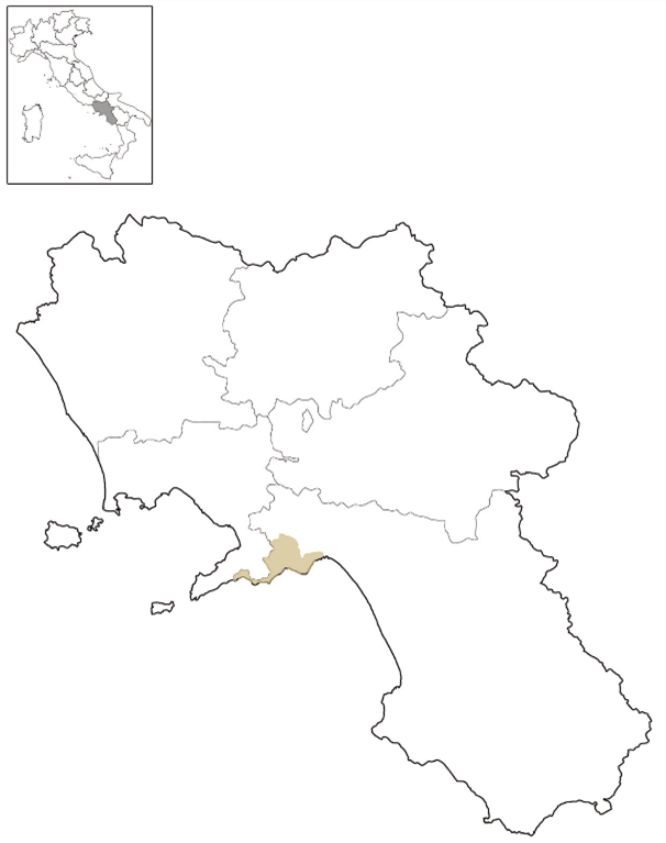
As Unesco underlined, this landscape is a significant example of successful interaction between nature and human’s work (Figure 1) (Unesco, 1997). Here, patches of semi-wild vegetation coexist with the orderly architecture of the terracing planted with pergolas that form an architectural weave of tiny patches overhanging the sea and masterfully adapted to the orography. Human activity in the area began with the Imperial Tourism, starting with Tiberius Villa in Capri, and continuing with the colonisation of the coast by Roman patricians looking for a retreat in the Campania Felix. Stazio first describe this wild nature as «divine» (Stazio, 93 AD).
Wild nature turns slowly in a Mediterranean garden of fruit trees, vines and olive trees during the Middle Ages. The large capitals accumulated through the mercantile activities of the Maritime Republic were reinvested in the land. Men and women built stone walls to make the land arable and fertile. And they succeeded. Agricultural activity begins to flourish with the discoveries of the Arab and the Scuola Medica of Salerno. This increased the demand for citrus fruits, determining prices in such a way to justify the investments needed to terracing dating back to 950-1025 AD.
In the 12th century, Beniamino di Tudela writes that the inhabitants of Amalfi “have an abundance of fruit, for it is a land of vineyards and olives, of gardens and plantations and no one can do war with them” (Adler, 1907, p.9).
This virtuous co-evolutionary process goes on along for centuries. Since the twelfth century, this flourishing agriculture has been integrated with silviculture, mainly chestnut groves, both for fruit as well as wood, which, as we will see, is closely linked to citrus cultivation. Bare rock was - with wonderful bravery - crushed, dry stone walls were built and the terracing was filled with soil transported by hand from the valley or the overlooking hills so that in 1836 Matteo Camera, inspector of the province of Salerno, writes: “the soil appears fertile and abundant with orange trees, lemon trees, and a kind of large citron trees, called ponsiri [...] orange trees, mulberry trees and many other different plants […], it seems to recognize a small town of Persia, where each house is located in the middle of an enchanted garden” (Camera, 1836). The whole scene appears between “the peaks of the woods, the crests of the mountains” and the “various jagged edges of the underlying banks, open on an immense sea that spreads out in an endless space”. The view is judged as “varied, cheerful and inexpressible” and “the beauty of the landscape of the Coast is superior to any comparison and description”. The hard work of men and women created the Amalfi landscape: terraces, scattered houses with vaulted roofs, lemon groves, pergolas, all these elements are crossed by a complex irrigation system made of masonry basins (peschiere), masonry canals (scelloni) and a capillary network of embankments dug into the ground by hoe.
1.2. The role of women in forging landscape’s perception
Women have always contributed to the realization of this paradisiacal landscape. In the ex-Byzantine dukedom of Amalfi some sources show how women had control over property (Skinner, 2015). Throughout the Middle Ages, while men were at sea, women participated in the commercial life of the city, both as entrepreneurs and in agricultural activities.
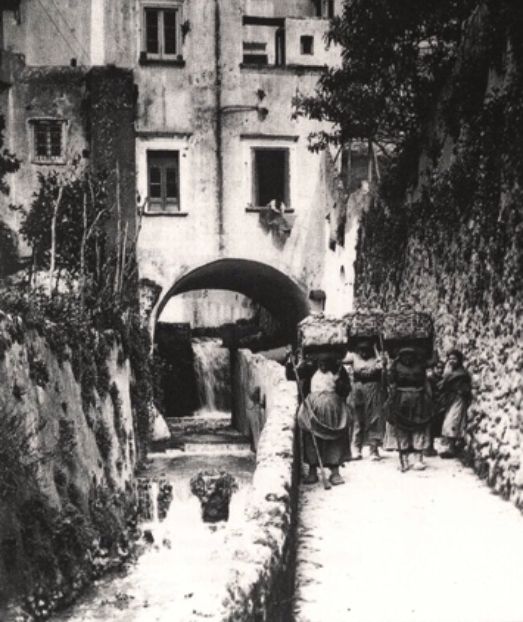
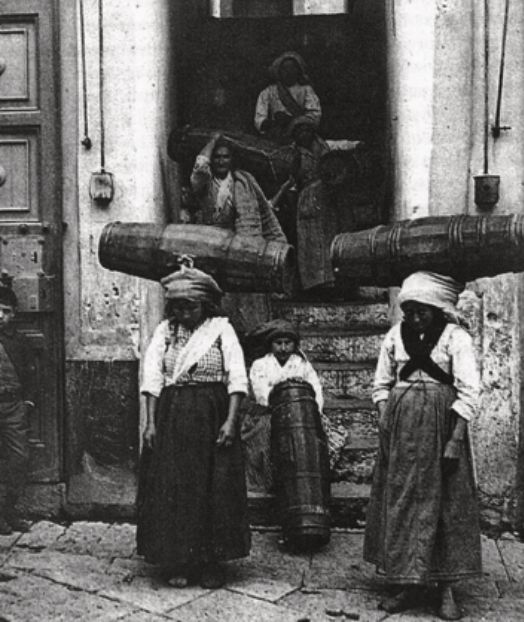
Female labour was so important that in the eighteenth century, when the cultivation of lemons becomes the main activity, women became the backbone of the coastal economy, carrying heavy baskets of lemons (57 kg) on their heads (Figure 2), going down and up the narrow paths and vertiginous stairs of the Amalfi Coast. They used to walk in a single line along the steep slopes of the Coast with huge bags on their heads (Figure 3), with their backs straight and the head bent by the weight; without shoes, feet wrapped in rags, they walked with slow and proud step, despite the exhausting effort: a line of only women who looked like many little ants, in dialect furmichelle (little ants).
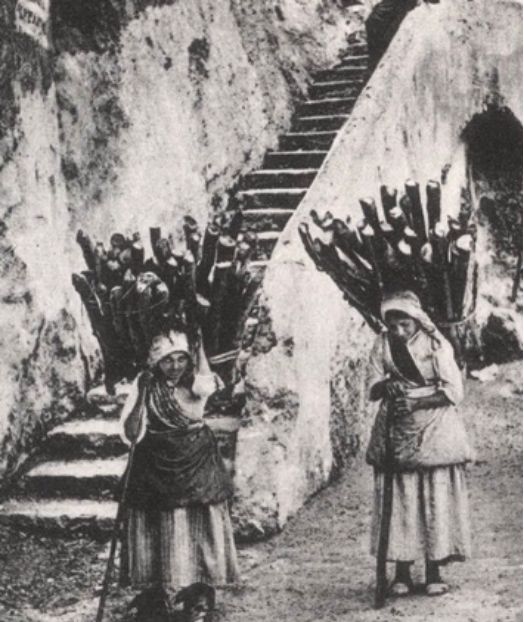
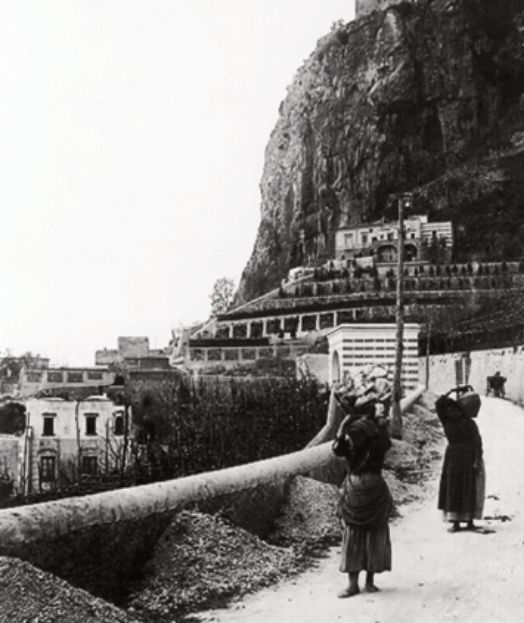
Over the centuries, the women of the Amalfi Coast continually descended and ascended their landscape: from home to the high mountains in the morning to collect firewood (Figure 4), and then lunch, the care of children and again a change of height, downhill or uphill, to reach the water sources or places of trade, to reach the lemons and bring them down to the sea, where the boats waited for the products to leave. The continuous up and down, which began in the morning and ended in the evening, created an inevitable symbiosis with the landscape (Figure 5), a bodily confidence with the spatial relationships of the paths and steps that still persists in women.
2. Objectives and Methodology
In this article my purpose is to approach the essence of this relationship, between the landscape and the body of women, using the words of some elder ladies, born in the higher parts of the Amalfi Coast between 1910 and 1920, interviewed by Rita Di Lieto and published in the book Il lavoro delle donne. Storie delle zone alte della Costa d’Amalfi (Di Lieto, 2015).
The testimonies are organized in an altitudinal order, that is, by landscape systems: from the forest of the mountain down to the sea, passing through the limestone rock, the ravines, and the cultivated terraces.
3. Mountain
The existence of a mountain near the sea was very important for the development of the local economy: inner areas provided water energy to drive mills, both oil mills and paper mills; firewood and charcoal provided thermal energy; chestnut wood was used for construction, furniture, boats and for the pergolas of vineyards and citrus groves. Although the recurring image of the Coast is that of lands that vertiginously overlook the sea, in reality there is an internal part from which many resources originate.
Women began to become familiar with the ‘inner Coast’ at a young age. The girls, in fact, had the task of carriare (carrying) the water from the springs to the house: they carried buckets and amphorae repeatedly up and down. Once they grew up, women could carry anything on their heads. Up to the post-war period all the products of the forest were carried down on foot on the head: Ho portato tutto dai boschi: sacchi di carboni, fascine, frasche, pali. Comme sunva miezajuone, accussi me menavoa copp’a muntagna e venevo ccà a dà a sugà ‘o criaturo
I carried everything from the woods: bags of coals, faggots, branches, poles. As soon as I heard midday ring, I would run down the mountain to nurse the baby.
Pur’io chella vita aggio fatte. Che vulite fa. ‘E carbon, ‘a ffrasc, ‘e pali…secondo ‘o tiempe, chelle che c’era a fa se faceve.
I’ve lived that life, too. What you want to do. The coals, the branches to cover the lemons, the poles for the arbors...depending on the season, whatever needed to be done was done.
Tenevamo i boschi. Si tagliavano, si facevano i pali, le fascine; tenevamo gli animali e andavamo a prendere ’e ffronn’ pe sott ‘e vacche. Facevo due viaggi al giorno…
We owned the woods. We cut them down and made poles, faggots. We owned the animals and went into the woods to get leaves to put under the cows
4. Rocks and Wild Plants
The limestone ribs descending down from the Lattari mountains in rough lines, break in great successive leaps to the sea and determine a series of precipitous spurs, wild gorges (Sestini, 1963). Near to the rock, in the wild fields, women usually gathered ‘o libbàno (Ampelodesmos mauritanicus) and braided its sharp leaves to make brooms or mats. Harvesting these leaves was a dangerous operation because the leaves cut the hands.
Mamma, che vita! E chi s’ ‘o ppò scurdà! Me facevo tutta ammatagnata, ammalagnata, tuta lividi, ero piena di rabbia e pensavo: e ché, non so comm all’àut, io?
Mom, what a life! And who can forget it! I was getting all battered and bruised, I was full of anger and I thought: what, I’m not like the others?
The women also made rolls of dried grass to give to the cows:
O jévan a bagnà, ce mettévan io e Rosa, tutt’e doje, una da un lato e l’altra dall’altro, nginucchiate pe terra, cu ‘nu mazzariello gruoss, facèvan ‘na vranca ‘e erba, arravugliàven vicin a chillo mazzariello e giràvan tuorno tuorn”.
Once it was wet, Rosa and I, all two of us, one on one side and the other on the other, knuckled down on the ground, with a large stick, we made a pile of grass and rolled it around the stick turning around
5. Cultivated Terraces
On the terraces, women took care of all agricultural activities: they shelled the ears of corn, crushed grapes, collected olives, ‘e sciuscelle, carobs; hoed the earth. In lemon gardens, being lighter, women climbed over the pergolas for pruning. They covered lemon trees when winter was coming; they tied the lemon branches to the pergolas. When it was time to uncover the lemons, they collected the bundles and carried them to sell them to the ovens. Io andavo sempre scalza, trasportavo i limoni da sotto Torello a Minori e da Pastena e Pogerola ad Amalfi. Tenèv ‘e sole sotto ‘e pièr!
I used to walk barefoot, carrying lemons from Torello to Minori and from Pastena and Pogerola to Amalfi. The soles of my feet were so calloused that I looked like I had soles under my
feet.
Women also helped in the construction of the macere, the stonewalls, in support of a husband or father: they carried the stones, selected them in homogeneous groups, they transported the ground, they prepared concrete.
6. Beaches and Sea
Near the sea the women were in charge of the selection and packaging of the lemons. The fruits were patiently wrapped, one by one, in white tissue paper, while the top row consisted of lemons wrapped in coloured and decorated tissue paper. In this way, the thin and delicate tissue paper not only protected the fruit but also promoted, along with the product, the landscape and culture of the Coast. On the paper was printed Pulcinella, the donkey with the baskets and other local symbols to accompany the lemon to the conquest of distant worlds. Appropriately packaged in boxes, lemons were loaded onto sailing ships (Giuliano, 2001).
7. Conclusions
7.1. Women’s vertical world
We have seen how women were involved in many activities in the different altitudes of the landscape of the Coast, but the prevailing activity was that of transport: from the forest to the sea, from the house to the village, women transported food, children, lemons, earth, wood, coal, water and wine.
The indispensable role of women manifests itself in the rhythm of a poem by a local poet, Giuseppe Di Lieto, titled ‘E Furmechelle:
E squarciaron’ ‘e muntagne, fabbricann’ ‘e macerine poi regnennele cu ‘a terra r’ ‘e campagne a nuje vicine; arrivava su una barca che attraccava a ‘o Vignariello e li femmene ‘a carriavan oltre ‘e torr’ d’o Castiello.
E piantarono i limoni con sistema originale, sostenendoli co’ ‘e perteche, in un modo assai geniale; e ‘sti perteche arrivavano sui traini a ‘o Vignariello e li’ femmene ‘e carriavano oltre ‘e torr’ d’o’ Castiello.
Bisognava concimare e ‘o cuncime p’’e giardine se scampava a rint’ ‘e puzz’ delle case cittadine, e ‘o letame s’accucchiava sempe ‘mmiez’ ‘o Vignariello e li femmene ‘o carriavano oltre ‘e torr’ d’’o Castiello.
Cummugliavano cu ‘e frasche, contro ‘a grandine e ‘a gelata, tutte ‘e piante d’’e giardine, poco primma d’a vernata. E curvate sott’’e frasche, sempe ‘a for’ ‘o Vignariello chesti femmene ‘e carriavano oltre ‘e torr’ d’’o Castiello.
Poi veniva la raccolta, e cu’ ‘a forza ‘e ‘nu gigante, chelli femmene minute sotto ‘o sforzo massacrante ‘e na sporta assai pesante, fin’ abbascio ‘o Vignariello ‘e carriavano cantanno ‘a copp’ ‘e torr’ d’’o Castiello. E ‘ntunavano ‘na nenia che pareva ‘na canzone, e ‘o pensiero gli volava alla misera magione addo’ attuorn’ ‘o fuculare tre criature e ‘o picciusiello aspettavano ‘o ritorno ‘a copp’ ‘e torre d’’o Castiello.
And they broke the mountains, building dry stone walls then filling them with earth from the nearby countryside; the earth arrived on a boat that docked at ‘o Vignariello and the women carried it beyond the tower of Castiello.
And they planted the lemons with an original system, supporting them with pergolas, in a very ingenious way; and these “perteche” arrived on trawls at Vignariello and the women carried them beyond the tower of Castiello.
It was necessary to fertilize and the fertilizer for the gardens was taken inside the wells of the town houses, and the manure was always piled up in Vignariello and the women carried it beyond the tower of Castiello.
They covered with branches, against hail and frost, all the plants of the garden, just before the winter. And curved under the branches, always in front of Vignariello
these women carried them beyond the tower of Castiello.
Then came the harvest, and with the strength of a giant, the tiny women with an exhausting effort and a very heavy bag, till down to the Vignariello and they used to sing in the tower of Castiello.
And they sang a song that sounded like a song, and their thoughts flew to the miserable mansion where around the fire three children and an infant were waiting for the return of their mother from the tower of Castiello.
While the poet tells about the landscape, the terraces, the boats, the pergolas, the lemons, the genius of the coastal community, the last verse is always the same, dedicated to women the femmene che carriavano cantanno ‘a copp’ ‘e torr’ d’’o Castiello. A constant in the landscape, the point to which we always return: the woman.
As they were carrying, the women were able to create moments of cheerful sociability and support for each other. Singing played a key role, music helped to alleviate fatigue and calmed the children.
In walking, a parallel female world was formed, in which the rhythms were dictated by the older women, called caporali, who organised the routes, often acting in concert with another older woman, called “marescialla” who supervised the selection, storage of lemons and packaging in the warehouses.
In walking, women’s work is freed from direct male control. The subordination of women to their fathers and husbands is temporarily interrupted in the dynamism of carriare activity.
In this feminine world a supporting economy lived, where women raised children with the support of other women and elders. Children were often taken out onto the terraces, in small baskets if infants, or free to play if older.
Carrying children, food, wood, sacks of coal, barrels of wine, baskets of lemons, baskets of vegetables, grass, water, from one terrace to another, women lived their territory in a very intense way, extending the care of their hearth to the entire landscape system. This shared history between women and landscape plays an important role in landscape protection strategies today. The women of the Coast have long lived in harmony with nature, tending the land, cultivating it and harvesting its fruits. They were the last guardians of the rural landscape during the Second World War, when, in the absence of men engaged in fighting, women took full responsibility for the territory and an unparalleled degree of autonomy. After that the landscape slowly changed and the process of cultivated land erosion began. When comparing 1954 to 2016, the quantity of citrus grove areas really contracted, changing into urbanised area and forestation process (De Pasquale, Nofroni, Savelli, 2021, pp.51— 54; De Pasquale, 2019; De Pasquale, 2018, pp.709—724). The abandonment of terraced fields determines the loss of a landscape heritage of enormous value and preludes to the complete physical and cultural desertification in Amalfi Coast (Laureano, 2004, p.97).
In this area the preservation of the landscape represents one of the fundamental objectives of sustainable development (Formica, 2010), as underlined by UNESCO (WHL 1997) and by the candidacy in process of the Amalfi Coast to become part of the Globally Important Agricultural Heritage Systems (GIAHS), a project by the Food and Agriculture Organization of the United Nations (FAO), that has the aim of mobilising global awareness and support for dynamic conservation and adaptive management of agricultural systems and their resulting landscapes.
The richness of the Amalfi Coast landscape is «the result of both human intervention and the benevolent hand of nature, which makes it also a place full of charm where sea and mountains passing through the wide-open spaces for cultivation, merge in perfect harmony».
If we understand the landscape not only as a historical construct, but as a symbol and expression of the relationship of human beings with nature, we must believe that in this relationship we can find the basis for sustainable planning, balancing landscape conservation and development.
The landscape of the Amalfi Coast is the unconscious result of the agricultural and social practices of the past. But the landscape is also an evolutionary space, both in concrete terms and as a field for the collective imagination, therefore a sustainable development of the territory must consider the permanence of traditional agricultural practices, rituals, uses (Antrop, 1997, pp.105—117; Agnoletti, 2014, pp.66—73). Such a complex territory from a hydrographic, geological and morphological point of view, can only survive through a capillary maintenance of the territory that only a conscious and widespread use by its inhabitants can guarantee (De Pasquale, 2021, pp.41—46).
In this vision, it becomes essential to resume the dynamic role of women as custodians of the landscape. Over the centuries, women have cultivated, tended gardens and forests, raised children and cared for the elderly. They have governed cows, pigs, chickens and rabbits, feeding them and cleaning stables, pigsties and chicken coops in total autonomy. All this created a very strong bond between women and nature.
A Pogerola ritornai finalmente a lavorare la terra, che è sempre stata la mia passione. In Pogerola I finally returned to work the land, which has always been my passion.
The protection of the landscape also passes, therefore, through taking care of this love and passion, feeding it with the creation of places that can facilitate female agricultural entrepreneurship, helping women in the management of their time, children, work.
The creation of rural spaces for sharing (agrarian nurseries, toy libraries, training spaces, seed storage facilities, time banks) is an extraordinary opportunity for the permanence of knowledge, love and landscape.
References
- Adler, M.N. (1907) The itinerary of Benjamin of Tudela. London: Oxford University Press.
- Agnoletti, M. (2014) Rural landscape, nature conservation and culture. Some notes on research trends and management approaches from a (southern) European perspective. Landscape and Urban Planning,, 126.
- Antrop, M. (1997) The concept of traditional landscapes as a base for landscape evaluation and planning. The example of Flanders Region. Landscape and urban planning, 38.
- Camera, M. (1836) Istoria della città e costiera di Amalfi.. Napoli: Stamperia e cartiera del Fibreno.
- De Pasquale, G. (2021) Il valore storico culturale dei terrazzamenti della Costiera Amalfitana. Eredità del passato e opportunità di futuro. SMC Sustainable Mediterranean Construction Land Culture, Research and Technology.
- De Pasquale, G.; Savelli, S.; Nofroni, L. (2021) The landscape of the Amalfi coast: an endangered paradise. SMC Sustainable Mediterranean Construction Land Culture, Research and Technology.
- De Pasquale, G. (2019) Uso del suolo e variazioni sul paesaggio. Un'analisi diacronica sulla Costiera Amalfitana, in Pignatti L. (ed.) IFAU '18 - Territori fragili / Fragile territories. Paesaggi_Città_Architetture / Landscapes_Cities_Architecture. Roma: Gangemi.
- De Pasquale, G. (2018) Paesaggi terrazzati dell'Italia meridionale: un'analisi comparativa tra passato, presente e futuro. Annales, Series Historia et Sociologia, 28/4.
- Di Lieto, R. (2015) Il lavoro delle donne. Storie delle zone alte della Costa d'Amalfi.. Amalfi: Officina Zephiro.
- Formica, C. (2010) Paesaggi terrazzati tra storia e sostenibilità. Il litorale campano e l'isola d'Ischia. Studi e ricerche socio-territoriali.
- Giuliano, G. (2001) Il limone e la costa d'Amalfi. Napoli: Guida Editori.
- Laureano, P. (2004) I terrazzamenti del territorio campano, in Italia Nostra. La coltura dei terrazzamenti per la salvaguardia del paesaggio. Salerno: Edizioni Menabò.
- Sestini, A. (1963) Il paesaggio, 7. Milano: Touring club italiano.
- Skinner, P. (2005) Donne nel commercio amalfitano (secc. X-XII). Rassegna del Centro di Cultura e Storia Amalfitana, XV.
- Stazio P. P. (93) Silvae. I italian edition in 1472. Venezia: Vindelino da Spira.
Rights and permissions
Open Access. This article is licensed under a Creative Commons CC BY 4.0 license, which permits use, sharing, adaptation, distribution and reproduction in any medium or format, as long as you give appropriate credit to the original author(s) and the source and indicate if changes were made.
About this article
Cite this article
De Pasquale, G. (2021). Femmene minute cu' 'a forza 'e 'nu gigante (little women with a giant's power) in the terraced landscape of Amalfi Coast.. International Terraced Landscapes Alliance Journal, 2(1), 16–31. https://doi.org/10.5281/zenodo.7306802
- Published
- October 2021
- Issue
- Volume 2, Number 1
- Journal
- International Terraced Landscapes Alliance Journal, ISSN 2754-7639 (Online)
- Archive
- Zenodo record 7306802
- Terraced landscape
- Amalfi Coast
- Agriculture
- Rural Spaces
- Mediterranean architecture