Terrace Pedagogy
Affiliations
- 1 Centre for Agroecology, Water and Resilience (CAWR), Coventry University, United Kingdom
- 2 Independent architect, Cyprus
International Terraced Landscapes Alliance Journal volume 4, issue 1, pp. 2–7 (2026) · Cite this article

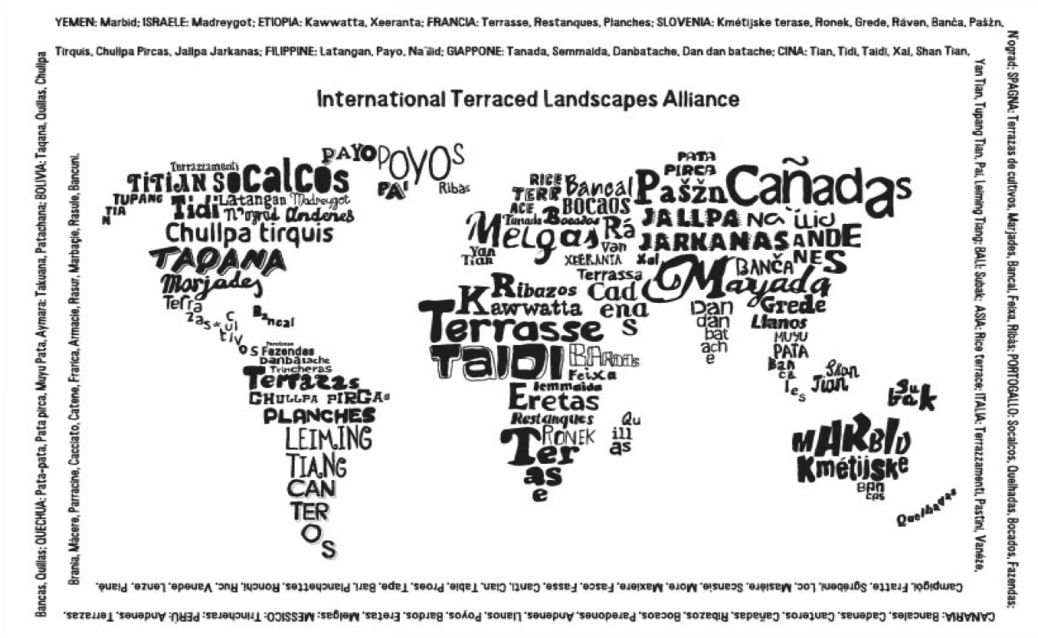
Terraced landscapes and humans share a history of intimate reciprocity as living beings on earth. Mountains world-wide embody the structural matrix that model human perceptions developing attuned, diverse earth stewardships of landscapes along the five continents of the Planet. A short list of names collected from the participants of the III International Terraced Landscapes Congress in Italy (2016) resulted in more than 60 names for terraces in different languages. More names reside in forgotten or even discouraged dialects. This inspired and unfolded a compelling recognition that terraced landscapes express a great mosaic of unique interaction forms created between agricultural societies and mountain environments. With the concept Bio-Cultural Diversity we understand life in terraced landscapes as manifestations of biological, genetic, species, ecosystems as well as product of human cultural creativity.
ITLA is aware of the destructive and extractive changes to liminal rural, particularly terraced landscapes, affected by the global world ecological crisis which impacts on all living systems in general. The global ecological crisis is further exacerbated by the militarisation of large swathes of terraced heritage, particularly in the Eastern Mediterranean. We should not ignore, since this area is located along the rivers of Tigris, Eufrates and Nile, which is the origin of agricultural civilisation, roughly 12,000 years ago.
The fine and intricate cultural matrix that supports the continuity of life deeply rooted in languages, cultures, knowledge and practices is under pressure everywhere to a larger or lesser degree. Therefore, ITLA Journal Volume 4 No 1 is dedicated to several pedagogical experiences with children, youths and adults that show different modalities of perpetuating knowledge and passing on of practices of keeping terraced landscapes alive. The aim we pursue is to create a space of reflection and action documenting and sharing a rich repertoire of learning initiatives from different regions and countries.
We recognise that the world ecological and other crises pose greater challenges to environmental education. There are approaches that neglect the intimate reciprocity between nature and humans by considering Nature as a material resource to be used with an extractive mentality. This view reinforces negative consequences for the future reducing learners into empty objects to be filled with top-down transmission of preconceived contents, highly structured by a teacher, in a classroom setting, and physically detached from the natural environment.
On the other hand, there are flourishing initiatives practicing approaches, often taking the classroom outdoors, to the landscape itself, that basically trust the intelligence and capacities of groups. Either children, youth or adults, accompanied by a facilitator, jointly discover the mysteries of Nature engaging Minds, Hearts, Senses and Hands immersed in a series of haptic activities, which enhance participation in transformative experiences. But they also embed memories of landscape deep into their psyche that they can return to in later years. However, these processes, particularly making memories through learned experiences for the future, elicit experiential knowledge that is shared collectively to boost stronger and cohesive relationships in the groups. It creates intergenerational transmission of wisdom, fosters critical thinking, empathy and fascination with nature. And develops never ending and unedited forms of social and environmental engagement to re-establish the intimate reciprocity as living beings on earth.
On this occasion we are very pleased to present seven original contributions in this first number of volume 4.
The first three articles announce information about stone walling training courses with different modalities and specific groups:
Mobile stone workshop Lahn River Vineyard Festival in Obernhof
Written by Frank Böwingloh & Heiner Brodt, Lahn Valley, Germany
Pupils experience dry stone masonry on Wachau excursions, Austria
School project “World Heritage meets Intangible Cultural Heritage” Written by Rainer Vogler, Wachau Region, Austria
Information about the Kinderwingert Training Course
Written by Gerd Knebel, Winningen, Moselle, Germany Then we present a cluster of four articles dealing with building terraces as pedagogical experiences that trigger a variety and complex transformative processes in different biocultural directions:
Averara’s Community and the “Muri a Secco” Project
Written by Lucia Pennati, PhD architect, Italy
Development of a living wall at the Maison Familiale Rurale de Ventavon Association
“Une pierre sur l’autre”
Written by Louis Cagin, France
What if we were children: Education Diaries of drystone-adapted activities for three-
to sixteen-year-old children
Written by Sevina Floridou, Heritage Architect from Cyprus
Diary 1 of Activities: First terraced landscape activity for 4-year-old nursery schoolchildren An Educational activity for High-school students, Yieroskipou and Salamiou Community, Cyprus
Diary 2: Restoring memory of land, educational activity with high-school students at Yiannis Taliotis Yieroskipou Lyceum together with Salamiou community, Cyprus
Diary 3: “Un cierchio di pietre belissime”, introducing children to the significance of drystone in Semestene, Sardinia
Experience and learn the cultural landscape of the terraced Moselle Inspiring children and young people for their home region
Written by Dieter Möhring, Lehmen, Moselle, Germany Each one of these cases about pedagogy of dry-stone walling is a unique testimony of each author written with a personal and compelling narrative on how learning unfolds and widens the subjective horizon of thinking, feeling and acting among the group of participants, children, youth or adults but also how this process returns to the educator through reflection. The learning experiences take place mainly in Europe in a specific time and in terraced landscapes generating a body of knowledge according to the local context, the institutional setting and the different roles of actors involved.
The uniqueness of each case is a source of insights at the same time all share the quality to provide an opportunity to reflect about the expected and unexpected flow of learning process in various levels of complexity.
We wish you great enjoyment and inspiration with these rich sources of learning experiences; please give us feedback by email to ITLA or directly to the authors. And if you are part of dry-stone walling or biocultural diversity on agricultural terraces learning processes you are most welcome to write your testimony and send it to us, we will publish them in forthcoming ITLA Journals.
Rights and permissions
Open Access. This article is licensed under a Creative Commons CC BY 4.0 license, which permits use, sharing, adaptation, distribution and reproduction in any medium or format, as long as you give appropriate credit to the original author(s) and the source and indicate if changes were made.
About this article
Cite this article
Salas, M., & Floridou, S. (2026). Terrace Pedagogy. International Terraced Landscapes Alliance Journal, 4(1), 2–7.
- Published
- October 2026
- Issue
- Volume 4, Number 1
- Journal
- International Terraced Landscapes Alliance Journal, ISSN 2754-7639 (Online)