Averara's Community and the "Muri a Secco" Project
Affiliations
- 1 PhD architect, Switzerland
International Terraced Landscapes Alliance Journal volume 4, issue 1, pp. 26–39 (2026) · Cite this article
- 2 views
- 0 downloads
- DOI10.5281/zenodo.23440565

Abstract
This account is not only about dry-stone walls. It's about the small-scale community of Averara (Italy) and the people who came together to rebuild centenary dry-stone walls, to maintain them, and to learn from one another while doing so. Through a five-year retrospective analysis of dry-stone wall workshops in Averara, the text aims to highlight how dry-stone walling can function as a tool for participation, shared responsibility, and the rebuilding of social ties grounded in the recognition of the landscape's cultural and heritage value.
Keywords
- dry-stone walls
- community participation
- chestnut grove
- inner areas
- Brembana Valley
Averara near Bergamo
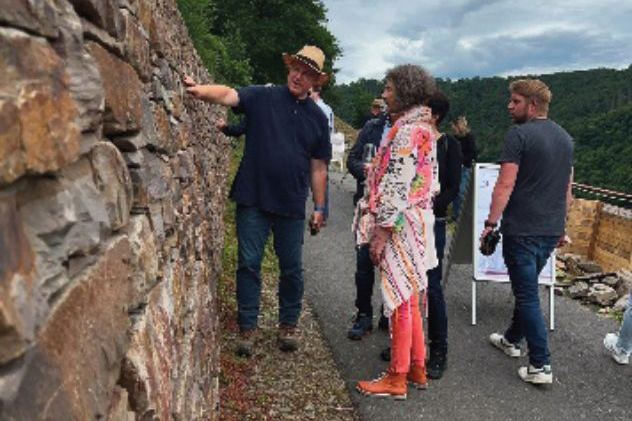
Averara is a small village with just over 100 inhabitants located in the upper Brembana Valley, about 40 km north of Bergamo, northern Italy. For centuries, this territory - known as Valle Averara - was a border area, marking the boundary between the Milanese - later the Venetian dominion - and the lands of the Grisons’ Tre Leghe, corresponding to present-day Valtellina.1 Due to this strategic position, throughout the Middle Ages the area was traversed by the commercial route of the Via Mercatorum, which connected Bergamo with the San Marco Pass and Valtellina.2 In addition, a dense network of secondary paths – known as the Vie del Ferro (Iron Roads) – linked iron mines to sites of iron processing and forging, typically located near watercourses.3 All these routes were carved into a mountainous terrain, ranging from approximately 600 to 1,000 metres above sea level, supported by dry stone walls and sustained over time through use and constant care.
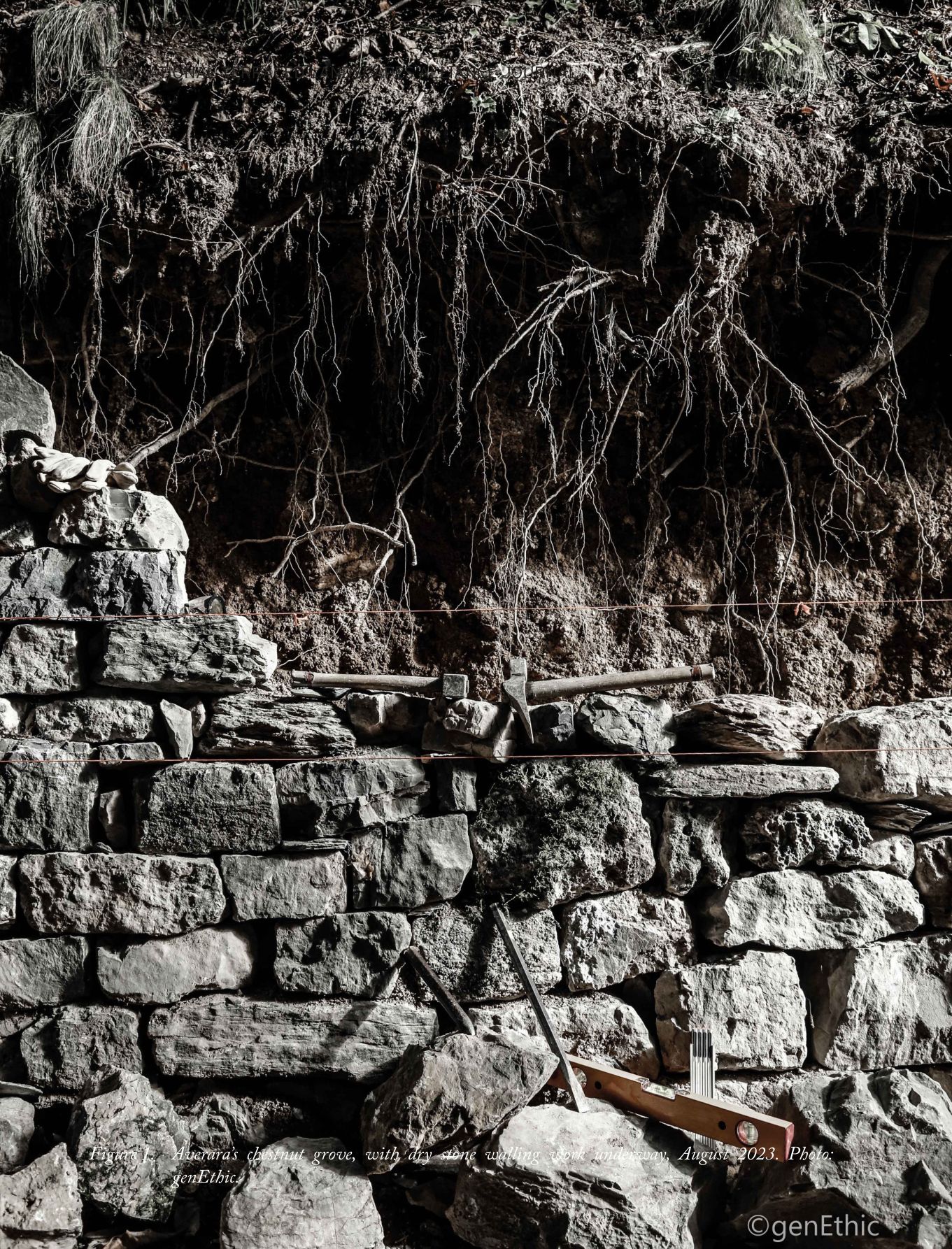
Local stone forms a defining element of the natural and man-made landscape, evident in terraces, fields, pathways. Within this context, stone became an integral part of the region’s material identity: it was employed in the building of houses, roof coverings, animal shelters, and infrastructures, as well as in the production of lime. In this way, stone shaped not only the built environment and its visual character, but also everyday practices and ways of life.4
Today, Averara is considered part of Italian “inner areas”, places located away from the urban centres – not only geographically, but also demographically and in terms of production and industrial plant – affected by depopulation and economic fragility.5 These areas are also increasingly becoming destinations for people relocating from overcrowded urban or suburban centres, drawn by the opportunities to reconnect with the surroundings –land, nature, knowledge, and shared practices – and to reactivate them as living, dynamic environments once again.6
The association of chestnut growers taking care of the chestnut grove
In 2015, a small group of Averara residents, supported by visionary individuals from outside the community, founded the Castanicoltori Averara association (chestnut growers of Averara) with the initial goal of caring for the existing chestnut forest, one of the rare cases in the area.7 The chestnut grove has persisted through decades of carelessness and the association made it the focus of its activities of safeguarding, promoting the maintenance of this area in terms of shared resource, while taking care of the trees and of the remaining built structures, almost ruins. Chestnuts once played a central role in local diets and economies, being a source of subsistence for the community.8 In these terms, caring for the chestnut forest today means safeguarding its natural value, but also its historical significance as a shared resource.
At the same time, caring for the chestnut grove also means securing its future and fostering a shared culture of care and maintenance, that could endure beyond the association itself. This vision is guided by a simple yet profound belief: the future of the association - and of the heritage it seeks to preserve - depends on the bond forged with the next generation. For this reason, from its very beginning, Castanicoltori Averara has placed special emphasis on reaching out to the younger members of the community - whether they are children, grandchildren, or nephews of long-standing members, or youngsters who return to the village with their families during the summer months. The goal has never been merely to inform them about the association’s activities, but to spark their curiosity and invite them into a deeper understanding of the land, its history, and its traditions, while nurturing an awareness of their own role in shaping its future.
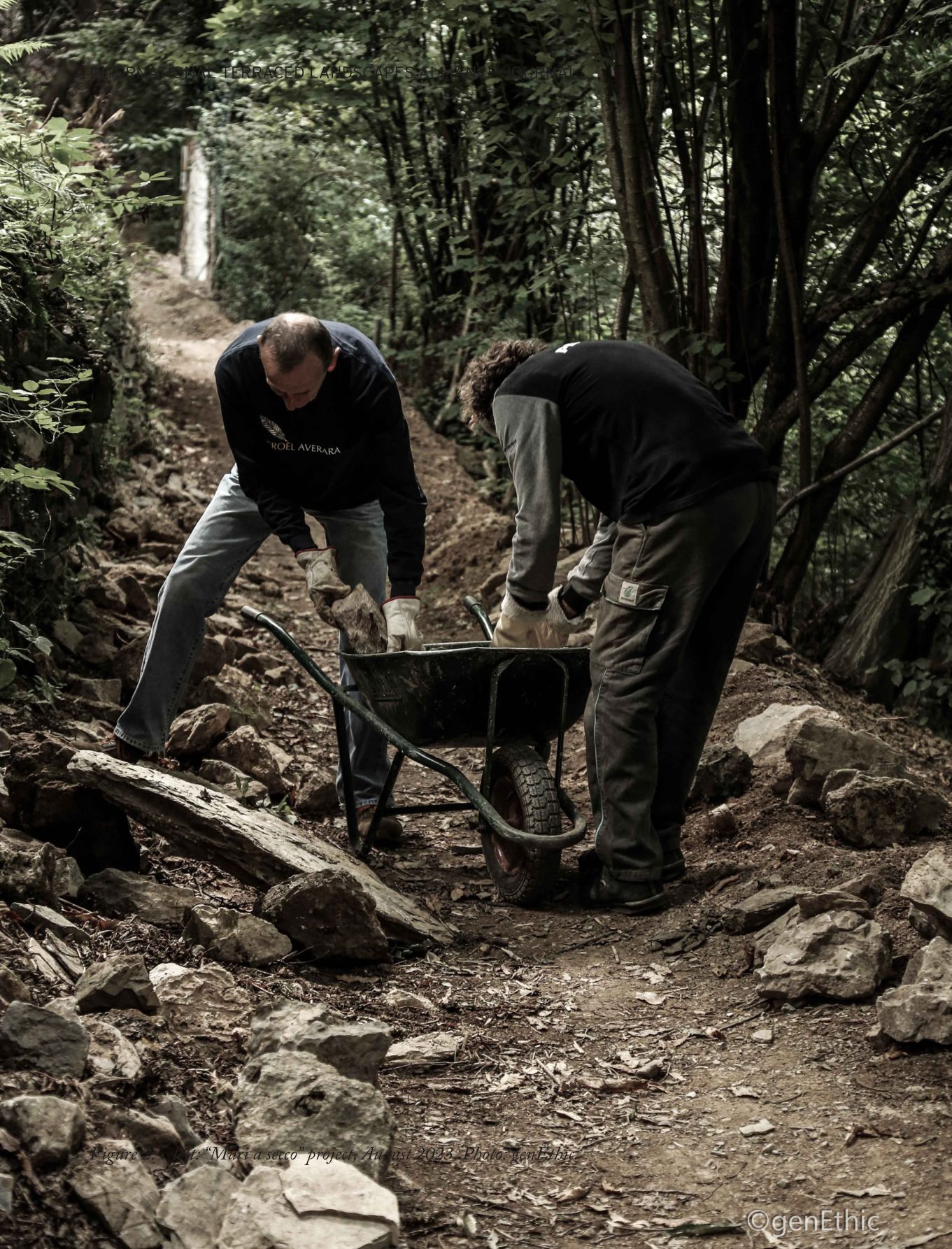
This philosophy has been vividly embodied in the care of the chestnut grove. What began as spontaneous weekends dedicated to cleaning and maintenance of the wood, open to everyone interested and willing to help, quickly became a hands-on lesson in responsibility, community, and respect for nature. As participation grew, these shared moments in the forest gradually transformed into opportunities for intergenerational exchange. Older members passed on practical knowledge, stories, and gestures refined over decades, while younger participants absorbed not only technical skills, but also the values embedded in them. Working side by side, children, youth and adults alike came to understand that caring for the chestnut grove was not a task to be completed, but a relationship to be nurtured over time. Through this collective effort, the grove emerged as a place of learning, encounter, and continuity — a space where environmental stewardship and cultural memory intertwine. This vision also took tangible form in specific projects of care. For example, during the years 2017- 2018, the municipality and the association joined forces for restoring the existing centenary barn, refurbish it and transform it into a meeting point within the chestnut forest, without losing its peculiarities and using traditional building techniques and materials. It was in the immediate surrounding of this restored barn that the Progetto muri a secco took shape.
The collapse of a dry-stone wall led to the Dry-Stone Wall Project in 2021
Launched in 2021 by the Castanicoltori Averara, the Progetto muri a secco is set within the forest and arose from a practical need: the collapse of a dry-stone wall in the associationmanaged chestnut grove, adjacent to the barn. Specifically, the wall formed part of the retaining structure of the Era pathway - an historic route used for centuries to reach barns and grazing areas. To address this, the association organised a one-week workshop to restore the damaged section while teaching the fundamentals of dry-stone walling to a group of around ten participants, under the guidance of ITLA dry stone builder and master Tommaso Saggiorato. In his words: “associations are the places where the people who face similar problems – but come from different paths – can finally meet.”9
The workshop was inspired by the P-ART project, initiated in 2020 in the Brembana Valley by the local group GAL.10 P-ART highlighted dry-stone walling as a traditional and culturally relevant construction technique, an art that deserved to be passed on to both hobbyists and future builders, reviving a craftsmanship tradition that had disappeared from the area. With the support of ITLA Italia, Castanicoltori Averara adapted the P-ART framework to the local context, designing an introductory course open to anyone interested and aiming to foster active engagement within the Averara community.
The first workshop in August 2021 brought people together in the aftermath of the pandemic, responding to a tacit need for common, outdoor activities. Local residents and non-local participants worked together, rediscovering the value of collective, hands-on engagement. Participants joined not only for the pleasure of manual work, but also with the aim of acquiring practical self-construction techniques that they could apply to the maintenance and repair of their properties, as an alternative to the commonly used concretebased building methods.11
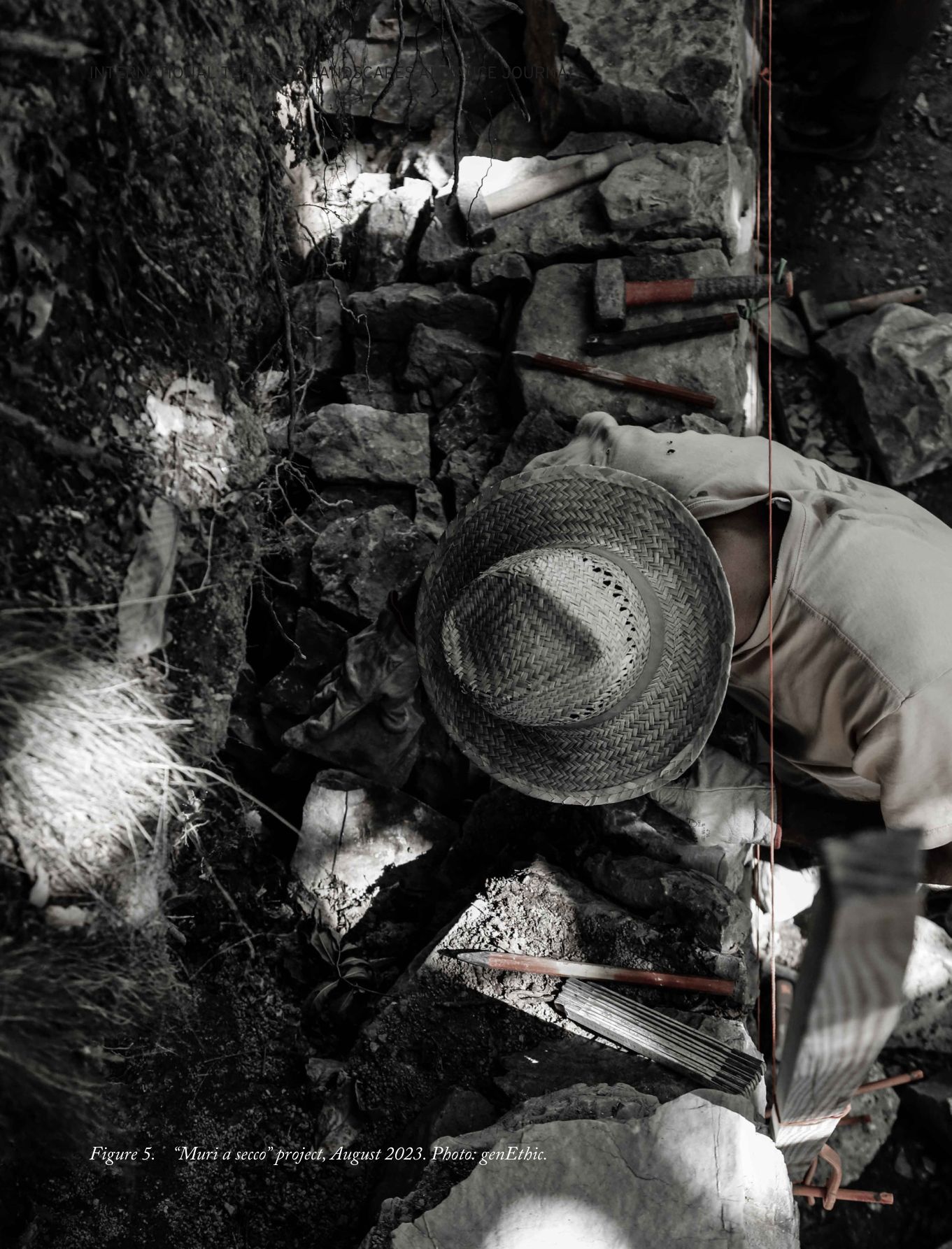
In the following years 2022-25, the format expanded to include weekend workshops led by ITLA dry stone builder Simone Lorandi, making it easier for residents and seasonal inhabitants to take part.12 It also expanded going beyond the constructive part and including walking through the village, talks about local history, and participation in cultural events. Each workshop was an intense experience of hands-on labour, where people worked side by side throughout the six days. Learning unfolded organically - through observation, mistakes and mutual help. Unexpectedly, the construction site became a temporary community, where decisions were made collectively, fatigue was shared, and progress was visible day after day; not just in the wall but in the group itself. This working environment fostered strong participants’ satisfaction, reinforced the bonds formed during the experience, and encouraged continued engagement in subsequent association’s activities or gatherings. In line with the guiding principle of the association, the workshops welcomed younger participants, to work side by side with their fathers or grandfathers, bridging generations through shared effort. They approached the demanding physical labour with vigour and curiosity, discovering not only the satisfaction of craftsmanship but also the rhythms and responsibilities of adult life. In doing so, they developed a tangible bond with the chestnut grove, learning to care for it through practical tasks.
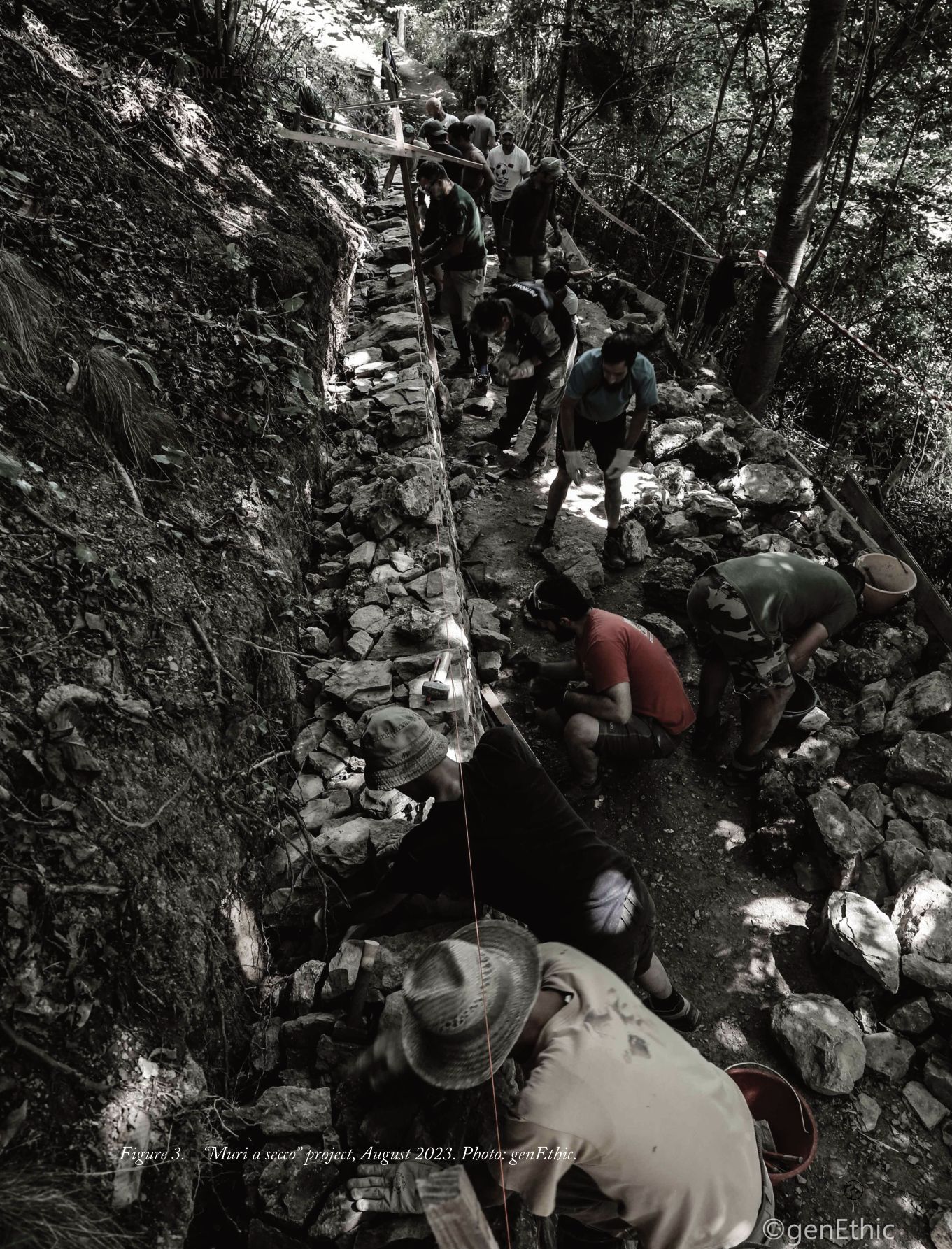
While the concrete goal was simple, namely to take care of an existing wall and pass basic skills to create a sense of responsibility towards the landscape, the unexpected added value of gathering and social coming together, overcame the experience and enriched the participants. Beyond the construction work, the workshops fostered shared meals, conversations, and convivial moments in the evenings. What emerged was something more than a workshop: as the wall grew, the relationships among the participants did as well.
The “Muri a secco” project forged its participants: strengthening community bonds, fostering a closer relationship with nature and historical heritage, and building or reinforcing a sense of belonging to the area. One participant, expressed this feeling on point “it’s not only about recycling stones and reusing them, but about rebuilding a sense of community, creating encounters, solidarity, and shared time in a mountain area.”13 Another described the experience as a “small social world, where knowledge circulates freely and work is never individual, but always collective.”14 These testimonials underscore the project’s ambition: not simply to “fix” a structure, but to create an open, shared construction site – one where locals and visitors, beginners and skilled workers – could come together and take part.
This inclusive approach shaped the way different members of the community - locally and beyond - engaged with the project. For children, the workshops offered a window rather than a hands-on role. They visited the site, observed the work, and joined in moments of collective gathering and celebration. Building on this experience, school classes from neighbouring villages organised visits to the chestnut grove, exploring the restored dry-stone walls and witnessing the ongoing life of the woods. In doing so, an even broader group of children was invited to step into the living history of their region, experiencing first-hand the traditions of their ancestors and the intimate relationship between people and land.
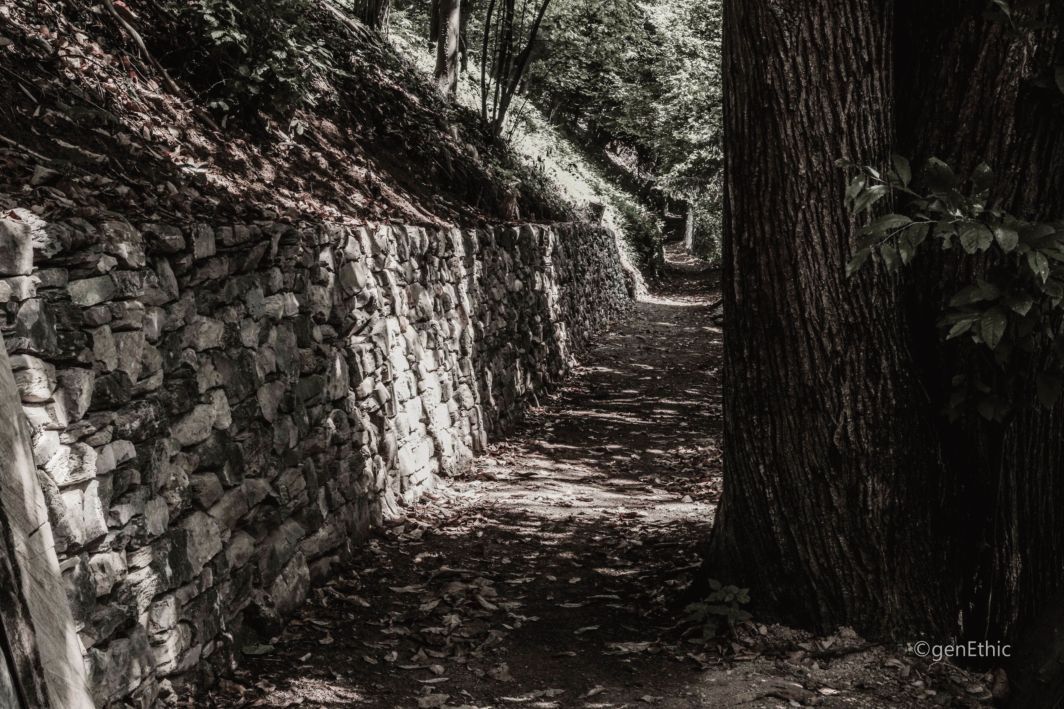
The initiative proved so successful, that it was repeated seven times for five consecutive years, resulting in the reconstruction of 88 metres of retaining dry stone wall along the Era pathway. Over the years the workshops evolved into a recurring meeting, not only for newcomers and beginners, but also for former participants, who would return to join the work for a day or stop by for a gathering or community lunch. Almost one hundred people took part in the workshops and many of them participated more than once. Former participants came back to Averara not only to build, but to see familiar faces, strengthen friendships, and feel part of something relevant for the community of Averara. Over time, restoring the wall became the starting point for something bigger: to work collectively with the cultural heritage, the landscape, and the land itself and to pass on an awareness of their importance. This series of successful workshops had led to make Averara a reference point for people interested in dry-stone walling, not as a profession, but as a shared practice, becoming an example for the Brembana Valley and a competence reference for other interventions on dry stone walls.15
Dry-stone walling is more than just a technical skill, it also connects generations
The experience in Averara shows that dry-stone walling can be much more than a technical skill. It can become a way to bring people together, connect generations, and reactivate neglected places. Experts and beginners worked side by side, without hierarchies, and some participants later applied the techniques they learned to repair small walls or build terraces on their own land. Others carried away a deeper connection to the place and to the art of dry stone walling itself, noting that when they now walk along mountain paths, they pay closer attention to the construction methods, the stones used, and the stability of the walls.16 Even though the Averara project is small in scale and limited in scope, it offers a simple and transferable idea: care for the land and for historical artefacts works best when it becomes a shared, lived experience. The enthusiasm generated among the participants gradually spread to more sceptical local inhabitants, who were struck by the quality and the size of the rebuilt wall. Even those who initially did not support the project began, over time, to observe it more closely and eventually to take part in it. This shift marked a real change for the community, helping to renew care for traditional building practices among residents and, hopefully, to pass on the importance of preserving this craft and prioritising it in future building interventions on their own properties. In this way, the work extended beyond the physical structure, becoming a catalyst for a broader cultural renewal.
By involving the community in tangible, shared actions, the association has helped ensure that the chestnut forest remains a living landscape, shaped by those who care for it today and entrusted to those who will carry that responsibility in the future. Specifically, it has nurtured a sense of belonging, responsibility, and wonder among its youngest members. By intertwining education, labour, and time spent collectively, Castanicoltori Averara has ensured that the legacy of the chestnut grove, the dry-stone walls, and the daily life of the village endure - not merely as history, but as a living, breathing part of the next generation.
A new phase of the association will include an experimental vineyard
Looking ahead, the Castanicoltori Averara association is entering a new phase. The Progetto Muri a Secco will move from the chestnut forest to an experimental vineyard closer to the village centre. This shift will make the work more visible and accessible, while preserving the project’s core spirit: using the landscape as a place where people meet, work together, and imagine a future rooted in their built past. Over the longer term, the association envisions the creation of a local centre for dry stone walling, where knowledge and practice can be gathered, shared, and ultimately passed on through a dedicated school.
References
- Bottani, T., & Taufer, W. (2007). Da Bergamo all'Europa. Le vie storiche Mercatorum e Priula. Bergamo.
- Carminati, A., & Invernizzi, P. (2012). Prida e piöda. Mulattiere, muri a secco, stalle, case e altri manufatti dell'edilizia tradizionale in Valle Imagna e Valle Taleggio. Bergamo.
- Politecnico di Milano. (2021). Altre Lombardie. Analisi e scenari strategici per le aree interne della Lombardia. https://www.altrelombardie.polimi.it/
Notes
- From 1516 onward, Valtellina (including the counties of Bormio and Chiavenna) was assigned to Grisons’ Tre Leghe. This situation remained unchanged until the end of the 18th century.
- Today, the San Marco Pass marks the administrative boundary between Bergamo and Sondrio.
- See: Bottani, Tarcisio and Wanda Taufer, Da Bergamo all’Europa. Le vie storiche Mercatorum e Priula, Bergamo: 2007.
- See, for example, the in-depth study conducted in the neighbouring Valle Imagna and Valle Taleggio. Carminati Antonio, Piero Invernizzi, Prida e piöda. Mulattiere, muri a secco, stalle, case e altri manufatti dell’edilizia tradizionale in Valle Imagna e Valle Taleggio, Bergamo: 2012.
- In 2013 Italian Governmental agency for territorial cohesion has launched a national strategy for «inner areas» with the aim of territorial reactivation of remote municipalities. Since then, different projects have addressed this question. For example: «Altre Lombardie. Analisi e scenari strategici per le aree interne della Lombardia.» Politecnico di Milano, 2021.
- See for example: https://www.altrelombardie.polimi.it/territori/valle_brembana_e_valtellina_di_morbegno/accessed on January 29, 2026.
- See the website of the association with the detailed project: https://www.castanicoltoriaverara.it/castagneto/accessed on January 29, 2026.
- The chestnut tree has provided the local population with indispensable support. Its fruits have been the staple food in times of grain shortages.
- Tommaso Saggiorato, Progetto Muri a Secco, 2021.
- The project was initiated in 2020, by GAL – Gruppo di Azione Locale – Val Brembana. See: https://www.galvallebrembana2020.it/progetti-00002/dettaglio-progetto/P-Art/ accessed on January 29, 2026.
- In this context, it is important to emphasise that construction has been one of the most widespread activities in the Brembana Valley over the past century, and that builders from Bergamo have distinguished themselves throughout Italy for their skill and strong work ethic.
- The weekend workshops took place in June, July and September 2023 and were organised specifically for people who were unable to attend the full week-long workshop in August.
- Giacomo Morlini, Progetto Muri a Secco, 2023.
- Antonio Monaco, Progetto Muri a Secco, 2025.
- Associations in the Brembana Valley that deal with similar issues turn to the Castanicoltori Averara association to get in touch with artisans and experts in dry stone walling.
- Statements collected from various former participants during a convivial gathering in October 2025, Averara.
Rights and permissions
Open Access. This article is licensed under a Creative Commons CC BY-SA 4.0 license, which permits use, sharing, adaptation, distribution and reproduction in any medium or format, as long as you give appropriate credit to the original author(s) and the source and indicate if changes were made.
About this article
Cite this article
Pennati, L. (2026). Averara's Community and the "Muri a Secco" Project. International Terraced Landscapes Alliance Journal, 4(1), 26–39. https://doi.org/10.5281/zenodo.23440565
- Published
- October 2026
- Issue
- Volume 4, Number 1
- Journal
- International Terraced Landscapes Alliance Journal, ISSN 2754-7639 (Online)
- Archive
- Zenodo record 23440565
- dry-stone walls
- community participation
- chestnut grove
- inner areas
- Brembana Valley