European Days of Terraced Landscape (EDTL) 2023
Affiliations
- 1 Independent architect, Cyprus
International Terraced Landscapes Alliance Journal volume 3, issue 2, pp. 26–67 (2025) · Cite this article
Abstract
Explores how the community of Salamiou revitalized its terraced landscapes through workshops, art, and intergenerational learning connecting agriculture, ecology, and culture.
Overview
The 5-day programme started off with educational activities presenting the terraced heritage by people from Salamiou, for all ages. The activities aimed to promote awareness of the terraced rural heritage, for children, volunteers, visitors, but mainly to bring together the people of the village itself, particularly its youth, and so that the community could collectively imagine its own future through generating possibilities that they considered viable for themselves and their children. With administrative support from local NGO’s, local teachers, educators, craftsmen, farmers, local authorities, men and women involved with agrotourism hospitality in Salamiou, all pooled their collective efforts and resources to present a different aspect every day, relating to Salamiou’s past, its present but also their own current and future concerns. These centered around the importance of the landscape heritage of the area through preservation of existing drystone terraces in olive groves, almond groves and vineyards.
Farmers also recalled cherry orchards and walnut groves on now abandoned terraces, while others talked about the microclimate in particular localities, their varied soil qualities and its fertility, and which areas supported which variety of grapes. Also once grown in the area were all kinds of legumes and particularly beans and pulses, as well as quinces, pears and fruit that could be grafted onto the ever-present wild hawthorns and mastic trees, making such fruit grafts more resilient, particularly now in climate changing conditions. Sampling their own locally produced wine together one evening, served at one of the village taverns, I listened to the young local nursery teacher, the middle-aged village mayor and the senior tavern owner reminiscing on the ten different localities of the surrounding terraced vineyards, and how each one, with its particular climate, but also different soils, affected the ripening time and quality of different grape varieties. Their swift exchange of knowledge concerning localities landmarked by specific toponyms, familiar to each, bonded them in close understanding, making me want to find out more.
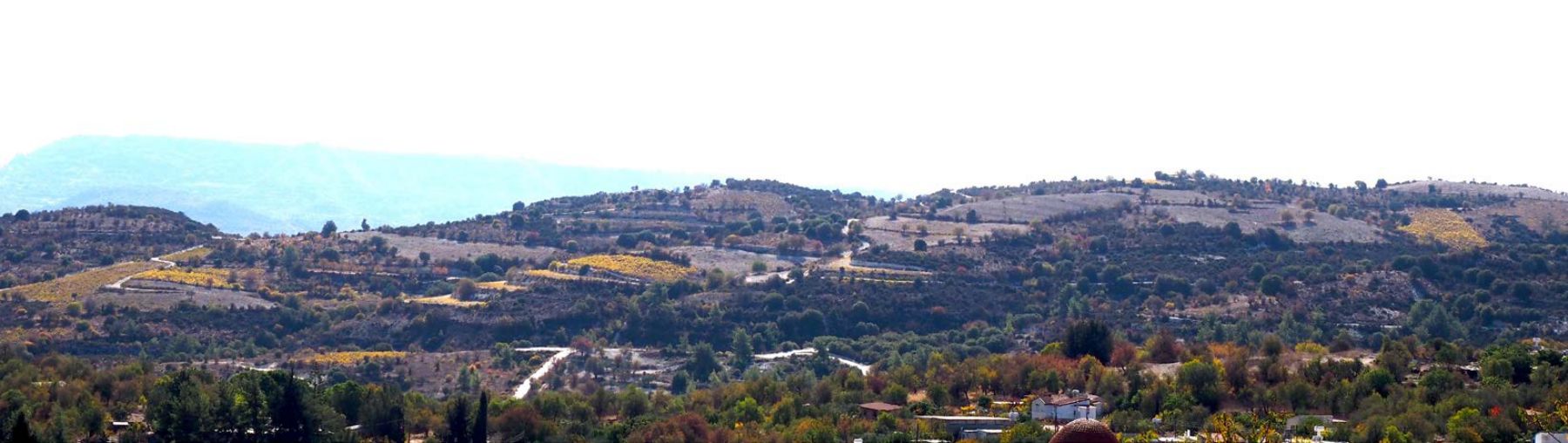
Salamiou
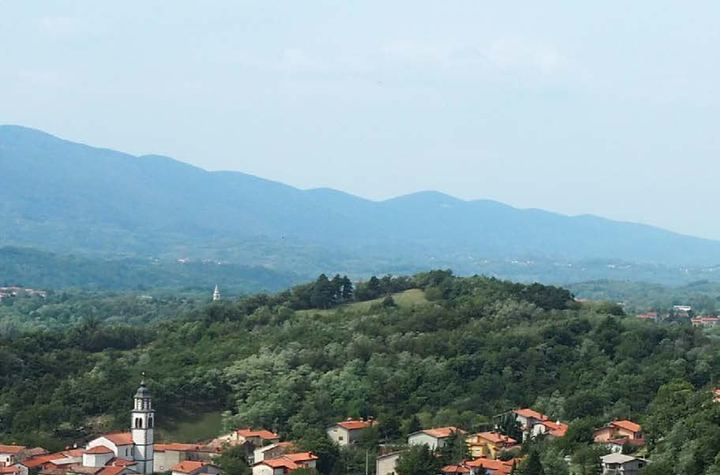
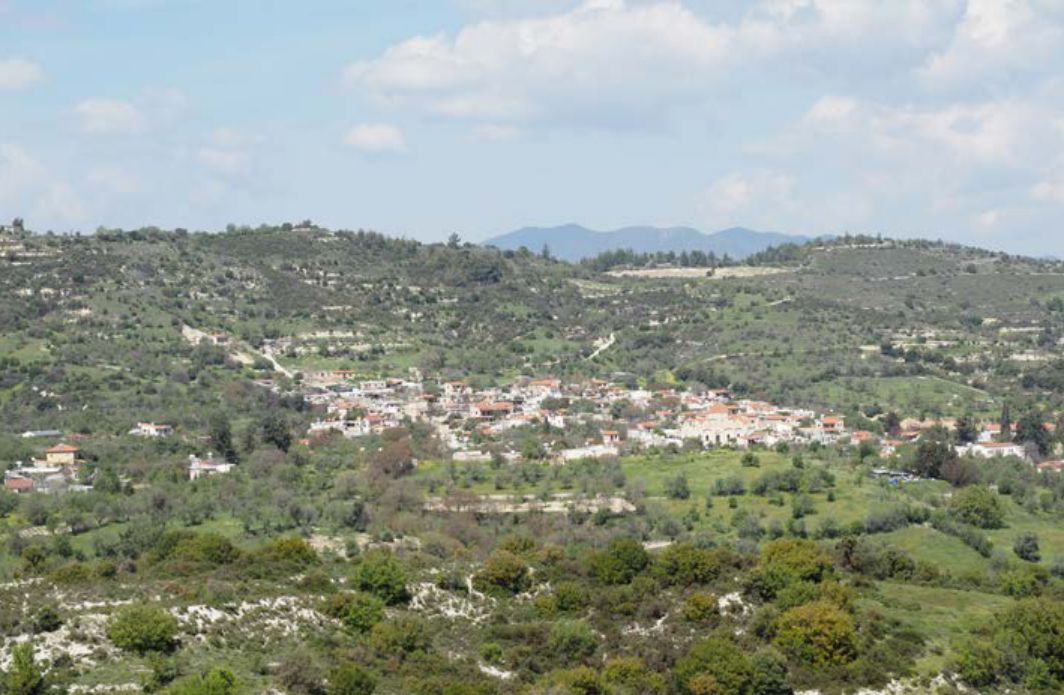
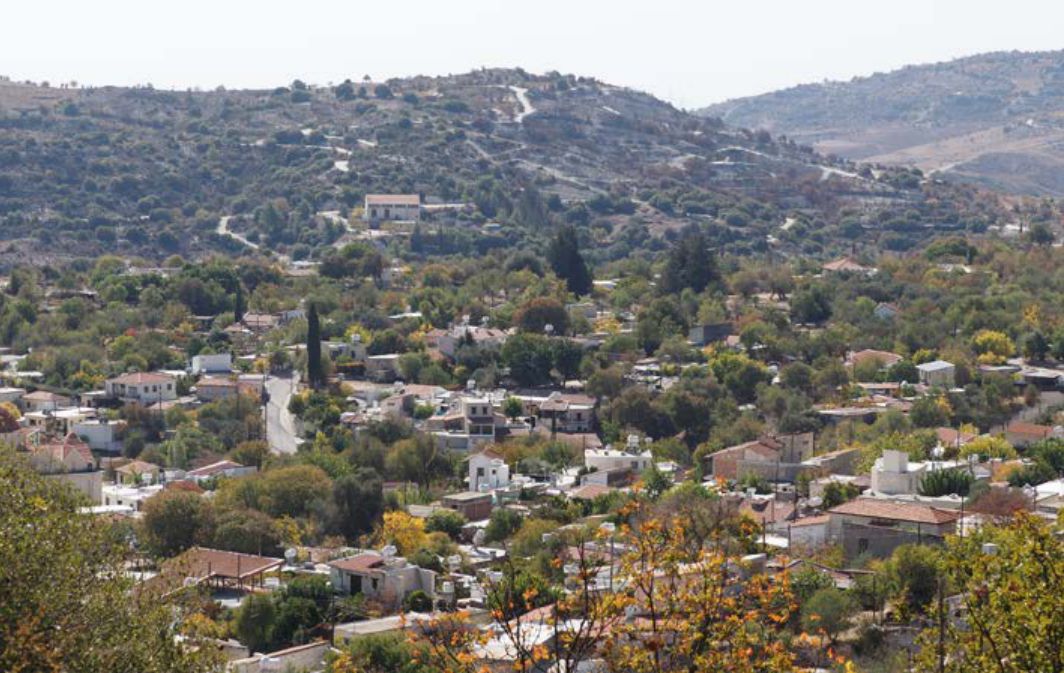
Located at 600 m above sea level, today Salamiou is a unique microcosm on the island, bordered by broad river valleys on both sides, wooded areas to the north and sweeping terraced farmland views to the south. The area is steeped in continuous farming history going back 6000 years but what sets it apart from other villages of the island is that it still has a vibrant community of permanent residents of all ages, including children and teen-agers and not only senior citizens. Salamiou also boasts a remarkable heritage of traditional rural stone houses packed around a beautiful early 20th c. church. The local primary school, has undergone sensitive yet extensive adaptation and has been converted into a fully equipped and well-staffed environmental education center that is open daily to visiting schools from all over the island. The local community center provides a nucleus for community gatherings, while the local multi-family owned Lakria winery also hosts a variety of contemporary venues both in the winery itself but also at its tavern in the village center where, through private initiative, the owners of the tavern have also created a small museum of local cultural and environmental history. The community also has a medical center and a good road system linking it to the nearby towns of Limassol (80km east) and Paphos (40km west). Furthermore, one of the outcomes of the aided discussion was that Salamiotes of all ages confirmed their determination to want to keep on living in their village.
Terraced Farming
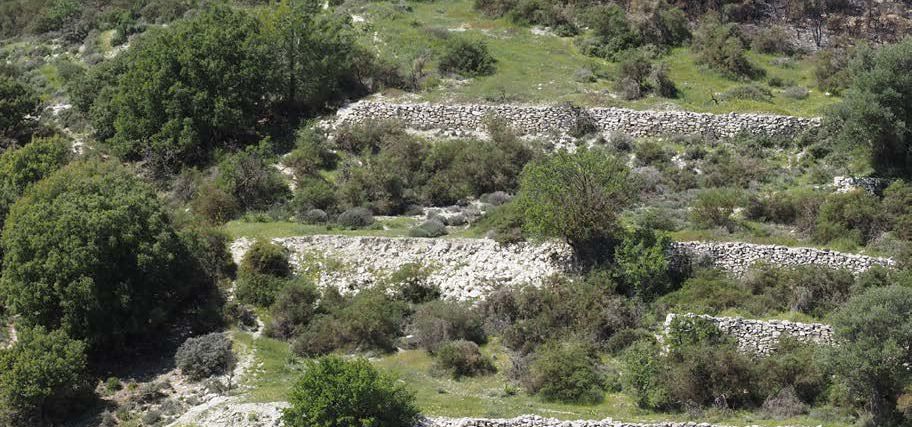
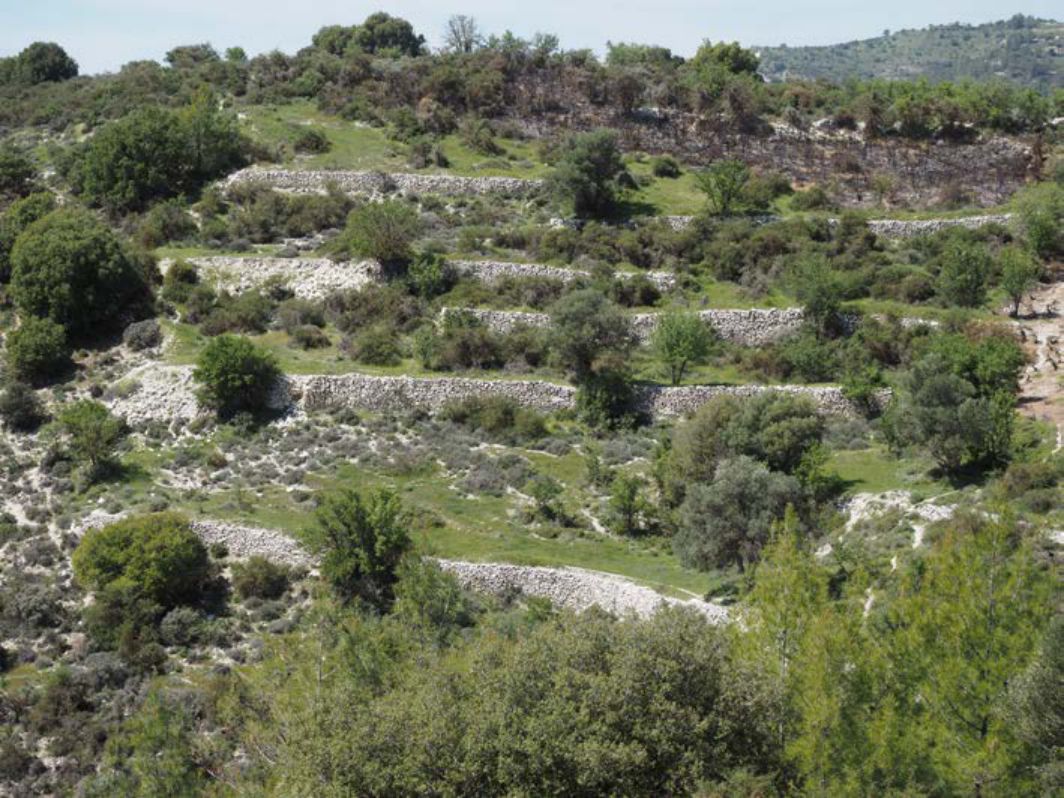
All of the above, involving the cultural history, the heritage landscape, but most importantly the vibrant community of Salamiou allowed us to experience what living amidst a landscape of terraces and drystone walls means to the community itself. Devoting our time to accept the hospitality of its residents made us try and look into an unknown side to terraced farming history which until recently, used to provide the local market with its main sources of fresh produce such as olives, grapes, fruits, but also a wide variety of beans, and vegetables, all authentic culinary products still included in the local diet. Our hope is that the intangible terraced landscape heritage, so important also for environmental reasons, can be preserved, brought back and reinstated in significance not only as a landscape but also as a foodscape for the future generations of the island. Through the local Salamiotes we saw the wisdom of how and why drystone terraced walls have been assembled at particular localities, reconfiguring the landscape for thousands of years, and what their environmental impact has meant for biodiversity and sustainability against erosion, landslides but also against fires. Together we talked about how terraces promote non-irrigation farming methods of rain water collecting and distribution but also how they help in sustaining the aquifer. The wealth of knowledge of our particular intangible heritage that has been painstakingly amassed over generations needs to come to the forefront of planning in the face of environmental challenges.
Living heritage
The community of Salamiou invited us to see the living heritage of their livelihoods and its intimate landscape with place-names, historic trees, daily farming activities and folklore. They showed us the practicalities of how they have been taught the art of drystone walling by their forefathers and how they are attempting to bring this knowledge by preserving but also restoring the food-producing ability of the terraced slopes, particularly since fertilizer and chemical contamination through pesticides in the low-lying farming areas at the foothills have begun presenting worrying levels present in produce that is often not admitted to market. This proves that terraces are not only historic heritage, but are an important part of contemporary landscape-compatible farming, sustaining both nature and its biodiversity in the face of climate change. Yet, while various institutions, through European funded initiatives which are taking place throughout the island are beginning to realise the importance of promoting sustainable activities in the island’s hinterland, including sustainable tourism options centring around the rich landscape with unique biodiversity, and particularly valuing agritourism, other older administrational bodies are slow in reforming centralised strategies, which are often based on outdated parameters, or marketing strategies that favour coastal investment and large scale produce imports. Such aggressive development strategies leave local farmers with little to no financial incentive. This sets into motion a vicious cycle of depletion of local human resources, forcing people to move. Depopulation then permits administrative planning to extract ‘unused’ valuable resources, chiefly water (for which more will be discussed) which in turn lowers government funding and investment for sustainable enterprises to the area, instead favouring massive projects of concentrated short-term benefits, chiefly along the coast. This aggressive cycle depletes hinterland communities irreversibly even further. Our five days spent in Salamiou gave voice to the local community of all ages who spoke openly about their love of place, their tenacity in holding on, but also their concerns for their own and their children’s’ futures.
Diary of Activities
Wednesday 25th October
Terraced landscape activity for 4-year-old nursery schoolchildren
The activity was undertaken by the local nursery school teacher, Ms Andri Kedariti, who commutes daily from Salamiou to a Paphos suburb where she runs her own private nursery. The children attending the activity were aged 4, and are of mainly local backgrounds, and the location of the nursery allows it to still retain some elements of its surrounding former rural landscape.
The children were led by their teacher on a walk in the neighbourhood to look at a drystone terraced wall.
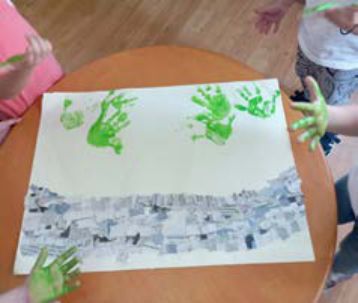
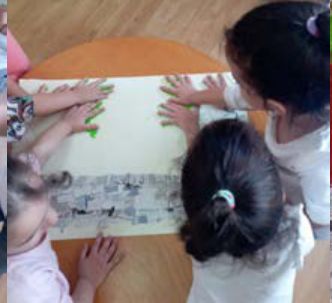
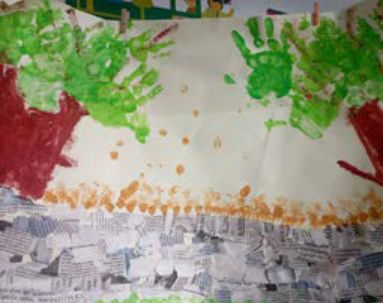
After discussing it on site, they returned to their classroom where Ms Andri had cut up small pieces of newspaper for them which they had to carefully assemble into a ‘drystone wall’ collage, making sure that each ‘stone’ covered the gaps of two below it. This exercise also aims to develop eye-coordination and delicate finger-dexterity skills. Next, the children were invited to colour the palms of their hands in green water-colour paint and to press them all together on the paper, above the ‘drystone wall’ that they had assembled. Next, some swift brushstrokes painted in the trunks of the trees, yellow dried grass was painted along the top of the ‘drystone’ wall (for autumn colour) and the terraced olive grove was complete (see images).
Preparation for the primary school terrace building activity
I approached the educators at the environmental center through an introduction by Vasiliki Petropoulou Panayiotou of ‘Terract’. After pitching the activity, a request in writing needed to be submitted to the head of the educational environmental unit, with the theme ‘Taking the school into the landscape’. Next the route of the activities needed to be determined and timed. The children would arrive by coach from Paphos at the environmental center on the village outskirts. Since this used to be the former village school, I decided to incorporate it into the first activity which involved walking towards and through the village to discuss its traditional architecture.
The second activity was to introduce the children to drystone wall building, for which a suitable partially collapsed drystone was identified in a field beside the educational center. However, the site needed to be prepared; brambles were cleared and piles of loose stones were assembled in neat heaps (to avoid surprises of crawlies living under stones). Local stone mason Panayiotis prepared the site, with the help of his teenage daughters Andrea and Melina, who were excited to take part in all of the stone-building works, since this made up a large part of their childhood experiences, often following their father into the fields.
Thursday 26th October
Educational activity for primary school children (ages 10–12), in collaboration with the Salamiou Environmental Center
The children visiting the environmental center on the day, came from the Paphos 13th Primary School, located in the tourist down-town center of the town, which is inhabited mainly by working foreign nationals from countries such as Romania, Bulgaria, Syria, Russia, Ukraine, Poland, Greece and China. Some of the children were English speakers, allowing them to cross over into groups of mixed nationalities, while those that spoke only their mother tongue gathered in tight isolated groups. A couple of the newly arrived children, who did not yet speak Greek, appeared bewildered and depressed despite their teachers’ kindness. The demographic changes occurring to Cypriot society are telling: of the 41 children who attended the educational event through their school, about 30 came to the island from abroad and about 10 of these spoke no Greek. Only one quarter were locals or of mixed families, with only one parent being Cypriot. When asked whether any of them have had contacts with a village, a grand-parent or parents who plant fruits and vegetables, 7 of them replied yes, but none of their villages were in Cyprus. The lesson therefore had to be conducted in an inclusive way; presenting the Cypriot countryside, through its timeless values, aiding them to understand and remember new words that give names to what they see around them, hence its significance, through visual and haptic connections. At the same time, what the basic knowledge aimed to achieve revolved around landscape, ecology and their own role as future agents.
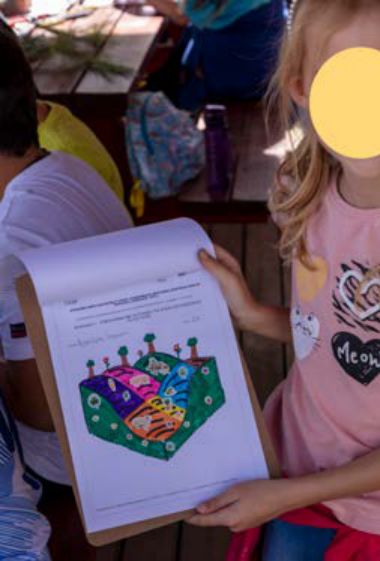
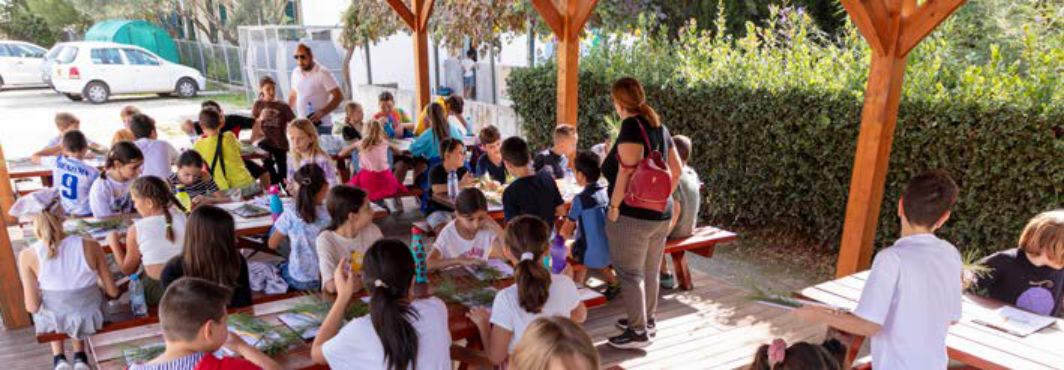
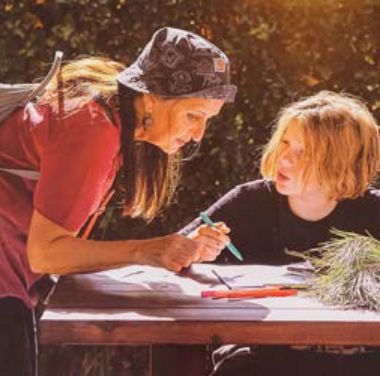
The educational activity was divided into two parts. The first part began as a stroll from the old ‘village school’ i.e., the environmental center situated on the village edge, towards the village center where the children were encouraged to experience entering the small scale of the settlement, while observing sweeping views towards distant mountains.
Observations were made along stops, on the experiential level; first-hand questioning about the scale, the views, and edges of the village, abutting landscape, the easy walking distance, through the village, and how all of the above differ from the current urban environment of cities. An old public tap also informed about the difficulties that the houses faced, without running water in the past. Since Greek was a second language to over 75% of the children, a vocabulary was introduced to explain through visual and haptic means what we were walking through. And since Cypriot dialect is itself very visual in conjoining words from the Greek language, the different traditional typologies of houses were pointed out: a ‘makri-nari’, or ‘long’ house, easily recognised from its exterior shape. It was different from a ‘di-choro’ (created from the Greek words for ‘two-spaces’, indicating a double-width house interior supported by a pointed arch. The ‘kso-porti’, the outer tall wooden gate, derived from ‘ekso-porta’ was explained as the outer door, and so on. They were next encouraged to discuss some of the courtyard dwelling’s interior particularities, and how these differ from the city houses. We looked at how trees and vines created shade and fruit (this was a feature many local as well as overseas children could relate to). Questions were put to the children to express similarities they may have encountered with houses in their own lives. They were also encouraged to look at, identify and touch different materials that make up traditional buildings (smooth dressed and rough-hewn stone, wood, clay tiles) as well as to discern different ways of building stone masonry, and its binding aggregates (mud and lime mortar in the cracks between stones instead of cement, garnered surprise and many interest fingers).
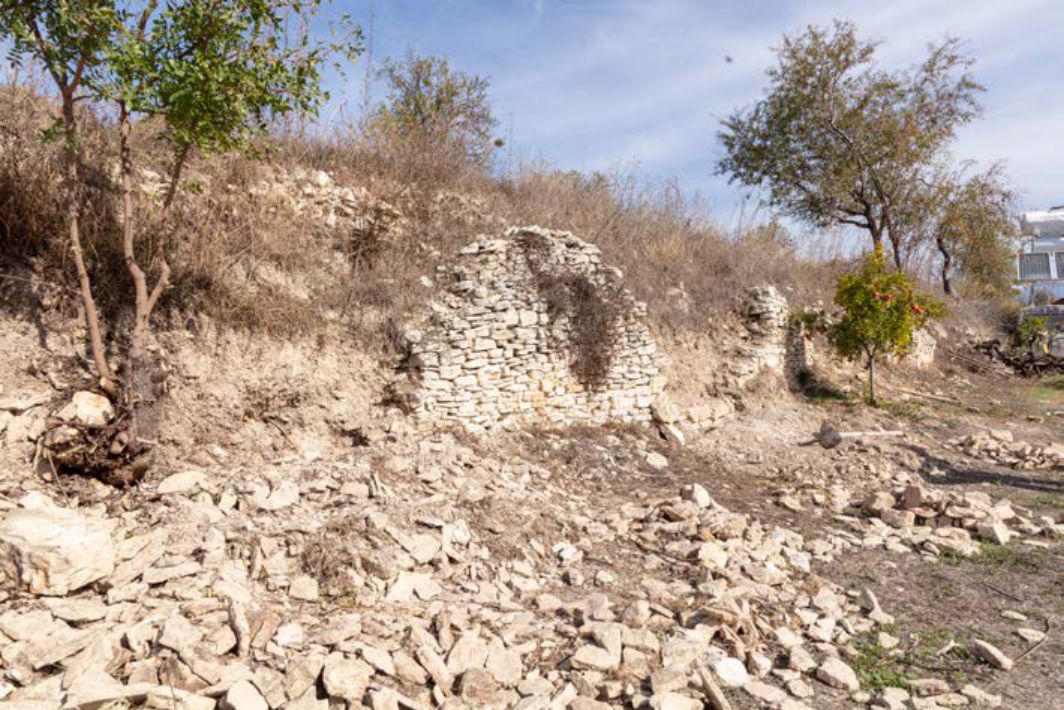
Next the qualities of stones used for the building were discussed, and where the material might have come from. The discussion was led to notice the different sizes, traces of markings. How a stone wall could be built was discussed; the children were encouraged to imagine building by hoisting the stones up, how they would stop them from rolling out of the wall (using smaller chinking to wedge them in place, like assembling a puzzle) and how they would be able to perform this feat at this large scale, understanding the collaborative effort required; they would need each-others’ help (one would need to stand high, perhaps on scaffolding – most knew what scaffolding was, probably because most of their fathers work on building construction sites). Other children would act out imagining hoisting the stones up.
We also looked at the significance of scale between the lower introvert houses, and the lofty domed village church, and also how when there are no cars, one can have steps down a narrow road. But we did agree that stones and wood can make cosy dwellings when we use our hands a, but also minds, and work together in making them.
The second activity took place after the children returned to the environmental center garden for a short rest and refreshments. They were next led to a nearby terraced field, having to walk up a short uphill to get there (along the way those children who could, sang English nursery songs, choosing English as their binding language even though their education is officially Greek). They were led to the clearing of the preprepared partially collapsed drystone wall. Walking with the children along the way, we looked at how easily the built village environment transitions to open fields, observing the depth of roots of trees along the road-cut embankment. At the terrace, how stones were used here was pointed out, comparing their different sizes and assemblage to that of the houses we had looked at previously. Also, that there was no mortar this time. We discussed how flat terraces that are easier to walk on than the uphill track that took us here.
They were next encouraged to identify the three zones making up a landscape, to turn their gaze to see what was higher up from where we stood (the pine covered hill tops) and then towards the green valley below. They were encouraged to relate the landscape to their own bodes, ie., their heads, with hair, were like the top of the mountain, with thick forests of trees growing there. The stone terraces where we stood in the middle of the slope acted like a belt that holds the landscape in place, much like the elastic on their tracksuit trousers, holding their pants to their waists. The Cypriot word for drystone walls was introduced, ‘Domes’ naming them and explaining their position in the landscape. The foot of the landscape, the plains, next corresponded to what is at their feet. The landscape was next presented to them on an outline drawing on a clipboard and pencils were handed around. They had to label the three corresponding elements of the landscape on the drawing – the mountain, the terraces and the valley plains, writing down the three words that describe the particular rural landscape zones.
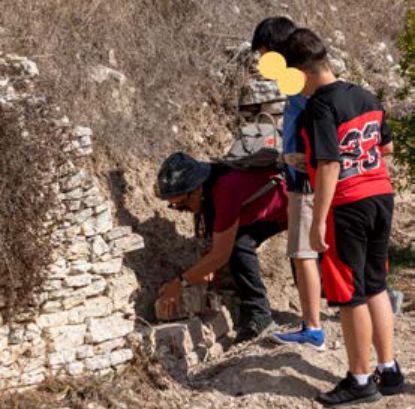
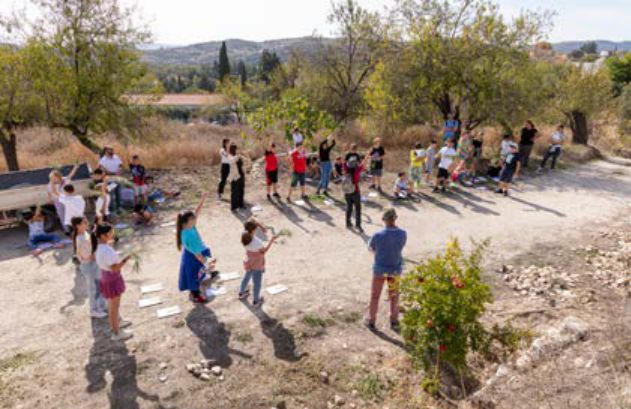
Next, a question was asked, “Why are the drystone terraces set in the middle of the mountain slope, and not further up or lower down?” And also, “What is the role of the trees on the mountain top outlined on the horizon?” “What do trees really do that helped people when they built terracing further down in order to grow their food?” Branches of pine boughs were handed around and the children were encouraged to hold them high up and look at the pine needles against the sky and clouds, to imagine how the pine-needles pull in water droplets from fog and clouds down along the bought, down along their arms which became the branches and they the trees. One little girl responded that the roots not only hold the tree up, but that the branches send water down deep into the roots and into the ground.
Question: “But what would happen to each tree in a violent storm if they are spread out like you are now? How will the trees protect themselves?” Instinctively they drew closer together, to make up the forest that they could see in the mountain tops above, and thus subjectively link with each other into a community.
And so, it was understood that the rain is captured by the trees, that the roots send the water deep down and that the terraces hold the soil and water in place, allowing things to grow. This was easily recognised from the drystone walls beside us which were standing compared to the parts that had collapsed and soil was eroding down the broken gaps.
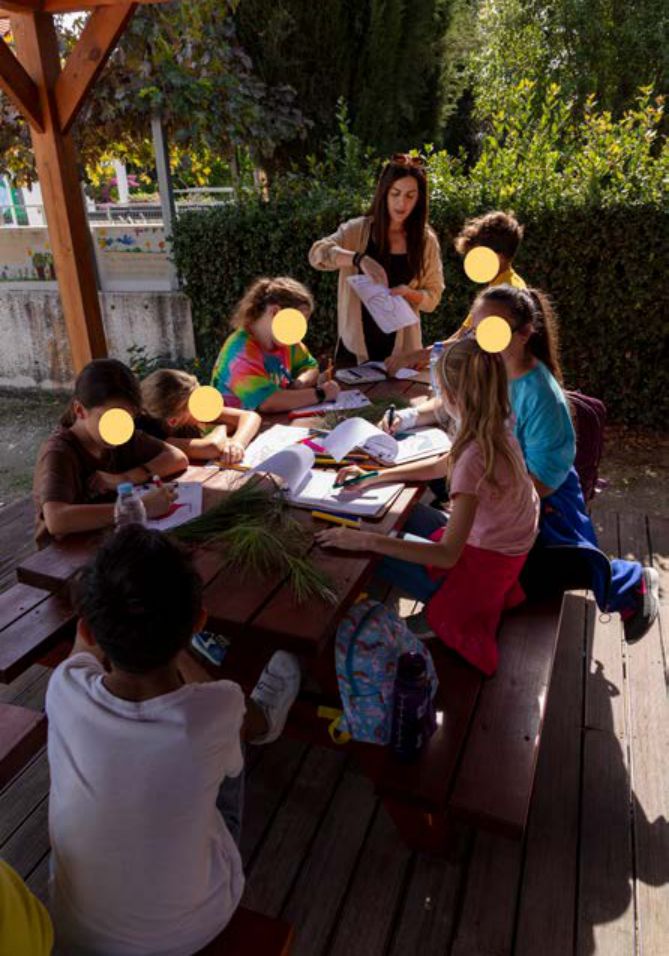
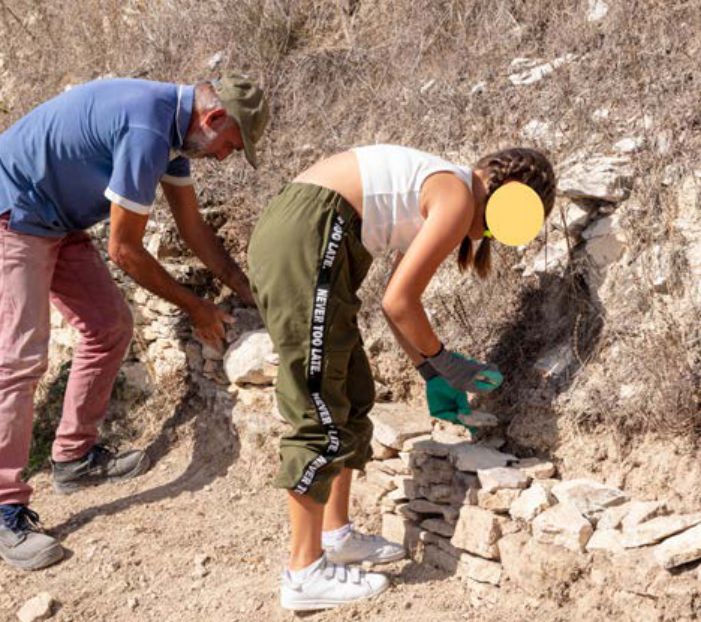
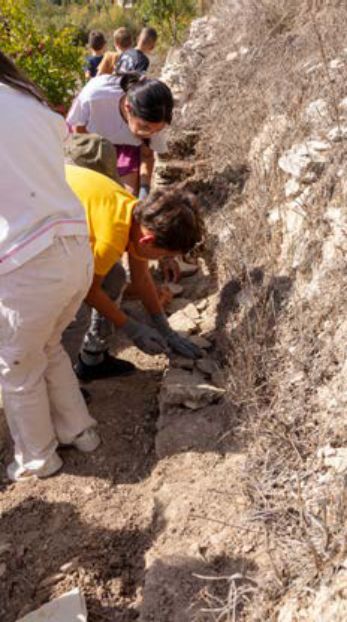
Next, they were handed out gardening gloves and were separated into groups. Stone mason Panayiotis took over one of the groups and I the other, and we looked at the remaining bits of the drystone and discussed how we were to rebuild it, filling it in as a giant puzzle, selecting suitable stones from the heaps beside us. The rules of the game were to select a stone to place in the front, but also that some stones should go behind the front one at the same time, placed but not thrown. When placing the stone, it should overlap the gap between two others, and we should feel it click into place. Some of the children eagerly took over with interest and initiative, working together to click the stones in place and fill up the gap in the drystone that had tumbled down. One little Russian boy who did not speak Greek, on his own initiative understood the significance of bringing larger stones that ‘tie’ the smaller ones wedging the drystone construction in depth. At the end of this activity the children were led down to the environmental center to sit under a pleasant shady canopy with wooden tables and benches. They were given the same outline sketch to fill in, this time with felt-pen-colours. The aim of this drawing was more technical in nature, and they had to schematically draw in the terraces in relation to the forests above and the valley below, by adding horizontal lines to represent the terraces. They could look out at the landscape they had previously visited for inspiration. Those who finished were given a selection of sticker pictures to decorate their drawing with.
The activity was photographed by a volunteering professional photographer and the photographs were displayed at the closing exhibition which was set up in Lagria winery.
Reflections on the educational outcomes
It became apparent that the children had developed a mental block towards being given too much spoken information; they did not want to listen, understandably since over 3/4 did not understand Greek, and particularly some of the boys would become unruly. The way to keep their interest was to move about and draw their attention to different elements that they could visually and haptically engage with, and particularly to point things out, to touch different qualities of stone masonry, reaching up, or stooping down, indicating the large stones and the small, how corners are dressed, and then stepping back to relate the different scales of the surrounding elements between them, using ‘bullet’ words. Even though the subject matter of traditional architecture was presented to them from an architect’s point of view, the children showed remarkable patience and engaged with interest when observing the different types of stone walls During the second terrace building Panayiotis was a more patient and exacting drystone educator; their group made 3 very decent rows. I lost control, the kids were excitedly bringing stones too fast and our wall was a sorry sight, but not for lack of enthusiasm.
The group comprised of two classes and was much too large (41 children in total). It was impossible to engage all of the children, particularly since there was to be no follow-on lesson. In effect, only half actively participated in the walkabout discussion and engaged in the drystone building. Some children clustered around their teachers, but it was impossible to know how much they were able to take in. However, barring the ones who did not yet know how to write in Greek (about 3), all wrote down the word for ‘terrace’ in the right place on the 1st sketch handed out. Only about 3 wrote down all of the three words describing the identified landscape zones which were pointed out to them in situ, while most of the rest got down at least two of the zones (the forested hilltop and the terraces, but missing the low-lying fields were factually out of view). This indicates that this part of the lesson must be structured differently for such a short-duration lesson. Over 30 children drew in the terraces correctly on the second handout sheet, showing them as interrupted horizontal lines in the middle of the landscape outline provided. The site for the drawing activity was selected so that they could be comfortably seated and could look out onto the terraced landscape we had just visited and engaged with. Aided by myself and their teachers, we continuously went around the different groups, assisting by discussing their drawings and engaging with their questions. I provided all children with enough felt-tip pens of varying hues for colouring (a luxury that I have seen scrapped across our education facilities as a cost saving measure). Those who completed their drawing were further allowed to select stickers of animals and plants with which to augment their drawn ‘environment’. (This gave time for those who were struggling to complete the set task, while still engaging those who were faster. In the end, everyone got stickers). During the drystone building activity, I noted that the previously naughtiest boys were also the best stone builders. Some of the (mostly foreign) girls also showed drive and independence in handling the stones and building them with careful precision. The children easily engaged with interest, collaboration and care during our half hourlong stone building activity and we had no crushed fingers. The first part of the activity prepared them to familiarise themselves with the material of stone so as to take initiative in handling it in the second activity.
Saturday 28th—30th October
Activity for volunteers and students: Introduction to terrace building
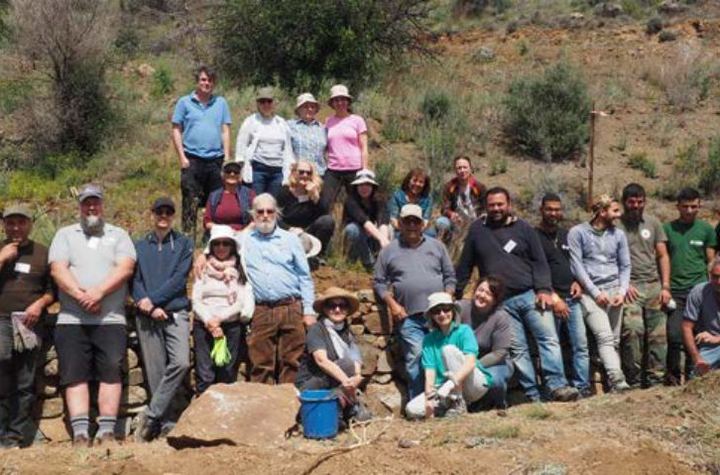
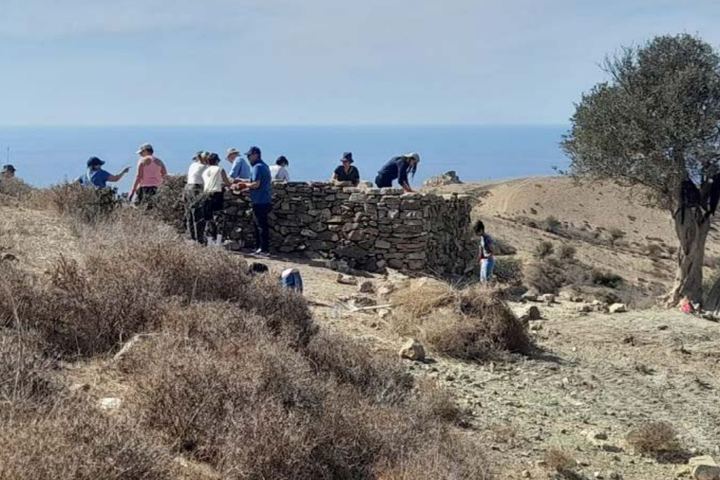
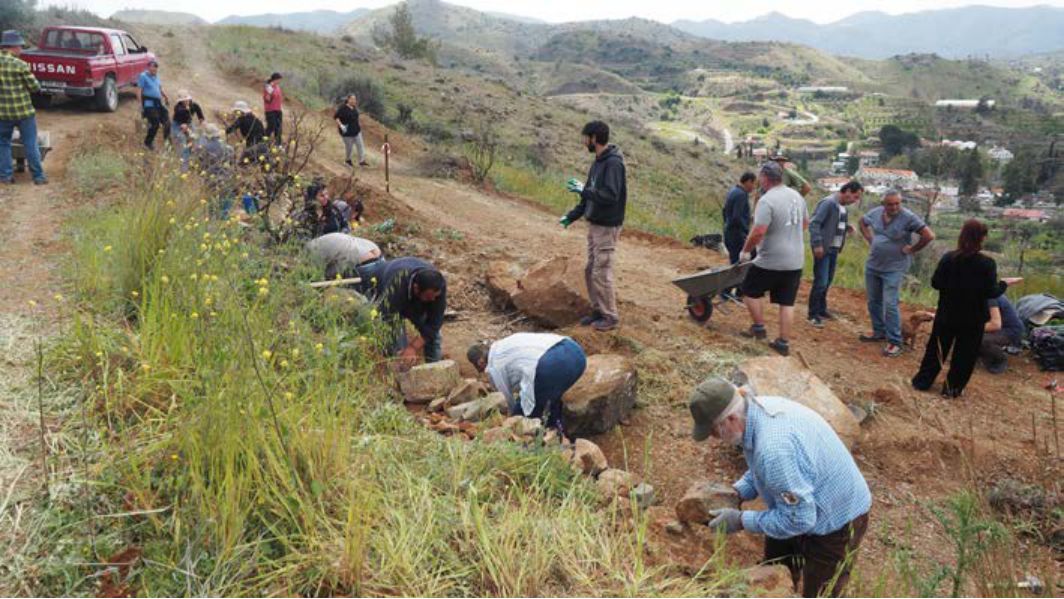
The site for the activity was selected along certain criteria: it had to be easily accessible; be on public land so that no permission was required from private owners; it had to be close to the village so that local residents could engage in its progress. The restoration of the selected drystone wall that was to be repaired had to benefit farming terraces as well as the village in general. There had to be enough loose stone lying around for the repair, and also the work could be stopped meaningfully at any point, but also to be able to be continued for future similar events. After visiting numerous sites surrounding the village, and there were lots to choose from, a stretch of the old abandoned road known as the ‘Kamilostrata’, at ‘Dkio Dendra’ (the camel road at two trees locality) was chosen for the event. This track, nestled between drystone terraced walls lining both its sides and surrounded by terraced almond groves, used to be the old camel road leading north from the village church towards the former Turkish Cypriot village of Ayios Ioannis. This village is inhabited since the population exchange following the war of 1974, with refugee Greek Cypriots who were displaced from the northern parts of the island. The almond trees provided much needed shade making the work enjoyable, for even though the event was held in late October, the sun was still scorching. The weekend activity was attended by about 30 individuals, and we instinctively banded together into a ‘Boulouki’, a Greek term for the bands of stone builders, men but also women, who used to roam from village to village, offering their services. A small but significant group had gathered for the day: conference members of ITLA, both local and foreign (Maruja Salas and Timmi Tillmann of ITLA honoured us with their presence), trainers, volunteers, students and even tourists; Cypriots, both local, and from across the island, as well as foreign residents on the island. Of those present, each had a differing level of expertise. The stonemasons of the village who were to be our terrace building trainers (Panayiotis, Argyris and Andreas), were also joined by some local farmers and even workmen from the village (including a young Syrian man), and a comradery sprung up between these older villagers, and the younger teenagers, boys and girls, who were the children of the trainers, all residents of Salamiou. The young girls in particular showed keen interest and asked a lot of questions taking in a wide expertise of local history, geology, social and cultural architectural heritage, water and irrigation, soil quality, biodiversity, geography, to say the least. Other attendees were engineering students, but we also had Ioannis Koutsolambros, architect and lecturer from the Paphos University of Neapolis. One young woman was visiting Cyprus for the first time from the United States, and happened upon a posting in social media with her local friend. Another, a Romanian now living in the UK was on a repeat summer holiday.
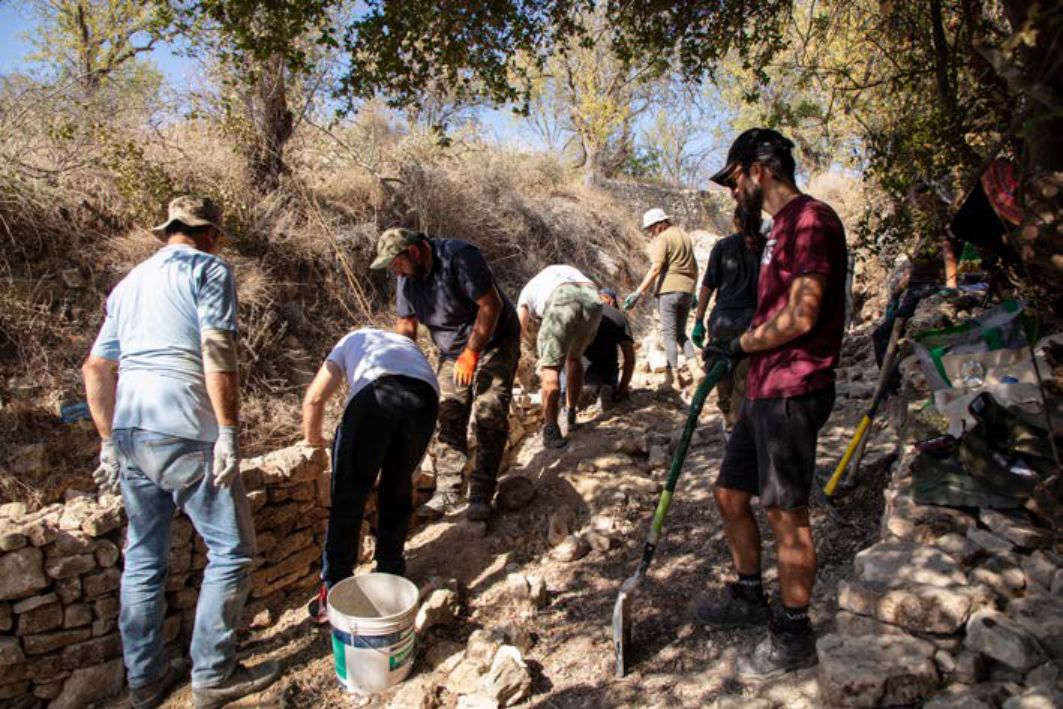
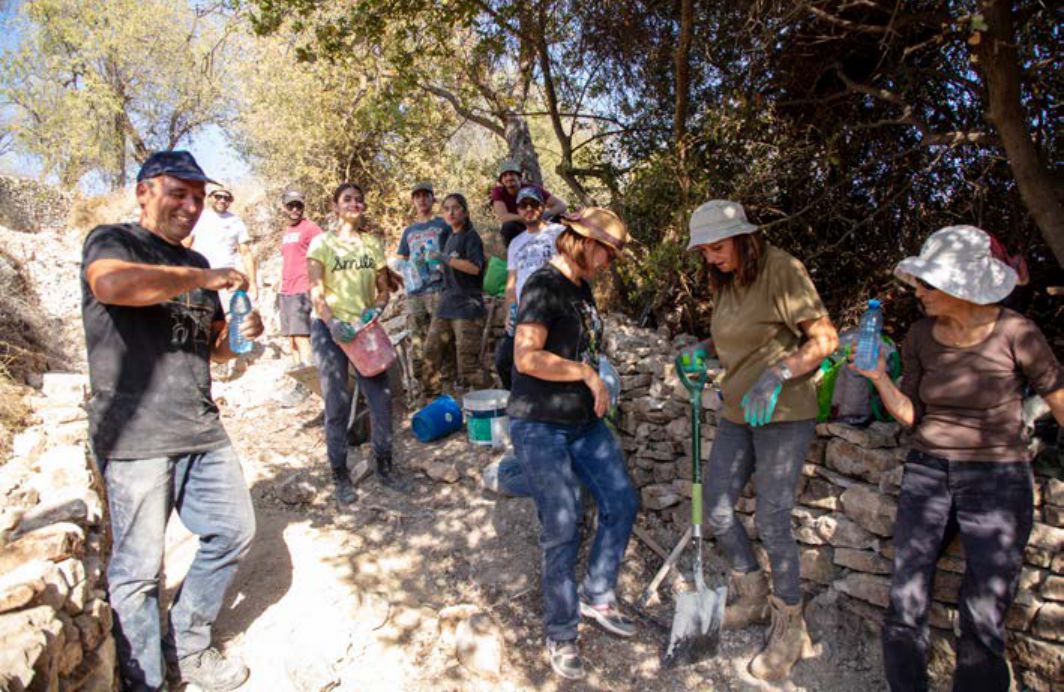
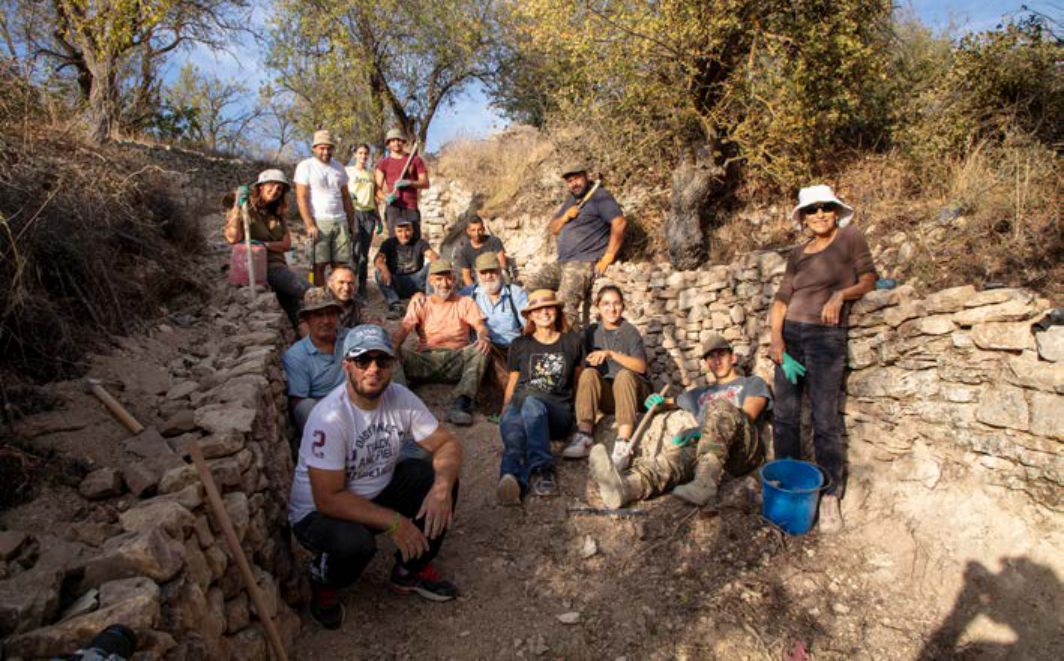
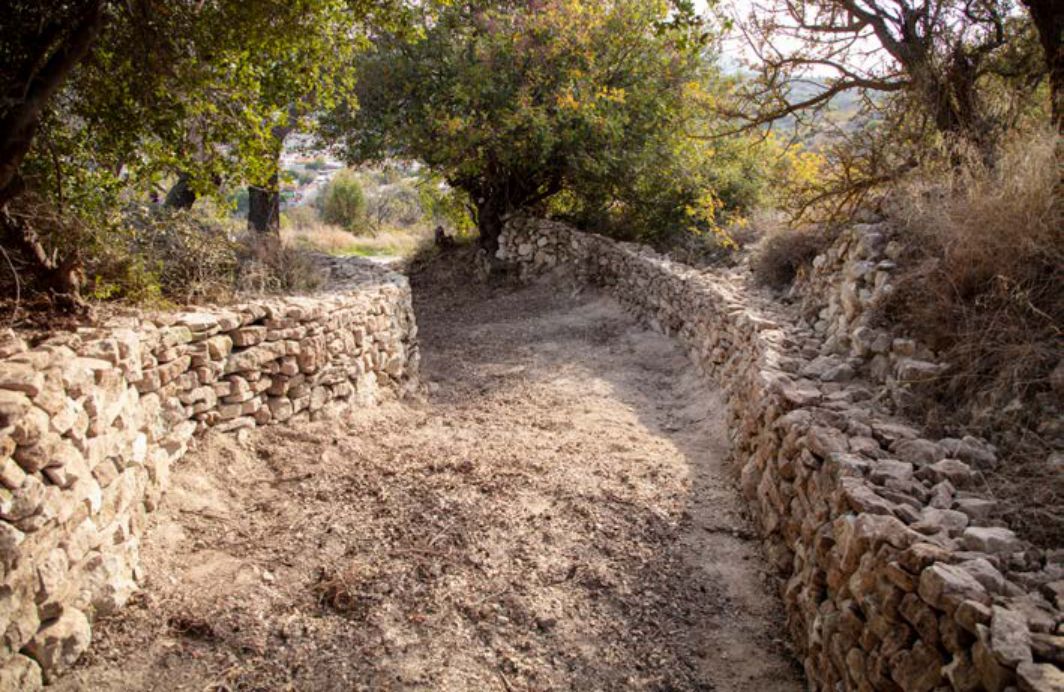
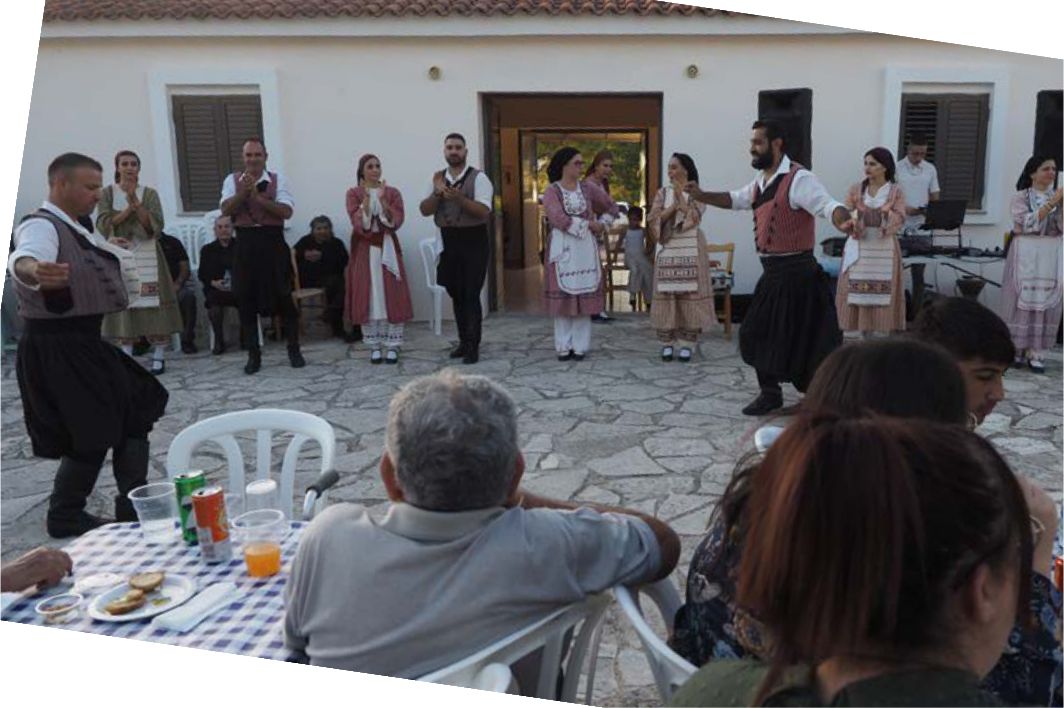
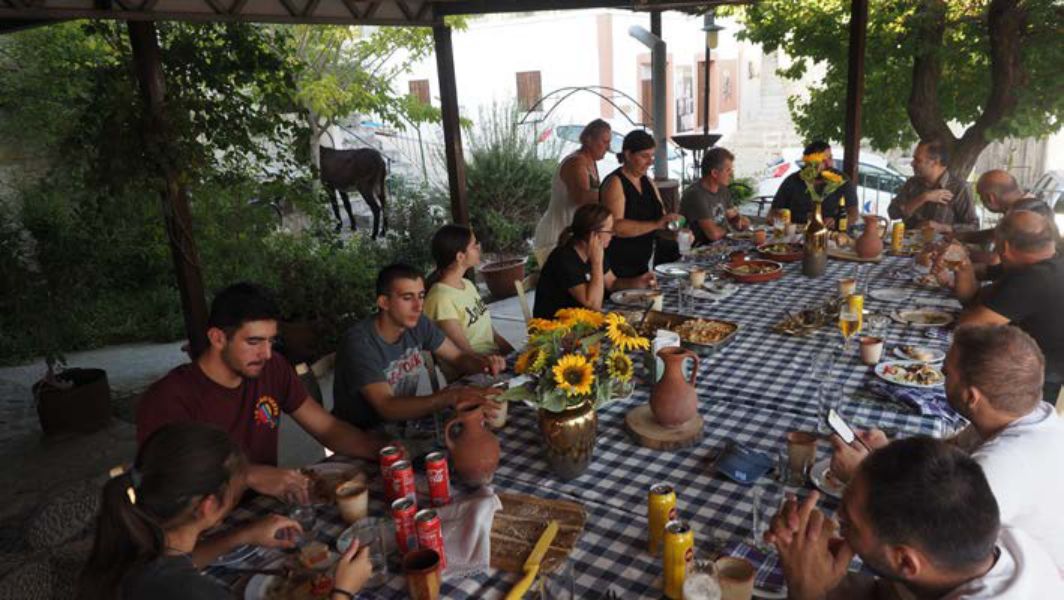
It is always an experience to listen to Timmi and Maruja share their knowledge from around the world, while humbly laying stones with us. The trainers were building but always had a watchful eye over what the more inexperienced of us were doing, encouraging us, showing us what they see, as they were taught to look by their forefathers, seeing what we do not. A stone that has just been placed by inexperienced hands would be gently removed by more experienced hands that would turn it around, re-position it, and suddenly it looked settled. It was joyful to feel the cool autumn breeze while watching the repaired wall ‘emerging’ swiftly before our very eyes. The ‘Boulouki’ experience of bringing together people from a variety of backgrounds, people of all ages, of different skills and talents, matches the qualities of the drystone assemblage; a variety of different sized stones are needed, each finding its tightly packed place. No stone is wasted, no stone is unnecessary. Similarly, everyone instinctively finds the role they are suitable for, they take on tasks that they feel capable to carry out. With each stone placed, a little more knowledge is gleaned, the hand to eye coordination improves chink by chink, stone placing becomes more confident. The work is continuous, as one bends to pick up a stone, others are laying the stones they gathered up. Still more bring buckets of chinking that is poured in the back and then eager hands redistribute these loose stones so that each one finds its fixed place. “The back must never be filled with soil, only stones”, admonishes Panayiotis. A discussion ensued with Argyris and the other craftsmen, and all briefly stop to listen to the practical sensibility of creating a vertical gravel filter behind the terrace wall, that lies between the larger stones and the earth embankment behind it, so that the filter will not become swollen with mud but will allow the rain water to percolate through. Lunch was served under the trees by Vasiliki Petropoulou Panayiotou from Lagria tavern. There were sandwiches and bites of pitta bread, with roasted wine-cured pork lountza and halloumi cheese, fresh herbs, tomatoes and cucumbers. For dessert there was Anari cheese dressed with carob syrup. At the end of the activity on Saturday, we managed to rebuild 40 linear meters of walls on both sides of the old path. The tumble-down confusion of the landscape which greeted us in the morning gave way to a calm sculpted meandering curve of the now re-defined path. Tired but content, the group next drove through the setting sun and autumn glowing vineyards to Ayios Ioannis whose current residents had extended their invitation to our conference, to visit their olive-pressing festival. Dancing the energetic ‘Sousta’ folk dance with Timmi holding one end of the village dance and I the other was a memorable end to a long and full day.
Terrace building continued with the trainers on Sunday 29th and Monday 30th of October afternoon for different groups of volunteers who came to the activity, while some students returned to continue for the second week-end day. On Monday afternoon the team was joined by Andy Constantinidou of the Pancyprian Organisation of Architectural Heritage (POAK). Maruja and Timmi continued unabated on Sunday as the path inched upwards. In all, about 70 linear meters of drystone were repaired during the workshop. “You always start terracing from below and move upwards, not the other way around”, advised Maruja.
The Bicommunal aspect of the event
The next phase of the activities involved an ongoing bicommunal exchange between the Salamiou craftsmen, Laona Foundation and Turkish Cypriot counterparts from two citizens organisations, the Cyprus Environmental Initiative and Çader (Ayios Epiktitos (Çatalköy) Development and Culture Association. Both organisations are based in the northern Kyrenia mountain slopes. This joint collaboration had begun from the previous years and various joint activities had already been completed with Laona Foundation, through a project on fire-scape revival titled ‘Pyranakampsi – Alevlerden Geleceğe’[1]. This is an ongoing Cypriot bi-communal collaboration across the island’s political divide, whose aim is to strengthen civic action in fire-stricken communities. This activity led on from the former Eucaland fires-capes international conference held during March 29 to 1st April 2023, where participants of various international academic backgrounds and organisations presented concerns on impacts of fires in terraced landscape areas throughout the world, with possible ways of recovery. The Turkish Cypriot counterparts were then Martin Marancos of the Cyprus Environmental Initiative together with environmental engineer Dr Salih Gücel of Near East University. With the unfortunate passing of Martin however, on the 2nd of October 2023, his wife Irene Raab stepped in to represent both the citizens organisations, together with Gücel. Two more members of Çader also attended; Ms Myriam Marancos (a hospitality professional) and Ms Sevilay Ramadan, as did retired Turkish Cypriot forester Mr. Faik Koyuncuoğlu. When the Turkish Cypriot counterparts arrived, they were warmly welcomed by the Salamiotes and after being settled into a traditional cottage, they were shown around the village and taken to the terraced site of the workshop. Here, together with Andy Constandinides of POAK, they chose to spend the afternoon working with the local craftsmen to continue the repair of the drystone terrace wall lining the abandoned path under the almond trees, and in sharing their experiences [2].
Tuesday 31st November
Presentations
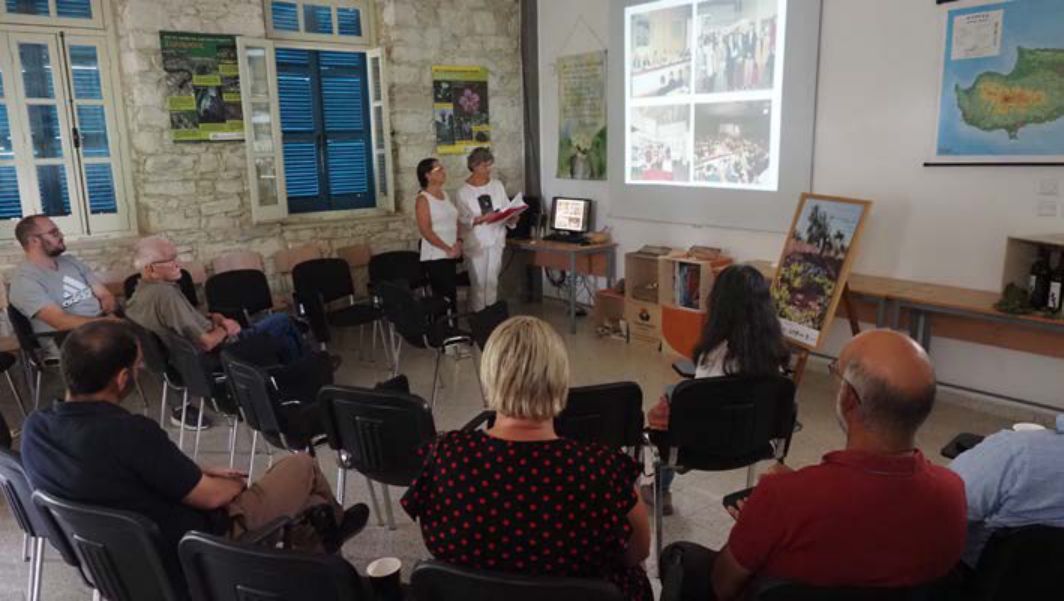
Andy Constantinidou (originally from Kyrenia in the north of the island) began by welcoming the guests of the conference and thanked the Community of Salamiou for hosting the event, as well as thanking Laona Foundation and architect Sevina Floridou for undertaking the educational workshops ‘Taking the school to the landscape’. She then went on to briefly outline a few of the Organisation’s activities from its founding in 1979, by architects Neoptolemos Michaelides and artist Telemachos Kanthos, as well as architect Pefkios Georgiades[3]. The Organisation boasts a wide range of research activities, symposia and publications on terraced landscape: (Proceedings of the Symposium on the Cultural Landscape of Cyprus, 1997 (2000); Conservation and Rehabilitation problems of Traditional rural architecture (1994); Sustainable Development management project for the area Ezousa-Xeros Potamos-Diarizos (1999-2001); as well as publications on the intangible heritage of traditional craftsmen (1982).
Next, Salih Gücel made a brief presentation of his own involvement with the rehabilitation of terraces in the Cypriot landscape. By coincidence, Salih’s grandfather came from the neighbouring village of Stavrokonnou, to the south of Salamiou, so this immediately warmed the Salamiotes towards him, accepting him as a ‘local lad’. In many ways he has tried to retain and develop some memories of knowledge of sustainable farming from his own family history, by acquiring a piece of Turkish-Cypriot owned land at Kornokipos locality near Kalavakia (Calavaç), where he has been learning and educating himself on drystone construction, mud-brick building and bee-keeping. The local participants together with the Salamiou craftspeople eagerly discussed how his site could host the return bi-communal terrace building event, planned for the following December.
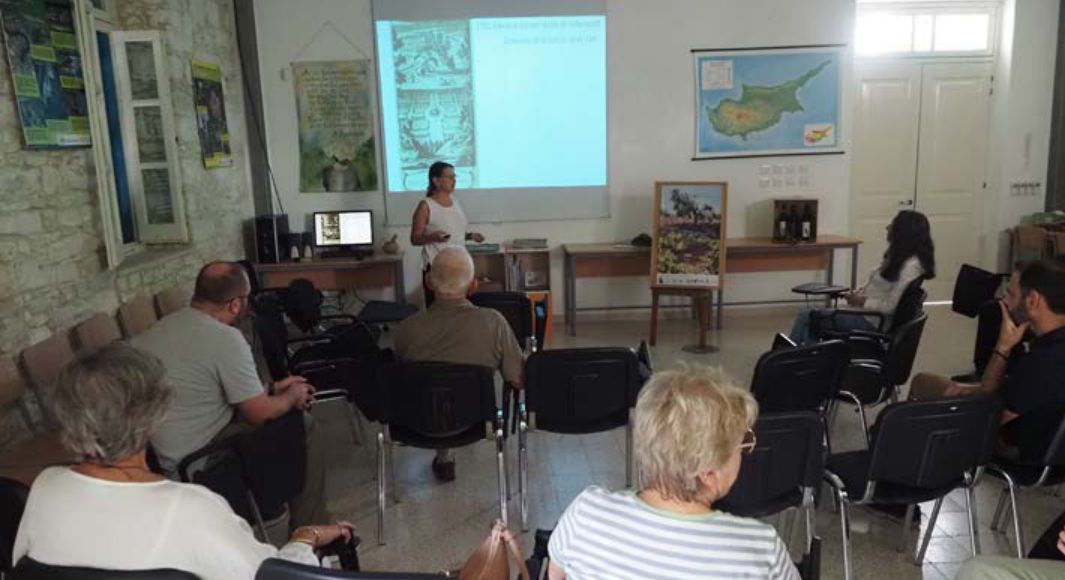
Timmi and Maruja’s presentation: Re-enchanting terraces
Timmi and Maruga introduced ITLA’s international scope and activities, since its founding in 2010, and its declaration, in Mengzi city, capital of Honghe, the autonomous Chinese prefecture in Yunnan province, near the borders with Vietnam. They discussed how the mountainous regions of the world cradle the terraces, whose origins go back thousands of years, particularly 4000 in the Mediterranean region. Maruja also talked about the ‘I ching’ 3000 BC symbol of terracing. They described how terraces are axioms of both biocultural diversity throughout the world, and regions of agricultural crop diversity and how terraces in fact provided the origins for agricultural development. They discussed how in each place the protagonists living on the terraces are often ethnic minorities, facing threats of introduced modern commercial varieties and mass tourism of no local benefit. In 2014,in Cusco, Peru, the conference centred on the multiple voices in intercultural dialogues, between knowledge systems, local perceptions and alternative visions for terrace development strategies. The first scope in this strategy addresses the acknowledging of diverse systems and diversities of landscapes; paradigm shifts from an urban to a mountain vocabulary of experiences; a bottom-up approach of listening to local voices, local guardians of traditional culture and their own associations to the landscape. The second scope involves creative proposals through visualising local wisdom; making terraces visible; making locals proud of their heritage landscape and regional cultural identity; a branding of terrace products. These strategies were implemented in the Moray-Inca experimentation.
2016 saw ITLA’s world meeting ‘choosing a future for terraces’ in Padua and Venice from the rich diversity of knowledge systems around the world. The Italian Manifesto recognises global but diverse terraces, that each terrace is a universe, recovery is needed not only of local heritage but also of local seeds and food cultures; growing and providing food as a framing profession must provide a dignified life; there are long term benefits for the public good through terraced farming and landscape preservation; organic small-scale production must be encouraged as should local circular economy and ethnodevelopment. 2019 ITLA conference at La Gomera addressed the current worldwide disenchantment of terraces; their population depletion, mass agricultural practices and overall abandonment. Therefore, goals to ‘re-enchant the terraced landscape’ were identified; from knowledge and coherent ideas to action, protagonism of local people, re-enchanting by each person, each field, each terrace.
The next conference will be held in Bhutan with the aim of ‘de-colonising our minds and perceptions of rural terrace development’.
Çader presentation
Irene Raab presented for Çader, which was founded in 2005 as a citizens’ development and culture association. Activities include a wide variety of initiatives starting from small-scale daily outcomes such as community tree planting, art work engaging with environmental issues, and cultural excursions centered around learning about Cypriot history and landscape. During Covid seclusion, Çader (with Martin’s construction input) created a flatpack bird’s nesting box which they distributed to homes of their community which children requested to assemble, with the use of tools, together with their parents. One of their more ambitious long-term goals however is waste separation. For this it was first necessary to educate members of the community in what is being done by overseas communities. A trip to Germany resulted in locally finding commercial partners, convincing the municipality to co-operate, developing a bag-concept for first separating plastics, metal and paper in homes, and next a sustainable marketing the concept. The project also includes mulching and composting as a communal initiative which improves social responsibility ties within the community.
In an emotional presentation, Irene next stepped in to present the work her husband had been doing through The Cyprus Environmental Initiative, on the Wildfire Protection Project Cooperation both before and after collaborating with Laona Foundation and Çader, through the Pyranakampsi / Alevlerden Geleçeğe initiative, and since the fires of 2021. The latter project’s aim is to strengthen ties by exchanging know how across the political divide through collaborative activities. Irene outlined the strategy of identifying stakeholders both public and private, who surround the communities both administratively but often physically as well and need to be involved (such as local farmers, local municipal authorities, village mayors, the fire brigade, forestry, civil defense, Ngo’s, sports and other clubs, but also financial enterprises in the tourism industry).
Presentation by Sevina Floridou
At the closing, I presented our Eucaland outcomes as well as my contribution and knowledge gleaned from the two years of collaborating with Laona and the Turkish Cypriot counterparts through Pyranakampsi/ Alevlerden Geleçeğe. One of the main outcomes that became apparent following the fires of 2021, was our emergent knowledge of how terraces behave when inserted into the landscape. Through information gathered both through ground research, mappings and digital sources of both the forestry department but also collaborations with topographers, we were able to understand how terracing acts and is a part of the wider landscape, and how it is impacted by climate change. Particular dangers affecting the terraced areas are the challenges of fire, overdevelopment, denuding of vegetation etc. In particular, cultivated terraces were examined in their role of mitigators against raging fires but also observed was how abandoned terraces continued to provide anti-erosion support when denuded of vegetation through the fires. Outcomes of how this affects rural communities has been monitored for two years, together with Laona Foundation over a wide territorial range, including over 10 communities, most of which were affected by the 2021 fires. These communities and their surrounding terraced landscape often have hidden histories of great social, historic, and cultural landscape value that have been left unappreciated, and creating a knowledge product of these could help to reverse challenges by promoting sustainable actions. The presentations ended with gathered momentum for follow-on projects by all participants, after the results of this workshop will be documented.
Wednesday 1st November
Searching to define future nature trails around the terraced landscape of Salamiou
For this activity we were joined by Mrs Andriani Charalambous of the Historic Preservation Department , which is under the Department of Urban Planning and Housing. The DUPH has recently joined the European Drystone Network REPS programme as a founding member, for promoting terraced landscapes in the island’s wine-growing areas, through designated trekking trails.
We decided to visit all of the sites around the village, enclosing a full circle, since the unique topography of Salamiou places the village on a crest of a hill, surrounded by two river valleys east and west, and also by other lesser vales and hilltop crests, providing panoramic vantage points. The first part was a treck, starting from the the village center to the locality of a wild self-seeded Apostolic olive grove at a distance of about 4 km, an easy hour’s walk. The trek was led by local stone mason Argyris Panayiotou, whose inspiring wealth of knowledge on various aspects of the landscape which he pointed out, kept us in awe throughout the whole day. The trail led us out of the terraces of fertile hawthorn shrubs loaded with golden coloured fruit and almond trees just beginning to turn into autumn hues.
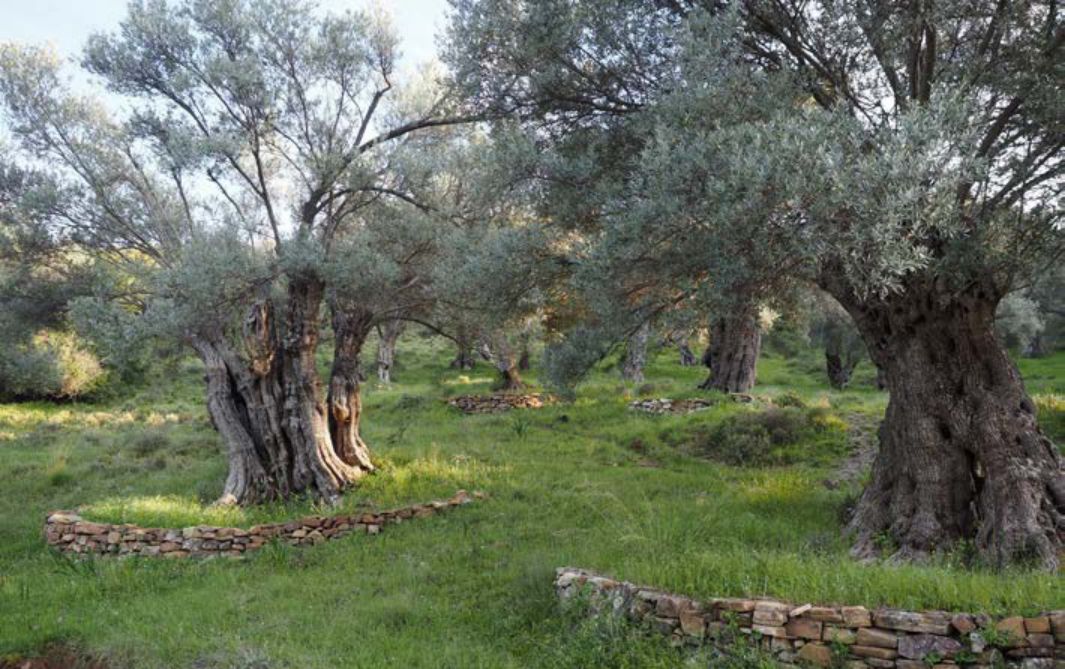
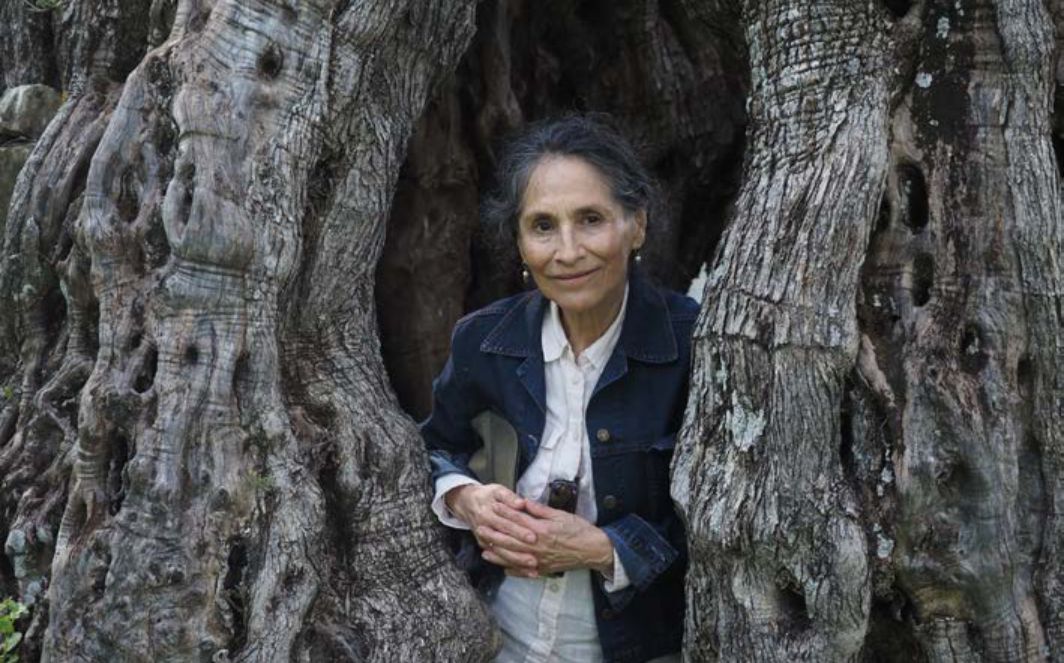
Proof that the terracing of Salamiou is one of the most ancient in the area, was when Argyris pointed out an embedded archaic burial which their team of craftsmen had discovered during drystone repair works, to the drystone walls just west of the village center. They carefully re-sealed the antiquity and are waiting for the Antiquities Department to excavate. We reached a short stretch of Roman road lined on both sides with white irregular slabs and tiled with dense packed white chalk-like stones. This path broke off at both ends where the current tarred road curve cuts into the cliff. We veered to the north-west through dense low brush and abandoned white chalk terraces, where Argyris pointed out a local tradition; former craftsmen would leave cavities in the drystone faces, to be inhabited by birds. We then continued onto a stretch of early 20th c colonial tarred road that had become disused due to severe ground shrinkage. Then onwards still, toa hill slope where the terrain shifted into reddish-purple clay, densely covered in maquis of low Cistus and prickly shrubs. We recalled how in the spring this place was a carpet of gorgeous flowers of all hues. Down from the crest, the carob and olive trees slowly arranged themselves in front of us in random clusters. We stopped to observe a lone, hundreds of years old Terebynth tree that looks as if it is ‘running’ across the field (on Stilettos, chides Vaso). Its roots have grown like muscled limbs, striding over a large boulder, overcoming the stone impediment. Beside the tree is an abandoned two-tiered drystone sheepfold and Argyris explains its layout before the collapse. We decide to keep it in mind for future possible restorative works. Further down and at a bend in the hill, nothing prepares us for the overwhelming experience of entering the grove of living ancient trees. It was as if the hundreds of years old living antiquities greeted us, spread out randomly along the shaded northern slope. Through their NGO Terract, Vasiliki Petropoulou Panayiotou, and brothers Panayiotis and Argyris Panayiotou have been conducting annual workshops at the site for the past eight years or more. Their chief aims are landscape conservation, supporting the soil from erosion around the base of the trees with revived drystone teracing, and careful traditional tree husbandry. It was here that Maruja and Timmi had spoken to us about the landscape during their previous visit in the past spring, not through the formal terminology of landscape quality as historic and cultural, but through the agencies of foodscape, agricology, food sovereignty and biocultural diversity. The site is in immediate need of legal historic landscape status of protection.
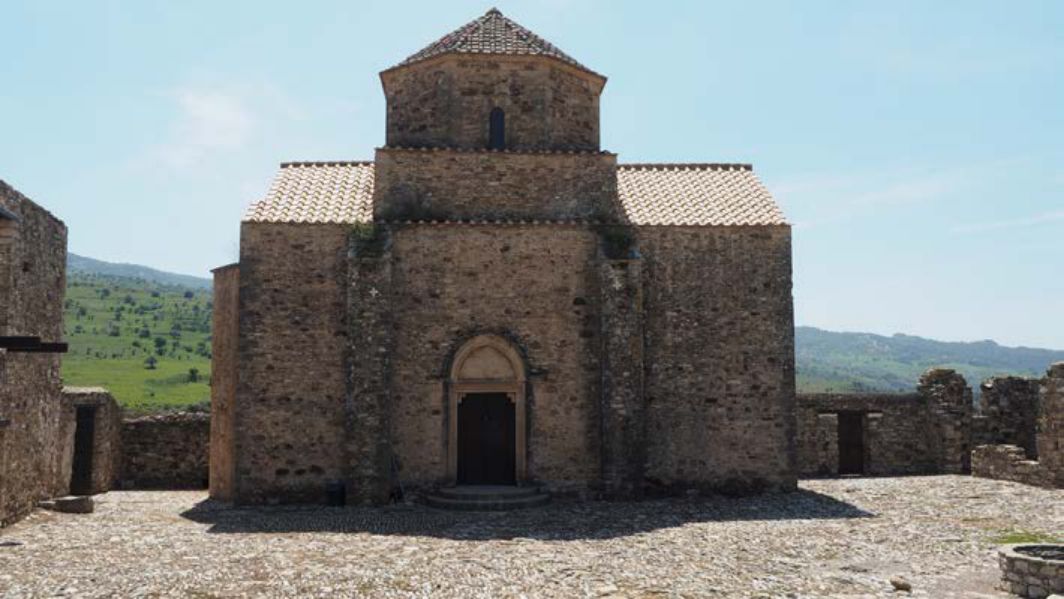
Vasiliki had arrived before and had laid out a spread for us in the shade of the trees, on the colourful and heavy-duty traditional woven rugs (known as kourelloudes, woven from reused strips of cut up fabric). Like the apostles stopping to rest on their journey preaching their way across the island, we snacked on fresh baked koulouri bread sprinkled with sesame, green and black olives and water cooled in clay jugs.
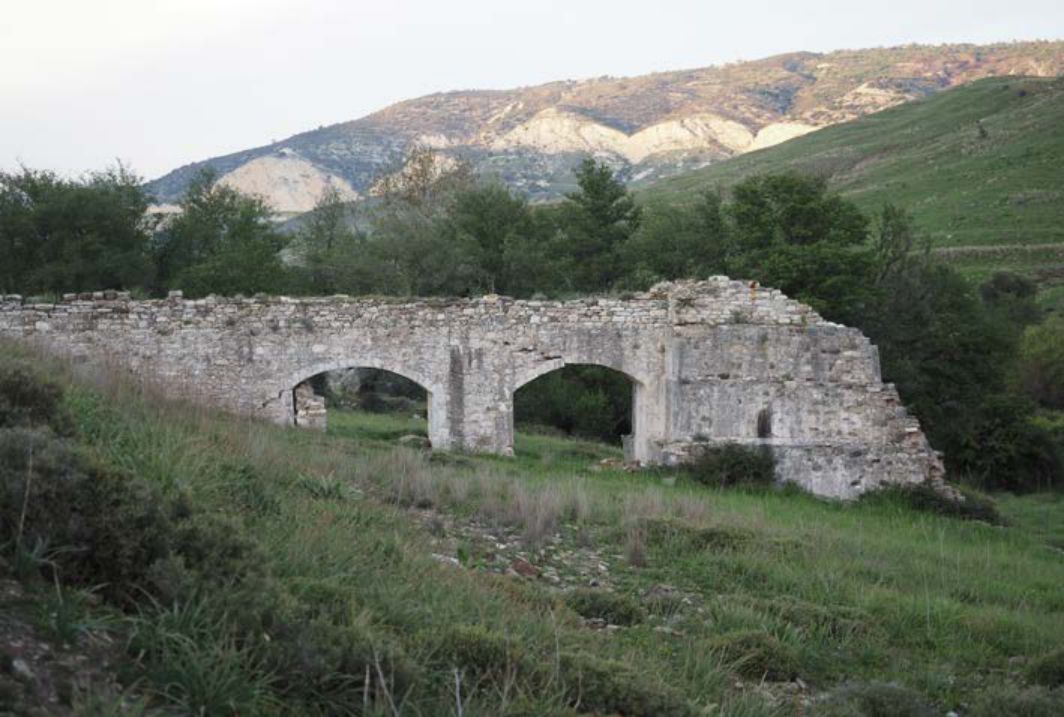
Below the olive grove, extended the seasonally dry Xeros river, accentuated by large scale medieval irrigation works; grinding mills, threshing floors, farm ruins and water channels, as well as shrines and even a beautiful historic monastery set between a fork of the river and dedicated to The Benevolent Virgin of Sindi. The word derives from the Greek word ‘συντέλεια’, meaning ‘impending deluge’; the location of the monastery landmarks through its name as well as constructed drystone embankments, its actions that appeased the once raging torrential water forces flowing beside it.
Jeeps carried us onwards to the 800-year-old Cypress tree locally named Kyparissos, since 2008 a favourite spot for screenings during the summer Animation Festival. The lunch spread included ravioli, yoghurt, wine-cured sausages and fresh tomatoes, and from there, we drove to 16th c. Salamiotissis monastery, where there is another rare ancient tree, this time an indigenous Στερατζιά (Styrax officinalis), also of enormous ecological, pharmaceutical and traditional significance. The tree was voted 2018 Forestry tree of the year. In the monastery courtyard there are also scattered stone implements of an ancient olive press. Tradition has it that if one is to crawl through the ‘eye’ of one of the pierced monoliths (serving as a lever stabilizer in the ancient press), bad luck will be overcome. The monastery sisters are engaged in preparing hieratic vestments and golden embroidery as well as traditional sweets and other local herbs and delicacies.
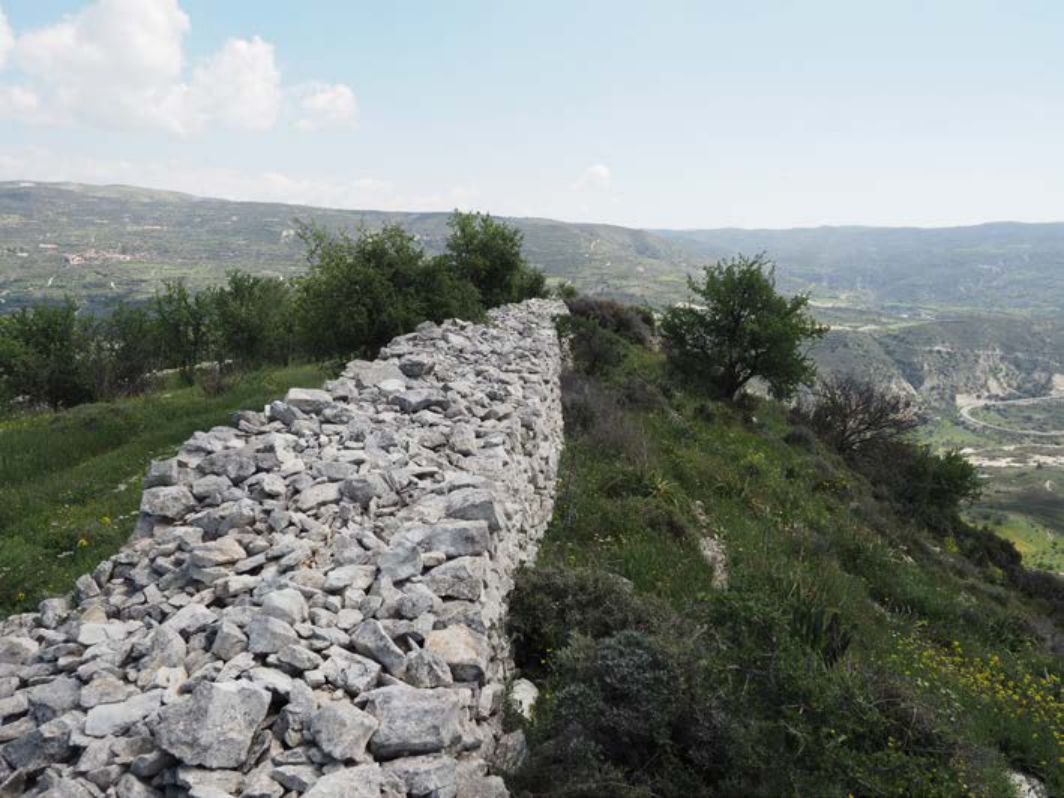
By now it was afternoon and we still had two more sites to visit. Next was the impressive ‘wall’ of Salamiou in the Lakria locality, facing east and overlooking the broad Diarizos river. This is the largest body of fresh water on the island, now tapped and confined in wide pipes. The impressive drystone construction, about 400m straight in length on the south side, straddles the white chalky terrain at the boundary between Salamiou territory and that of neighbouring Kedares village to the south-east. No one remembers who built this wall, or why the encircling hilltop was enclosed in an elongated terraced area. The wall to the south is like a fortification, over 1.5m wide and about 1.8m high at its tallest point. The surface is made of densely compacted small stones, while the edges are articulated with firm dressings. Beside us on the hill, stalks of Scylla maritima were waving in the afternoon breeze, and St. John’s Wort, (Σπαλαθκιά in Cypriot, Bαλσαμόχορτο in Greek), was still ablaze with yellow flowers. (The spring carpets of bright pink orchids were long gone).
We were told that in the fires of 2015, the village menfolk battled the raging fires approaching up the southern hill crest taking cover from the safety it provided. The terrace construction helped them to hold back the onslaught of the fire.
The north-facing encircling terrace walls, are similar in build but lower. The enclosed area is itself further terraced, although cultivation is now abandoned due, we were told, mainly to lack of water. Repairs to the fallen segments should be undertaken and a proper archaeological survey should be conducted to ascertain the date of construction of this unique agrarian, drystone, fortification-like construction.
Our last stop was at Aetomoutti (Eagle peak) to enjoy Salamiou’s panoramic views and the sunset over the Xeros river facing west. The site is a known nesting home to eagles which the local community together with government agencies are trying to revive.
Vaso had again prepared us a final and fitting treat; we drank to the future of Salamiou, to each other, and to the success of our future ventures with shots of one of Lagria’s finest sun-kissed desert sun-dried wines, the Foinike.
Thursday 2nd November
Citizen Participatory Activity and Closing session: “Salamiou speaks”
The closing session, where all the community’s residents were invited, was guided by Artemis Yiordamli, director of Laona Foundation. The event was held at the community center in an open and inclusive discussion with all those attending respectfully and reflectively listened to, and with those attending voicing their pride, love and connections to their village, its fertile terraced lands, their concerns about threats their community faces, but also opportunities and strengths.
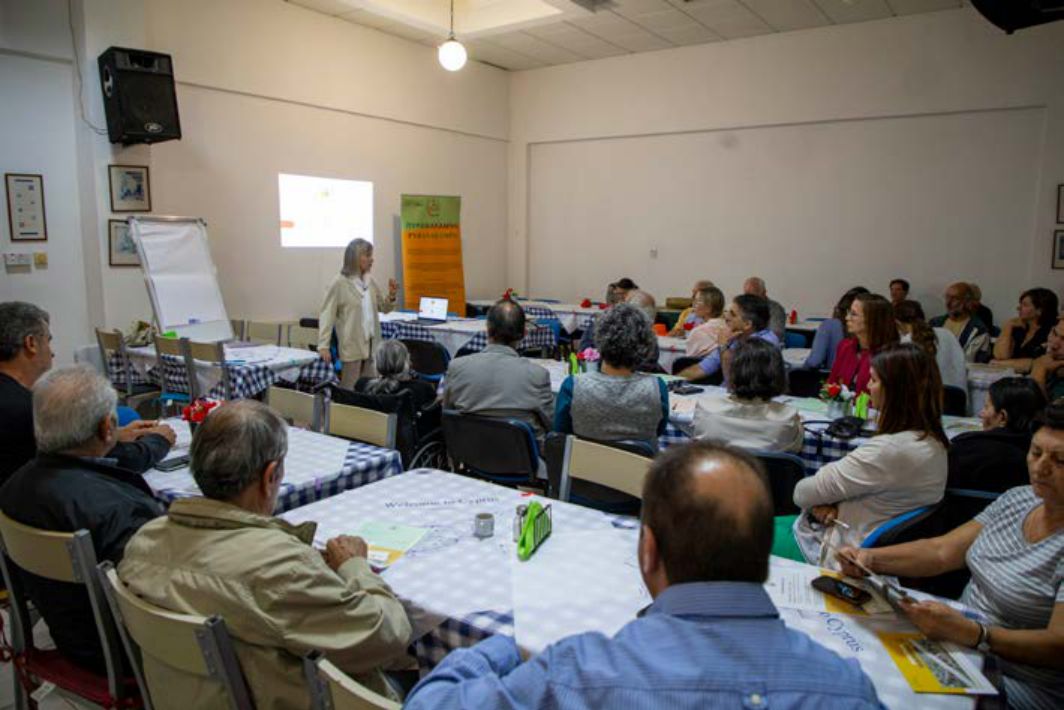
The session was conducted as an open discussion of the community, and the wide representation of residents of Salamiou were encouraged to share their knowledge of their village, in what is known as a SWOT method. The discussion is grouped around topics which concern Strengths, Weaknesses, Opportunities, and Threats that the community faces. This is an effective way of bringing together diverse members that would otherwise rarely meet in a non-hierarchical setting. Older farmers of the community attended, together with the village youth; teenage boys and girls still in school, listened and participated; residents from the left to the right of the political spectrum took part. Teachers, the village priest, but also women of all ages, were represented, including Mrs Foinike, who is close to her nineties, a farmer herself, and wife of the former priest Papa Georgis. She has lived and contributed to Salamiou all her life. In the first part of the session, the local people’s opinions on the four (SWOT) topics were noted down by the Laona Team on a flip chart, as another team member documented minutes on the computer. In the 2nd part, the locals were encouraged to voice what they would like to see as a future for their village, from the smallest suggestion to more visionary ambitions. All proposals were noted down, both on the flip-chart, engaging the audience, but also written up in a digital document.
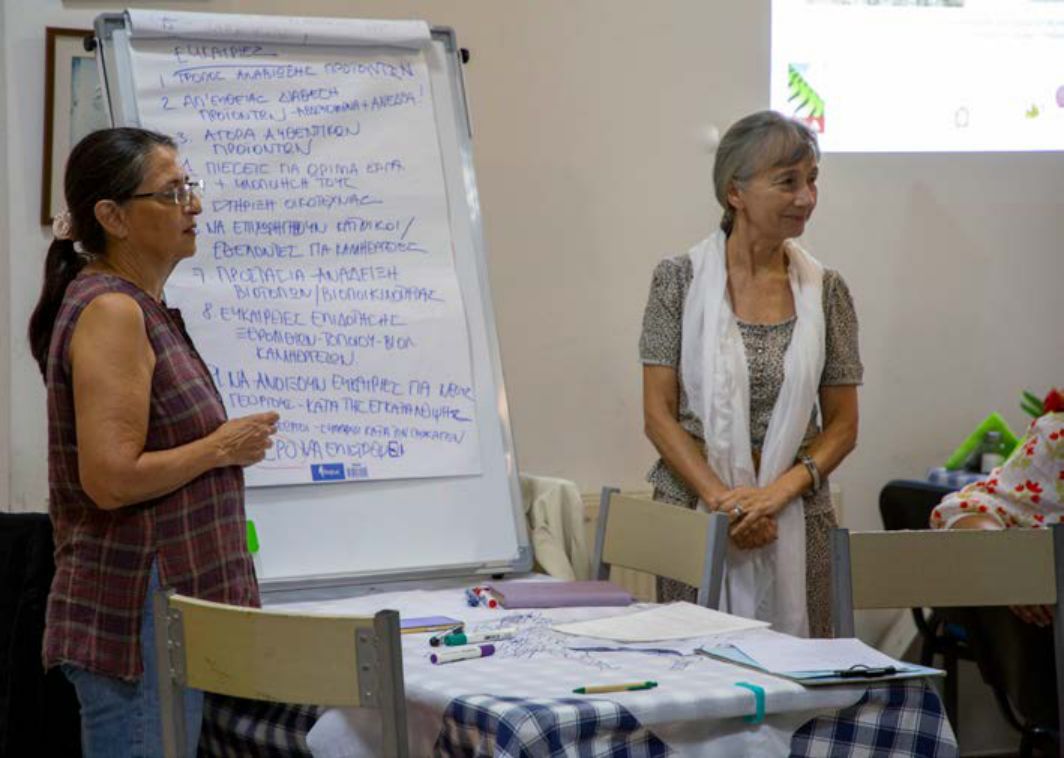
All suggestions were next discussed, and separated according to complexity and possible cost, into actions that can be immediate, mid-term or long-term.
The choices were then put to an open vote to all the members of the community. In the following days, the minutes of the meeting will be completed and delivered to the head of the Community in the form of a report that formally documented the meeting, with who attended and what was discussed. The Community Council can use this document to approach local district authorities with tangible proposals in writing, as well as to request assistance from possible other organisations.
The discussion revealed that the greatest daily difficulty which the community faces is diminished public transport, with no bus to the nearby town past 3 pm, leaving children of school age either isolated or made to move out of the village together with their families. However, the greatest threat that transpired was that common water, belonging to the village from the Diarizos river has been systematically diverted for over 20 years (!) to the drier east of the island (which provides potatoes but also commercial summer tourism). Following protests from the village, about 10 years ago, a new agreement was drawn up by government departments. Promised reconstruction and upgrading of water infrastructure, the village beneficiaries signed over their water rights, believing this to be a temporary measure until the works were complete and water was returned to them. However, this resulted in a full transfer of their water rights to the government system, and their resource has effectively never been returned. For over a decade official promises to take back their share of water have not been honoured. This has led to abandonment of many fertile terraces and loss of livelihoods of farmers who used to produce cherries, walnuts, legumes, lentils, etc. This depletion of water has further led to a cease in the transfer of knowledge between older farmers and the next generation who have had to seek jobs elsewhere. It is inconceivable that there are government programmes which endorse drystone terraces as intangible UNESCO world heritage on the one hand, while other departments quash the intangibility of unique and particular farming and irrigation knowledge, depriving the living community’s intangible heritage. Particularly given that this community still wants to continue its terrace farming tradition because they recognise and evaluate their lands, their way of life and livelihoods as the only viable sustainable way which can provide for their future. The community realised that they probably need legal assistance but also possibly further support from the organisations which have sponsored their 1st International Day of Terraced Landscape event.
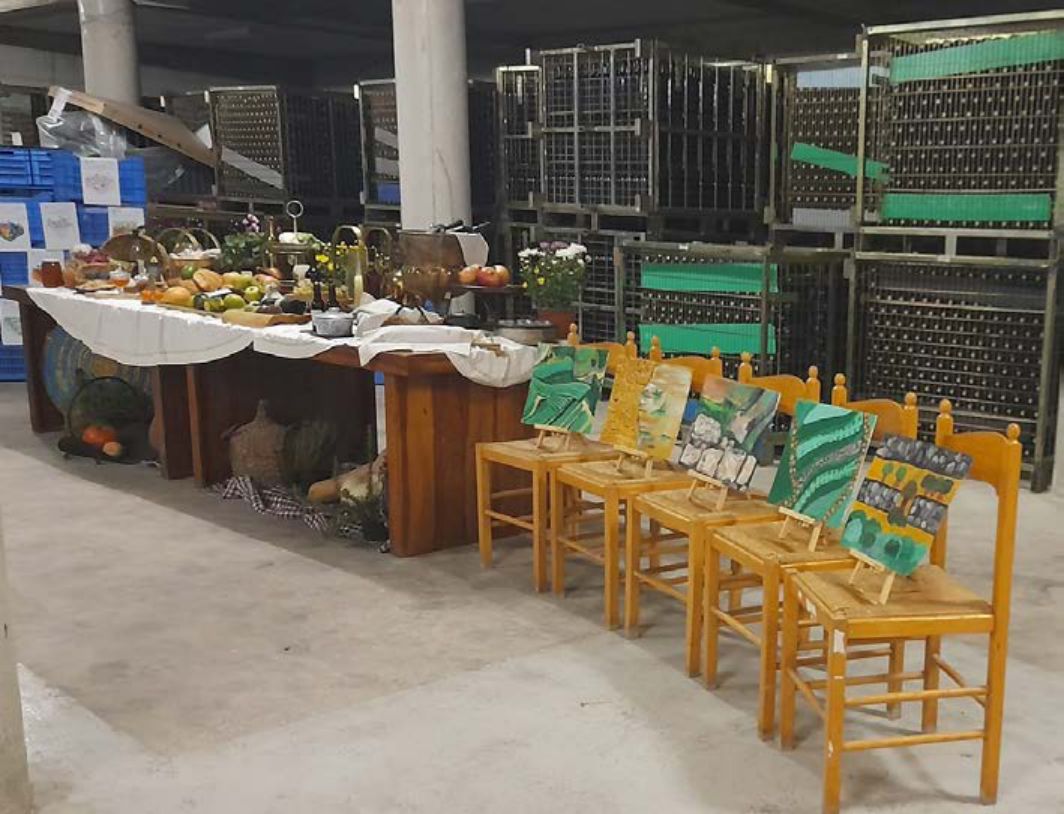
Closing exhibition at Lakria winery
The evening ended at the multi-family owned Lagria winery in the village outskirts where we had earlier helped Vassiliki to set up an exhibition of our six, full-packed days of different activities. Pride of place was given to the photographs of terraces by Glyn Edwards and his team of photographers. Artwork of youths and the children’s terrace related education activities were also displayed, as was a selection of photographs of birds of the area (living in and around the terrace habitat) previously compiled by BirdLife Cyprus. The imagery, together with a display of the cornucopia of fruit, produce and delicacies of the land, served to portray the full living environment of the area that has been living in harmony with the convivial human toil, and that has historically shaped the areas cultural intangible heritage.
Acknowledgements
Huge thanks for the support of ITLA. Thanks for all the financial support we were given by the Pancyprian Organisation of Heritage, by Laona Foundation, by the Cyprus Scientific and Technical Chamber, and the Cyprus Architects’ Association. Also sincerely grateful to Irene Raab Marancos of Çader women’s organisation of Ayios Epiktitos (and the late Martin Marancos of the Cyprus Environmental Initiative) and also to Salih Gücel for continuing in our collaborative efforts. The Turkish Cypriot presentations of the environment challenges they face across the island have made us consider that environmental degradation such as fire and climate challenges pay no heed to political or military borders. Our thanks also reach out to many individuals from Salamiou, from its mayor Mr Kostas Avgousti but also to the farmers and stone masons of the village, primarily Panayiotis Panayiotou and Argyris Panayiotou, and their families who embraced our actions and selflessly offered all assistance. Particular thanks go to the very talented Andri Panayiotou, nursery school teacher and ‘wise woman’ of Salamiou, its histories of cultivation, and to her creative way of involving toddlers. To Stelios Kedaritis and his children who enlivened the terrace building event by bringing along their donkey, and by taking part in the discussions. Special gratitude goes out to Yiorgos, Melina and Andrea Papageorgiou, our teenage participants, who were with us at every step of the way, clearing and preparing the educational activities, helping in terrace building, taking part in the discussions about the future of their village and actively engaging for their own future in their community. Together with other young people of the village, their participation in the discussion was perhaps the first time that they became aware of what their village faces. In the ‘SWOT’ session they actively requested that they be included in decision making processes which concern village youth. Many thanks also, to photographer Glyn Edwards not only for the wonderful landscape pictures of the area taken with his team for the exhibition, but also for his tireless photographic documentation of all our activities that now inform our archive, to be used for future actions. Also, to dearest Carolina Teodorescu, graphic designer, for the uploading of beautifully edited social media postings, and the final poster. Particular thanks to architect Ioannis Koutsolambros, who forwarded our activities to the local press, and spent a day building with us, but also funded the coloured pens for the children’s activity. Because of the community’s initiative and support, the support of ITLA but also local heritage, environmental and architectural organisations and volunteers, we can now confidently plan for following activities, one of which will be to exchange terrace building expertise across the Island’s divide. Of course, the final applause and respect must go out to Vaso Petropoulou Panayiotou, of Terract; her vision, expressed through excellent food, quality hospitality, organisational skills but primarily her deep-felt care for the life of Salamiou made us see what she and her family see, live and create, by holding onto their terrace heritage.
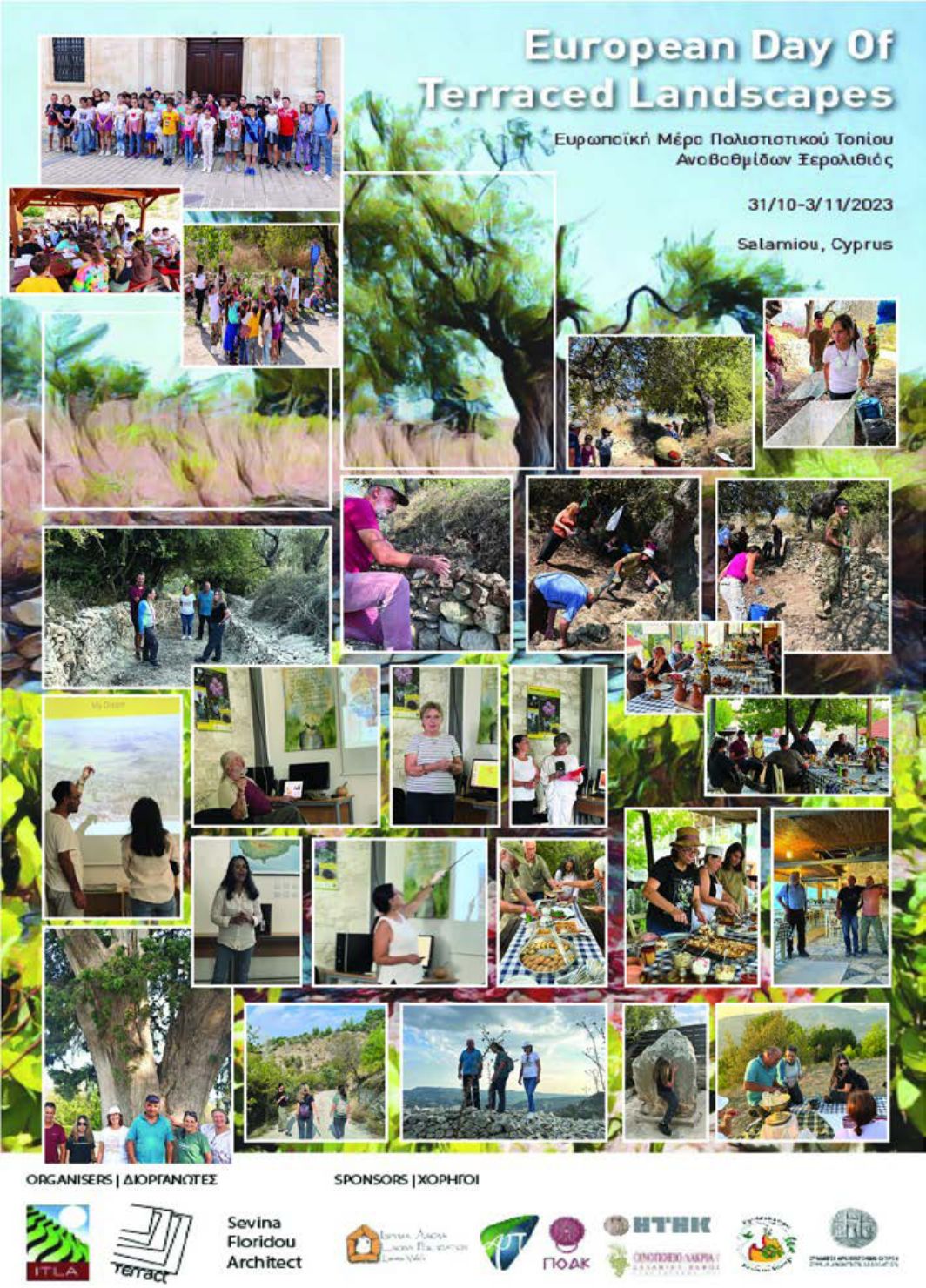
On the occasion of the European Day of Terraced Landscapes, and under the framework of the International Terraced Landscapes Alliance, Terract hosted a conference and a series of workshops highlighting the importance of terraced and drystone rural heritage.
The events took place in the village of Salamiou, in the Paphos district, from October 28 to November 2, 2023.
Organisers: International Terraced Landscapes Alliance – (ITLA), Terract, Laona Foundation for the Revival and Preservation of the Cypriot Rural areas and Sevina Floridou, Heritage Architect Under the auspices of the Pancyprian Organisation of Cultural Heritage (ΠΟΑΚ), the Scientific Technical Chamber of Cyprus (ETEK), Paphos Development Company -Aphrodite (ΕΤΑΠ) and the Cyprus Architects Association (CAA)
Rights and permissions
Open Access. This article is licensed under a Creative Commons CC BY 4.0 license, which permits use, sharing, adaptation, distribution and reproduction in any medium or format, as long as you give appropriate credit to the original author(s) and the source and indicate if changes were made.
About this article
Cite this article
Floridou, S. (2025). European Days of Terraced Landscape (EDTL) 2023. International Terraced Landscapes Alliance Journal, 3(2), 26–67.
- Published
- October 2025
- Issue
- Volume 3, Number 2
- Journal
- International Terraced Landscapes Alliance Journal, ISSN 2754-7639 (Online)