
Perspectives of women at the forefront of pre-Inca terrace stewardship in Central Peru
Affiliations
- 1 Independent researcher, Canada
- 2 University of Guelph, Canada
- 3 School of Environmental Design and Rural Development, University of Guelph, Canada
- 4 Independent hydrogeologist, Huelva, Spain
International Terraced Landscapes Alliance Journal volume 2, issue 2, pp. 34–53 (2021) · Cite this article
- 224 views
- 179 downloads
- DOI10.5281/zenodo.8081232

Abstract
This article highlights the experiences, struggles, sentiments, contributions, and reflections of four diverse women representing four rural Andean communities in Central Peru. Women take on various roles as leaders, innovators, protectors, and knowledge holders of terraced agricultural systems in Central Peru. The four communities are situated within the Nor Yauyos Cochas Landscape Reserve (NYCLR), which comprises twelve districts and communities in total (SERNANP, 2011). The women who agreed to participate in interviews for this research do not represent one particular female view of rural Andean terrace livelihoods but offer four distinct perspectives. The interviews demonstrate intersectionality as they represent different age groups, ethnic or Indigenous backgrounds, education levels, family life, and lived experiences.
Keywords
- terraces
- community resilience
- heritage conservation
- Andean worldviews
- women's knowledge
The four communities (Figure 1) are situated within the Nor Yauyos Cochas Landscape Reserve (NYCLR), which comprises twelve districts and communities in total (SERNANP, 2011). The landscape reserve was established in 2001 to protect the rich natural resources found in the region, and programs and strategies were implemented to conserve biodiversity, promote scientific research, encourage eco-tourism and ensure food security, water protection and clean air for local communities (Government of Peru, 2019; SERNANP, 2011).
The four women who agreed to participate in interviews offer four distinct perspectives on rural Andean terrace livelihoods. Permission was granted by the interview participants for this publication.
The interviews are part of Sampoorna Bhattacharya’s M.Sc. thesis titled “Heritage-led Planning for Rural Community Resilience: Terraced Landscapes in Peru”. Research was conducted between January and May of 2020 and was entirely online due to COVID-19. She employed three methods: semi-structured key informant interviews; participatory video; and collaborative GIS mapping. The interviews were conducted in Spanish and translated and interpreted in-situ by Dr. Silvia Sarapura to produce English scripts. The article concludes with reflections from the perspectives of the authors Sampoorna Bhattacharya, Silvia Sarapura, Regan Zink, and Jorge Novo.
As an outsider to Peruvian culture and the research communities, the researchers ensure that the research was guided by leaders from Peruvian organizations including The International Potato Centre (CIP) and Servicio Nacional de Areas Naturales Protegidas por el Estado (SERNANP). This research is the product of ongoing collaborations between the graduate program of Rural Planning and Development at the University of Guelph and Andean communities in Peru.
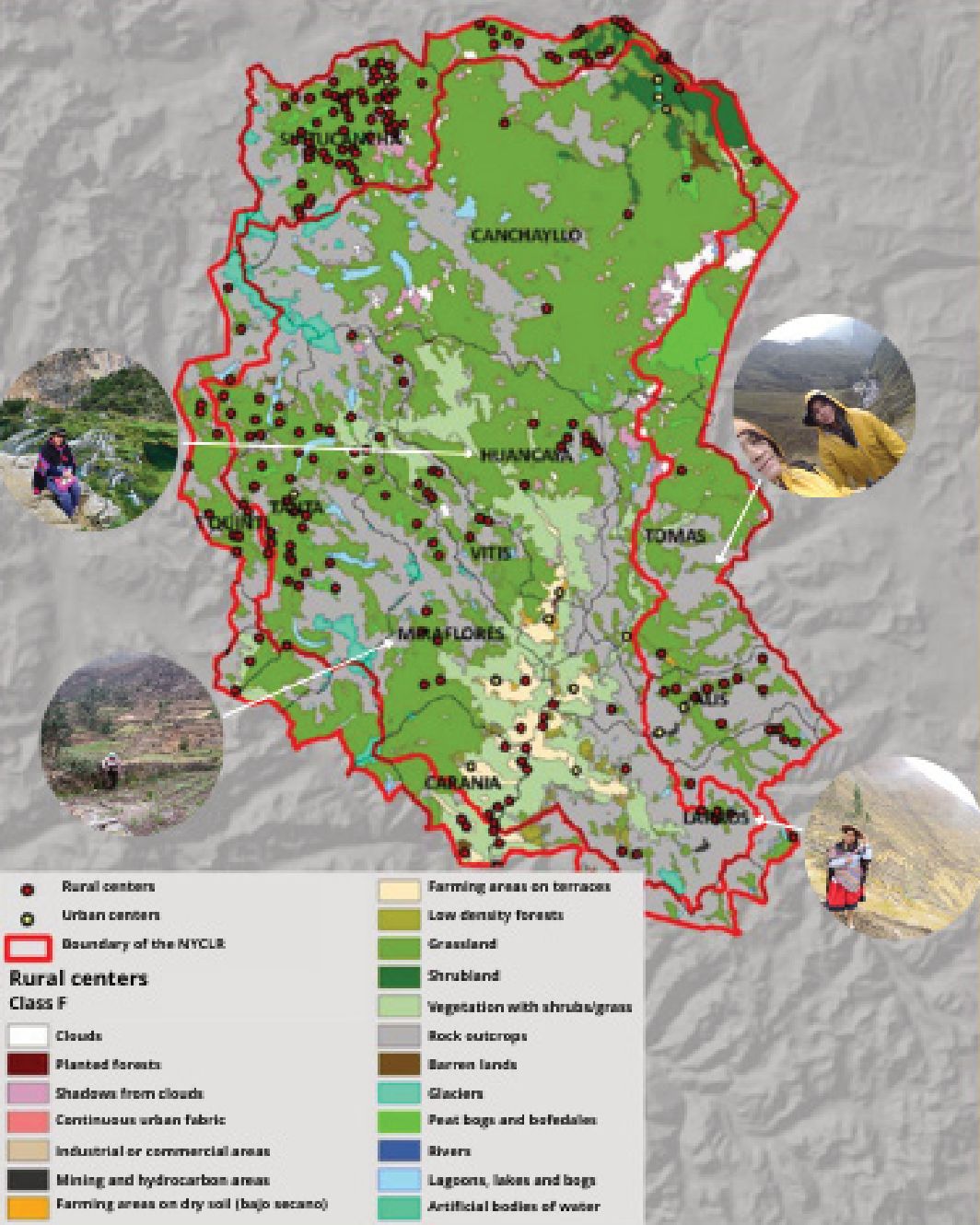
Location of the communities of the 4 interview partners
The NYCLR is located in Central Sierra, or mountainous region of Peru, and expands over 221,268.48 hectares (SERNANP, 2011). Of the thirteen communities, terraced landscapes are found in the communities of Miraflores, Laraos, Carania, Alis and Huancaya, and in smaller areas between communities. Figure 1 shows a map of NYCLR and the relative locations of the communities which the four women represent.
In Peru, terraces are classified as Inca and pre-Inca. Existing pre-Inca terraces can be dated back to the Wari period (Guillet, 1987; Londono et al., 2017; Sáez and Canziani, 2020). According to Guillet (1987), the earliest terraces in Peru can be traced back to c. 500 AD. As new cultures and civilizations were formed, existing terrace designs and construction styles were studied and adapted to best suit the new civilizations’ needs (Guillet, 1987). The terraces in the NYCLR communities are known to be pre-Inca terraces which for generations have been maintained by communal effort (World Monuments Fund, 2018).
Diverse perspectives of four Andean women from the Nor Yauyos Reserve
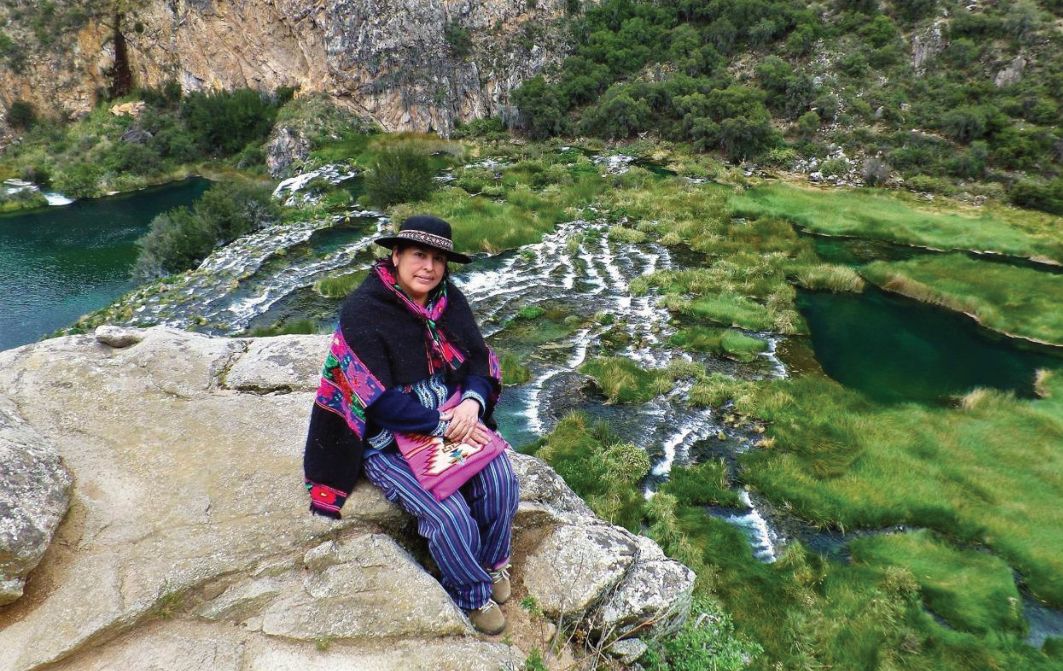
Name: Isabel Lozano Occupation: Tourism Operator and Economist Community: Huancaya
Relationship with terraces: for more than 13 years is the close relationship that I have with Huancaya and the Nor Yauyos Reserve. I am a pioneer in promoting the tourism industry in the area - I inherited it from my dad and we worked together to strengthen the business in Huancaya and in the Yauyos area. My interest and love for Huancaya motivates me to think about the reserve as an ecological place to promote sustainable tourism.
It is something that is ours, it belongs to us and we inherit it from our ancestors. And our obligation is to preserve it for future generations, as others have done.
There is no doubt that the terraces or andenes are part of the cultural heritage of Huancaya. It is part of our own life, of our traditions, it is an economic heritage because it gives us the possibility of having some agricultural and livestock activities and generates income for the community. They will be here forever, because these structures are solid and pass from generation to generation, but it also depends on how we take care of them and improve them.
Can you tell us more about the terraces in Huancaya?
God praise us! Our landscape is beautiful. Through our grandparents… we heard that these came from ancient pre-Inca civilizations, the Wari civilization. We keep the festivals that celebrate the preservation and use of the andenes. For example, on the first day of May of each year, we have a celebration to clean the canals - the cleaning of the ditches - that irrigate the andenes. All the members of the community come to participate in the community activity to clean the canals so that we have water all year round and good production.
As mentioned above, there is some understanding and knowledge about who built the andenes or terraces, the irrigation ditches, and the water collection system. We need some support or action from the central government, from the municipalities to be able to finance studies that allow us to identify which civilization built them, at what time and how to preserve it. We have a museum, and we have information from people who came here and did some research, but it’s not detailed research. We need research that integrates people from different disciplines for a better understanding in the anthropological, sociological and cultural aspects.
Before COVID-19 there were no significant changes in the use of andenes or terraces. However, the community was influenced by the tourist activity that began in 2001 promoted by the participation of my father, tourism began its development. On the other hand, cultivation on andenes or terraces decreased, as they are privately owned, people began to abandon their use.
Now, with COVID-19 and lockdown, people have returned from the city and use the andenes or terraces again. All of this is a life lesson, because we do not value agriculture, terraces or andenes. We had no food, we couldn’t go anywhere else, so we had to cultivate our terraces or andenes; and it is the reason we returned to farming.
For example, I have four terraces where I grow alfalfa, oca, broad beans and potatoes. I dedicated myself more to tourism, because it generated more income; but now I also have to dedicate myself to producing my andenes or terraces.
It rained months ago, our crops were beautiful, and the weather was perfect. But a week ago everything was destroyed. We had a freezing night. And unfortunately, we do not know of technologies to combat these difficulties. We need to have technical information and training to know how to prevent it. The ancestors knew how to do it, but the erosion of the ancestral agro-hydraulic cultural heritage lost that knowledge, we need to recover it.
The second challenge is alternative pest management, because we tend to grow our produce organically. Due to these problems with the weather, we have no choice but to use synthetic fertilizers and pesticides. But we need to have the option to use ecological pest management approaches. We also need knowledge to adopt and bring these technologies to our communities.
These challenges have always existed due to the construction and position of the andenes and terraces. For example, there are andenes or terraces that accumulate more water, and the water filtration is not as it should be. We have rotting crops and we have more damp incidents, and we have to apply industrial pesticides. There are seasons when one area is damaged, and another is not. Because we farm for subsistence, we have to have food all the time, maybe not food to spare, but at least to subsist. There are good years and bad years, and you have to know how to manage according to changes in weather and climate.
In addition to technical support and support from municipalities and the government, there must be productive development projects, financed by NGOs or other international groups. For example, activities such as the Potato Park. The people and communities of Parque de la Papa have been able to preserve and maintain the terraces. But also all these experiences need to be spread to the world. My husband and I are interested in getting involved in this type of activity, so that we can promote, maintain and recover the terraces, and share the experiences of our communities with other communities, and inspire each other.
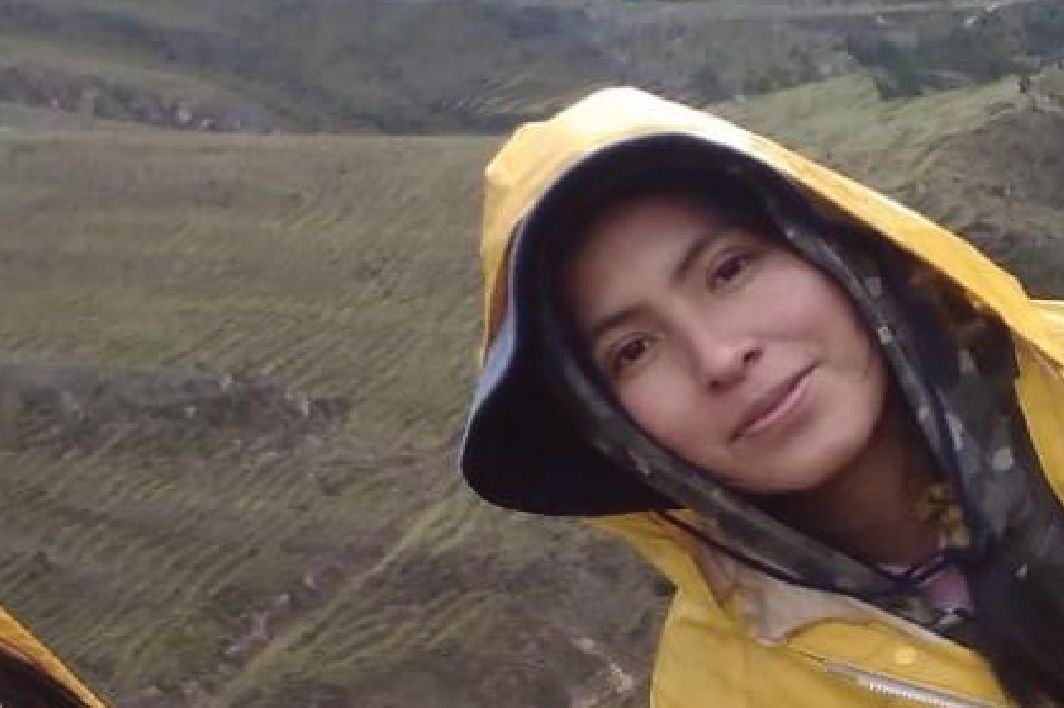
Name: Alexia Obispo Alberto Occupation: B.Sc. in Agronomy Community: Huancachi
Relationship with terraces: The terraces have great significance in my personal and professional life. I grew up with andenes. They are part of my identity and because of my studies, I have learned to value the contribution of andenes to the life of the communities. It motivates me to preserve, take care of, and maintain the terraces. There is a growing initiative that terraces can be more open to the public and to tourism. I want to emphasize that the Nor Yauyos Cochas Landscape Reserve initiative started 11 years ago and it supports the communities to preserve the terraces.
It is a group or a cluster or could be a construction, could be cultural values, that characterize a community and are part of the identity of a community or group of people or individuals. And it is also the responsibility to maintain and to conserve them.
The andenes are part of the heritage and are heritage. Why? Because these are constructions built for civilizations, maybe pre-Inca or Inca civilizations and it is part of our identity and our values. We preserve them thinking about our ancestors, but also considering the benefits for the community because these are a source of food, a source of our livelihoods, and these are part of our life.
Can you tell us more about the terraces in Huancaya?
I remember, the andenes were there when I was born. This means that they existed before me. My ancestors - parents, grandparents, and great grandparents recall that it was an old civilization called Yauyos. From my own knowledge, I understand that Yauyos came after the Incas and before the Spaniards. And maybe it’s a myth but I think that Yauyos emerged as a result of the appearance of three mills – molinos - and Yauyos managed these water mills.
The use of andenes has not changed too much because of the service that terraces provide to the communities. You cannot use modern tools in order to cultivate the terraces, but people still do it, using the barbecho technique and traditional tools like taclla. I think that the purpose of the andenes still has not changed because they still produce the same crops that they produced before.
The main problem is soil erosion which makes the maintenance of the terraces more difficult. This is due to landslides and the effects of climate change.
Until two years ago, nobody supported the maintenance and recovery of andenes. Since 2019, Yanapai has been working with the community and rescuing the native potatoes, and SERNANP is also supporting this. I think that there is a lot to do, because although we have support from Yanapai and SERNANP, I would like to see how we can increase the productivity and the production of native potatoes so we can sell the products everywhere. I would like to see more involvement from the Ministry of Culture to support our capacities to cultivate. For example, in other areas of Huancayo and in the central area, they have support from Agrorural. Agrorural is a program for farmers to become more economically productive, they are able to commercialize their products and promote it to international markets. I would like to see this happen in my community.
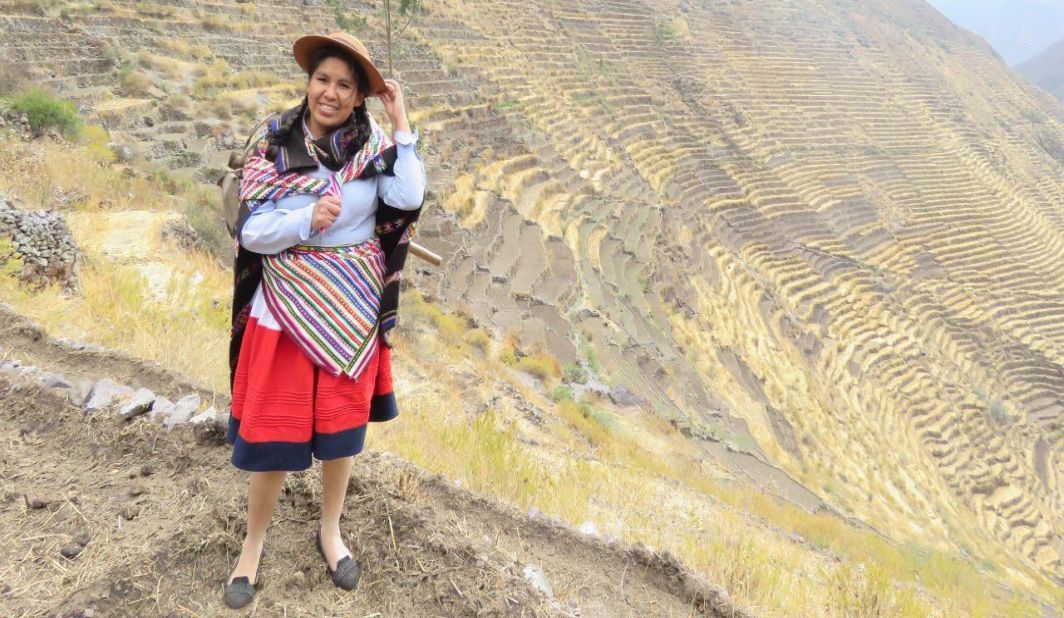
Name: Clara Gladys Meza Gago Occupation: Tourism Operator Community: Laraos
Heritage is identity. And it is the reason why I appreciate what we have here in Laraos. Years ago, I practically ran away from Laraos. I hated the culture, I hated the people, I did not like what we had. When I went to Lima, I started appreciating what we have in Laraos and reflected on my culture and my ancestors, and I came back. I started thinking - I have to appreciate it, but also, I have to share with others how much we have and how much we can value. It is what our ancestors gave us.
For example, in our culture we don’t use pesticides or synthetic fertilizer to cultivate our crops, and everything is healthy here. The landscape is in balance with people and the crops. We have to appreciate that, especially young people, and it is my interest to motivate them and help them to be aware of what we have.
Yes, terraces are part of our heritage because they were brought to us through our ancestors. They are also heritage because they are closely linked to our culture, our values, as human beings, as people who live in this specific space. Therefore I am interested in rescuing and valuing them. People have to know that it is our culture, it is our identity. I also think terraces are part of heritage because of their engineering and structure. The engineering of the andenes requires a high level of thinking and planning. The structures are strong and sophisticated. For example, how water management is done through the acequia go through the walls and through the terraces. I cannot imagine who built that! I am aware they are my ancestors, but am impressed by their understanding of engineering, technology, and design.
The management of and appreciation for the terraces has changed over time. Years ago or maybe in other generations, people took care of the terraces. They worked hard to maintain them because the terraces were the source for food, it was the place that fed families. They could cultivate anything there and it was produced in good amounts and quality. But nowadays, especially young people don’t appreciate the andenes. They think that terraces are the place where I cultivate my crops and that’s it. You can see the difference now between young people and old people. How old people stay, maintain and appreciate the terraces, and young people don’t take care of maintenance and management of the terraces. The older people are constantly checking things like shade, erosion, and rain and they are constantly fixing the terraces.
The main factor that explains why young people do not appreciate the terraces and agriculture activities in the terraces is globalization. If they have to choose a career they choose a career that is not related to agriculture, because agriculture for them is not a career, it is not a source of income. They choose careers that are more profitable and typically not located in Laraos. And so they have to leave town.
Another option if they want to make money is to go into mining as a labourer. They are happy making some money and coming back to visit. They don’t care if the work is steady or not, permanent or not, it is the way that they have some income.
The work in terraces is hard. There are no mechanized tractors or machinery that can enter into the andenes and we have to use only ancestral tools like the chaquitaclla. It requires more work and effort than other activities. But what they don’t value are the advantages they can generate from this activity. The food produced from the andenes can be marketed to an exclusive group in the cities. It can generate more income.
Agriculture production has increased since COVID-19 because people are returning to Laraos. Who are these people? These are pensioners, retired people, but also young people, who were studying in universities but because universities closed, they came back to town and started working in the terraces. They are cleaning the terraces and cultivating. For example, this year there was a lot of production of maize, potatoes, mashua and oca. We are trying to create some awareness among young people about the importance of food and agriculture and they are starting to value and see the difference between here and the cities.
We need integrated efforts and not to work separately or for the interests of certain groups or people. For example, we have a tourism association and there is another association for souvenirs and crafting, but they work separately because they don’t have the support from the local, regional, or national governments. There is also tension between the local government and the community about governance. The community is guided by traditional forms of governance and the government uses formal laws. There is an opportunity to work together, and to talk, to sit down and decide what we are going to do.
Most of the politicians operate from outside but they become authorities in the community without knowing what is happening in the community, what the community wants, and how they can work with community members. They decide about everything, and it is a top-down approach. They have to learn that decisions should come from inside in order to understand and support our interests which include business and entrepreneurship activities with the resources that we have.
My dream is that people become entrepreneurs - that they are educated in entrepreneurship. We want to generate income from what we have. We know that cultivating in the terraces will require a little bit of reimagination. And we do that - we are cultivating flowers and niche crops such as aguaymanto. They are very expensive. What I aim to do is target exclusive markets of wealthy people and people who are aware of good food. I have been doing it since 2012.
For me, it is important to generate tourism, but it requires a lot of capital. For example, we don’t have lodges or hostels. We can give people life experiences and involve them with our life experiences. Now we have started to promote eco-agricultural tourism - we give people traditional clothes, and they go to the field, they cultivate, they dance, they eat the food that they produce. It is the best way to generate income!
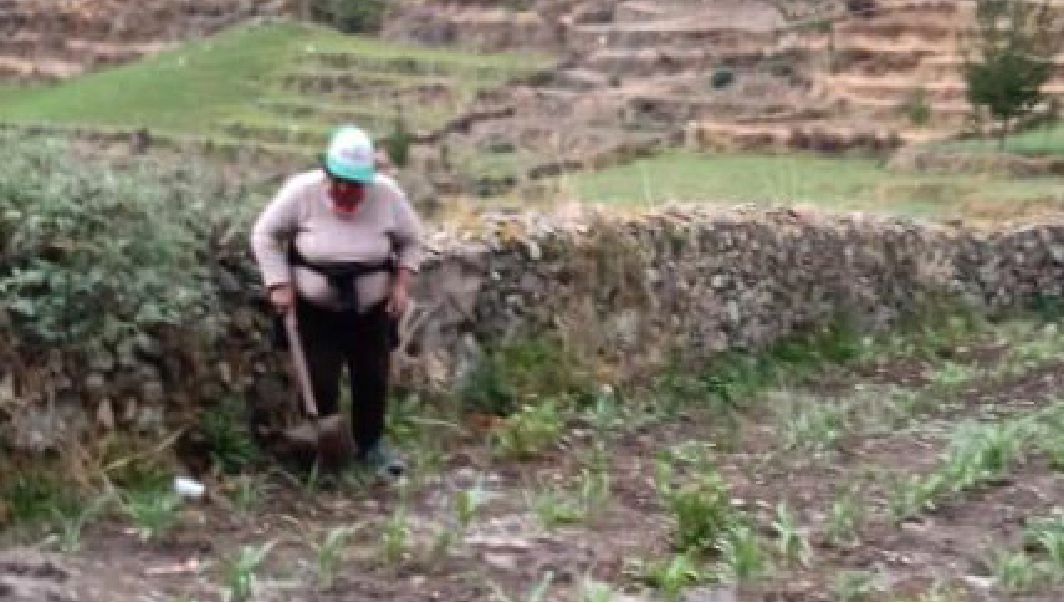
Name: Rita Castillo Flores Occupation: Farmer and homemaker Community: Miraflores
Relationship with terraces:
My main activities on the terraces are agriculture and livestock production. I produce Andean crops - oca, mashua, potatoes, and maize. I also raise alpacas and llamas. Llama are used for cargo - to transport the harvest, seeds, manure, and fertilizers. We use natural fertilizers, no artificial or synthetic fertilizers or pesticides, everything is natural. From the alpacas I use the wool. We also consume llama meat.
Herencia - what we got from our ancestors. For example, we value our biodiversity and the structures. The andenes serve us and are a source that helps us maintain our history. Miraflores is a small Machu Picchu - we have the best andenes. And this also came because we value what our ancestors left us, we fix and value the andenes, and we produce our food from them.
(The previous name of Miraflores is Huacis): Huacis is an Aymara term... it means the ‘town of warriors’. Most of the language that we use, or that my ancestors spoke was Aymara.
Since COVID-19 people have come back to Miraflores. Because of the lack of jobs and other limitations in Lima, they came back and they are cultivating the land and some of them are harvesting now. Terrace use increased to 40 to 50%, an increase of 10 to 30%. Elders that came back from Lima will stay in the town, because they realize that they have a piece of land. Life is simple and healthy in the community and they are saying that they are going to stay after COVID-19. Before they were in some ways obligated to go to Lima to support their children and to stay with their children, but now they realized that it is a better life in Miraflores. On the other hand, youth will have to go back to Lima, because they study there, they work there, and their lives are there. It is difficult to tell them to stay here, because there is nothing to do, only to work in agriculture.
One is that we don’t maintain the canals, the acequias, because there is a lot of uncertainty. We don’t have the rain we had before. We have rain from November to March, but last year’s rain came in December for a few days and then it stopped. Now we have some rain but it is not as regular as it was before. We don’t have water - the rivers, the springs, and the lagoons (cochas) are dry. This leads to the second point. The other main problem is climate change.
The support that we need is to educate our youth, our children, to incentivize them to love what they have and to identify themselves with their culture and their traditions. They have to identify themselves with their community and it would also be very valuable for us to see them do that. When they identify with the community, they will see themselves in the andenes, in el camino (the road).
We don’t have any support from the government or NGOs. We have the Huacis, the ruins, and it is not only Huacis, we have more ruins. The irony is that the ruins are considered heritage but nobody has done anything to maintain them or promote tourism with them. The worst is that because nothing is done, it is full of trees, shrubs, and vegetation. It has been destroyed by nature and they say don’t touch, it is natural heritage. This could be a good source of tourism - the Huacis, andenes. But unfortunately, we don’t have funding to maintain, to preserve, and to make these more visible.
Conclusion
The four women interviewed face distinct struggles to preserve their heritage and natural resources as they navigate forces of change within and outside of their communities. They are passionate leaders striving for endogenous development. Their love and contributions to their communities make them ideal role models for younger generations, especially rural female youth who encounter limitations to study or pursue careers related to agriculture, natural resources management, and business management and engineering in local contexts. Isabel, Alexia, Clara, Rita, and many other Andean women lighting the way forward for their communities and their cultures. Our chance to support them is now, by sharing their success, promoting and partaking in their ventures, and mobilizing their efforts around the world.
The team
We are an interdisciplinary team of researchers based out of Canada and Spain. We share a common interest for endogenous governance, community resilience, participatory methods, and collaborative research. As a team and individually, we are inspired by and grateful to Isabel, Alexia, Clara and Rita for sharing their experiences and knowledge, and for giving us their trust.
References
- Bhattacharya, S. (2021) Heritage-led Planning for Rural Community Resilience: Terrace Landscapes in Peru. Master's thesis, University of Guelph. Available at: https://atrium.lib.uoguelph.ca/xmlui/handle/10214/26351 (Accessed on: 22 January 2022)
- Dourojeanni, P.; Giada, S.; Leclerc, M. (2014) Evaluación de Vulnerabilidad e Impacto del Cambio Climático en la Reserva Paisajística nor Yauyos-Cochas y su zona de Amortiguamiento. Lima: Fundación para el Desarrollo Agrario (FDA) dela Universidad Nacional Agraria La Molina (UNALM). Available at: https://www.globalsupportprogramme.org/sites/default/files/downloads/via-espaol.pdf (Accessed on: 5 January 2022)
- Lima Government of Peru (2019) Reserva Paisajística Nor Yauyos Cochas. Available at: https://www.gob.pe/institucion/sernanp/informes-publicaciones/1833915-reserva-paisajistica-nor-yauyos-cochas (Assessed on: 19 December 2021).
- Guillet, D.; Browman, D.L.; D'Altroy, T.N.; Hunt, R.C.; Knapp, G.W.; Lynch, T.F.; Mitchell, W.P.; Oliver-Smith, A.; Parsons, J. R.; Quilter, J.; Sherbondy, J.E.; Treacy, J. (1987) Terracing and Irrigation in the Peruvian Highlands, Current Anthropology 28(4), pp. 409—430.
- Londoño, A. C.; Williams, P. R.; Hart, M.L. (2013) A change in landscape: Lessons learned from abandonment of ancient Wari agricultural terraces in Southern Peru, Journal of Environmental Management 202/3, pp. 532—542.
- Sáez, E.; Canziani, J. (2020) Vernacular architecture and cultural landscapes in the Sondondo valley (Peru), in The International Archives of the Photogrammetry, Remote Sensing and Spatial Information Sciences, Volume XLIV-M-1-2020, 2020 HERITAGE2020 (3DPast | RISK-Terra) International Conference, 9—12 September 2020, Valencia, Spain, pp. 175—180.
- Republica del Peru (2011) Reserva Paisajistica Nor Yauyos Cochas. Plan Maestro 2006-2011. Lima: Instituto Nacional de Recursos Naturales – INRENA. Available at: https://old.sernanp.gob.pe/sernanp/archivos/biblioteca/publicaciones/R.P._Nor_Yauyos/Plan%20Maestro%202006%20%202011%20RP%20Nor%20Yauyos%20Cochas.pdf (Accessed on: 29 December 2021).
- World Monuments Fund (2018) Laraos Terraces. Available at: https://www.wmf.org/project/laraos-terraces (Accessed on: 6 January 2022).
Rights and permissions
Open Access. This article is licensed under a Creative Commons CC BY 4.0 license, which permits use, sharing, adaptation, distribution and reproduction in any medium or format, as long as you give appropriate credit to the original author(s) and the source and indicate if changes were made.
About this article
Cite this article
Bhattacharya, S., Zink, R., Sarapura-Escobar, S., & Novo, J. (2021). Perspectives of women at the forefront of pre-Inca terrace stewardship in Central Peru. International Terraced Landscapes Alliance Journal, 2(2), 34–53. https://doi.org/10.5281/zenodo.8081232
- Published
- December 2021
- Issue
- Volume 2, Number 2
- Journal
- International Terraced Landscapes Alliance Journal, ISSN 2754-7639 (Online)
- Archive
- Zenodo record 8081232
- terraces
- community resilience
- heritage conservation
- Andean worldviews
- women's knowledge


