
From world heritage to an international living networks alliance
Affiliations
- 1 International Terraced Landscapes Alliance (ITLA)
International Terraced Landscapes Alliance Journal volume 1, issue 1 (2020) · Cite this article
- 233 views
- 200 downloads
- DOI10.5281/zenodo.5205429

Abstract
This communication will consist of two parts: The first part is about the Honghe Hani Rice Terraces classified as a World Heritage Site (WHS), reminding the importance of the First Terraced Landscapes Conference, in which the author has participated, that led to this prestigious recognition and was the very foundation of the International Alliance for Terraced Landscapes (ITLA).
This first part also raises the consequent issue of mass tourism and tourists’ accommodation in native villages and argues a “Living Heritage” vision for conservation and sustainability.
The second part invites us to think about the best ways for organizing a thematic international alliance. A pragmatic approach will lead us to draw up the concept of “Living Networks Alliance” which could be applied to other international movements or networks.
Keywords
- World Living Heritage
- Hani Terraces WHS Issue
- ITLA Organization
- Living Networks Alliance Concept
World Heritage site. It is undoubtedly a great acknowledgement to the Hani and Yi
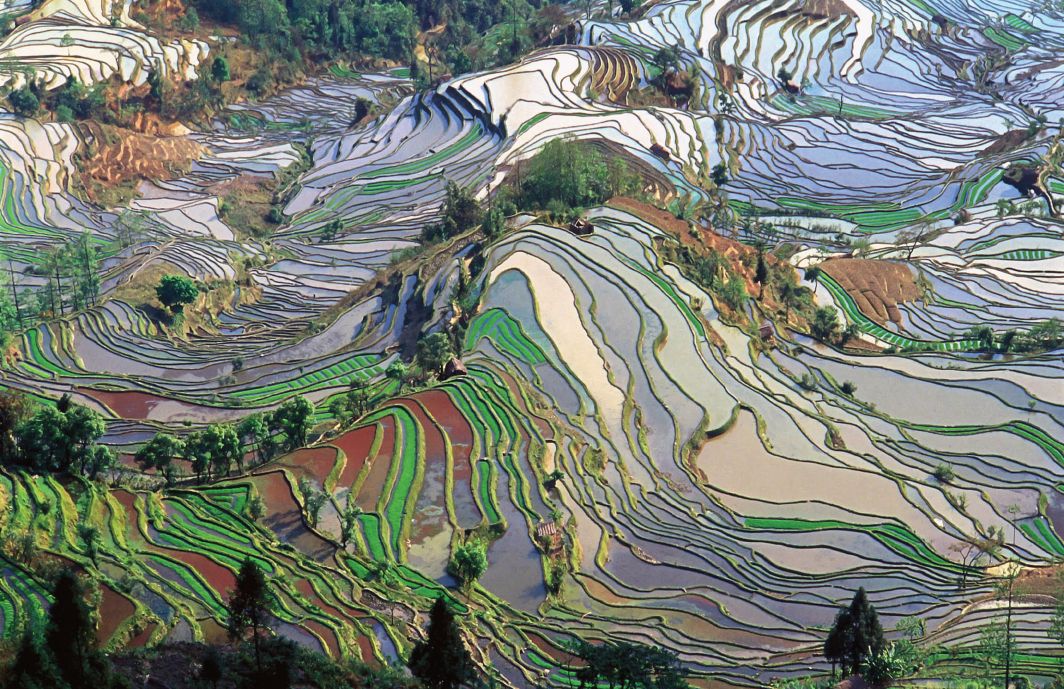
1. Towards World Heritage: the Honghe Hani Rice Terraces
peoples, placing to the highest level their incredible art for landscaping terraces. “The Cultural Landscape of Honghe Hani Rice Terraces, China covers 16,603-hectares in Southern Yunnan. It is marked by spectacular terraces that cascade down the slopes
This wonderful threatened heritage also highly raises consciousness about the necessary of the towering Ailao Mountains to the banks of the Hong He (Red River). Over the
preservation of all threaten terraced sites around the world and helps to demonstrate the past 1,300 years, the Hani people (and their neighbouring ethnic groups like Hmong,
key relevance of terraced landscapes for geo- and biodiversity conservation at global level. Yi, Yao, Zhuang and Dai) have developed a complex system of channels to bring water
Consecuently, at the end of this first conference, it was decided to create an International from the forested mountaintops to the terraces. They have also created an integrated
Alliance for Terraced Landscapes as discussed further in this communication. farming system that involves buffalos, cattle, ducks, fish and eel and supports the production of red rice, the area’s primary crop. The inhabitants worship the sun, moon,
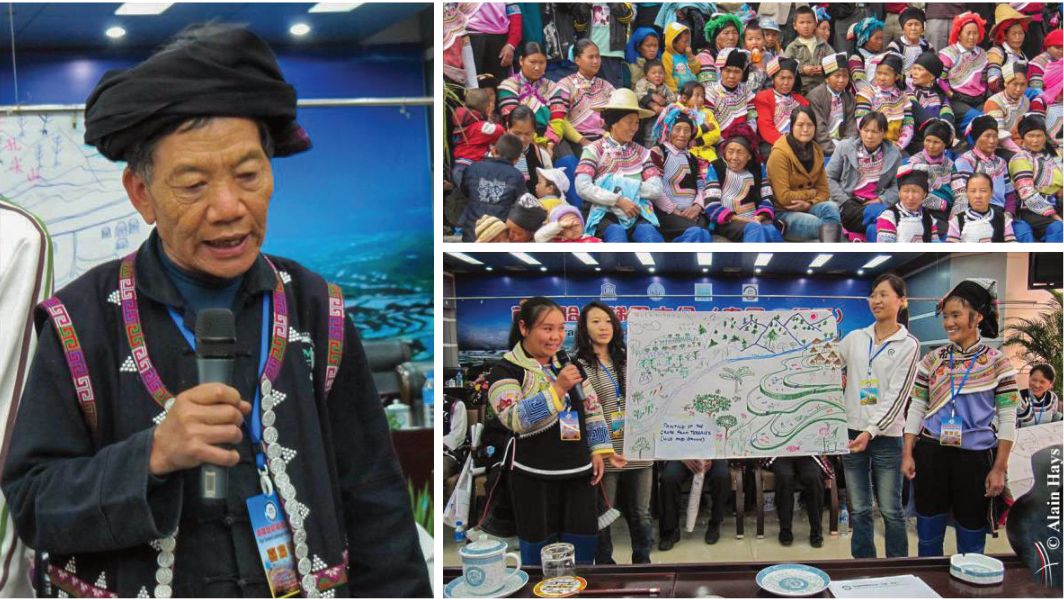
1.1 Giving the Floor to Hani and Yi People
mountains, rivers, forests and other natural phenomena including fire. They live in 82
During the event, a special attention was paid to the inhabitants, giving the floor to villages situated between the mountaintop forests and the terraces. The villages feature
Hani and Yi people. The organizers applied a participatory approach, using participants traditional thatched “mushroom” houses. The resilient land management system of the
visualization2 to facilitate the exchange of information and to promote all participants rice terraces demonstrates extraordinary harmony between people and their environment,
awareness and understanding. both visually and ecologically, based on exceptional and long-standing social and religious structures.” (UNESCO, 2013)
The First Terraced Landscapes Conference was scheduled in November 2010 by the Honghe authorities as a preliminary stage in order to obtain the Hani Rice Terraces classification as World Heritage, which created great expectations and probably also raised a lot of questions from the locals at that time.
The wealth of the Honghe water rice terraces is worth the recognition as World Heritage site for the amazing beauty of the handmade transformed landscape, but also for the indigenous multicultures1 which have demonstrated over the centuries a real potential for rice diversity production and natural resources management. The Honghe rice-growing terraced fields are a wonderful example of eco-cultural practices, biodiversity conservation and living invaluable heritage for our World in search of sustainable development. Reflection of human genious, we could name the Honghe rice-growing terraces as the “Thousand Sky’s Mirrors of Rice Civilizations”. (Alain Hays, Comments on Hani Rice Terraces, Honghe, 2010-11-14)
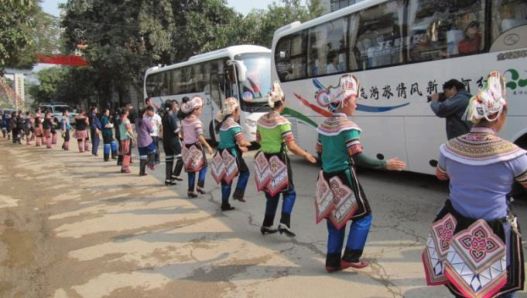
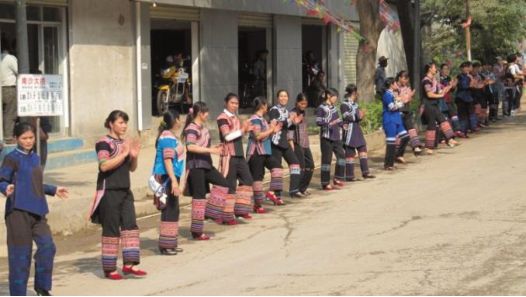
Three years after this Conference, the Hani Rice Terraces have been declared a UNESCO population and their leaders to welcome us were obviously motivated by an enormous expectation for this worldwide recognition. One has only to remember our “triumphal” entry in Yuanyang county on 11 November 2010 (see video).
1.2 a Very Telling Drawing
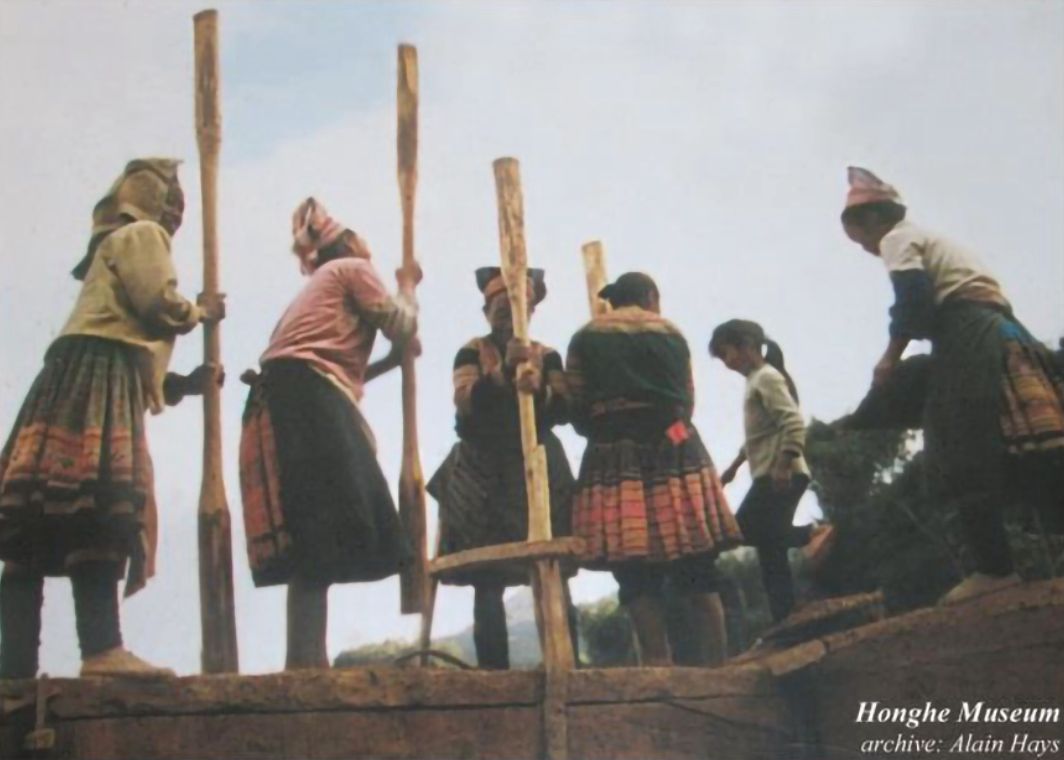
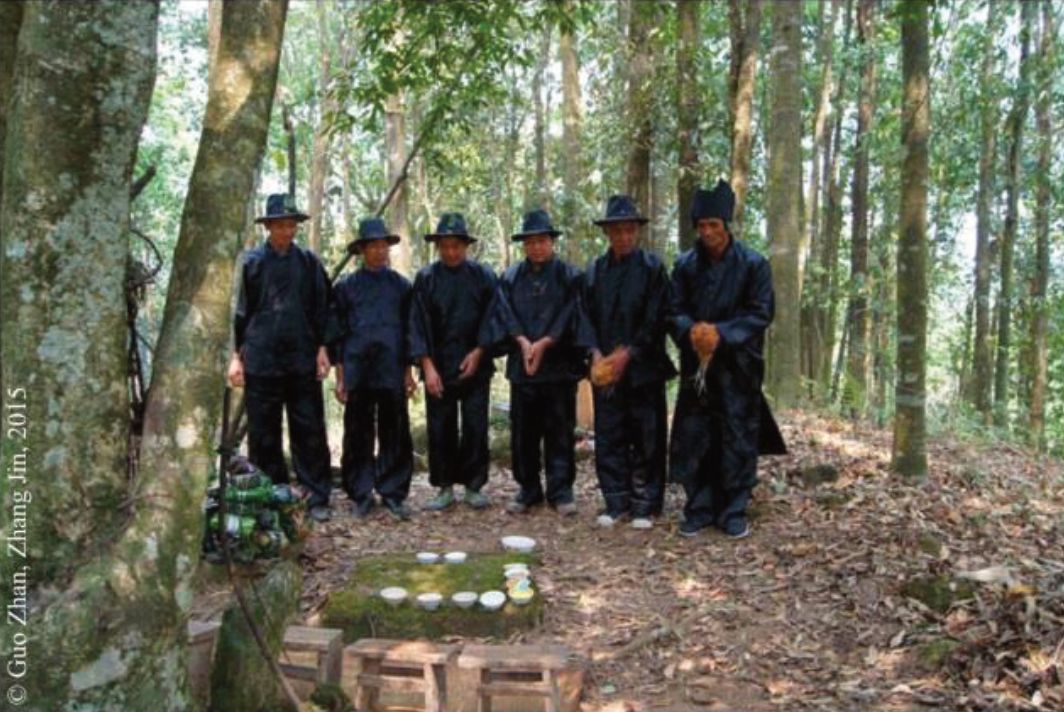
Hani and Yi people explained us in length their complex relation to their fabulous earthy terraces. They put a special emphasis on their traditions, practices and relation to nature, explaining the importance of their beliefs and the deep respect they had for their holy forest and nature deities.
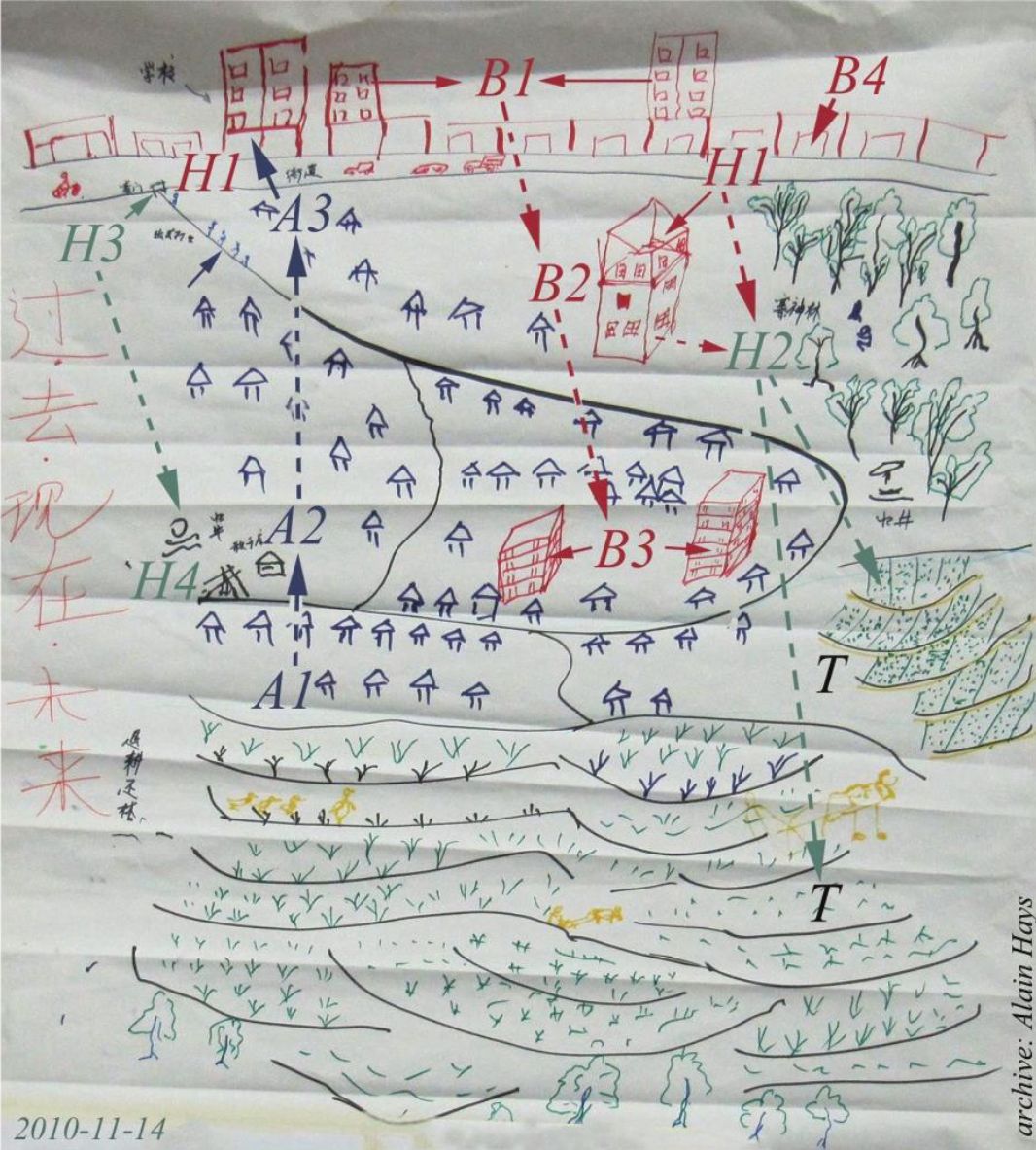
Despite the great interest aroused by their presentations, I have had the impression that the exponents just tell us what we wanted to hear because they knew who we were and the main reason of our presence. Strangely enough, they did not speak so much about the future of their land as a possible World Heritage site while the great mobilization of the However, a Hani presentation was brought to my attention. A Hani speaker made a
“The landscape reflects an integrated four-fold system of forests, water supply, terraces and houses. significant drawing that turned out to be premonitory.
The mountain top forests are the lifeblood of the terraces in capturing and sustaining the water needed for the irrigation. There are four types of forests, the ancient ‘water recharge’ forest, sacred At first glance, we can be surprised that the terraces’ area (T) is reduced to less than half
forest, consolidation forests, and village forests for the provision of timber for building, food and the image of the landscape when the built areas (A and B) are dominating the drawing.
firewood. The sacred forests still have strong connotations. Above the village are places for the The speaker explained that since 1990, terraces areas are decreasing, for the lack of water,
Village God “Angma” (the soul of the village) and for the Land Protection God “Misong”, where and also for urban extension and new infrastructures, perhaps also for rural exodus of
villagers pray for peace, health and prosperity.” young people to the cities in search of jobs.
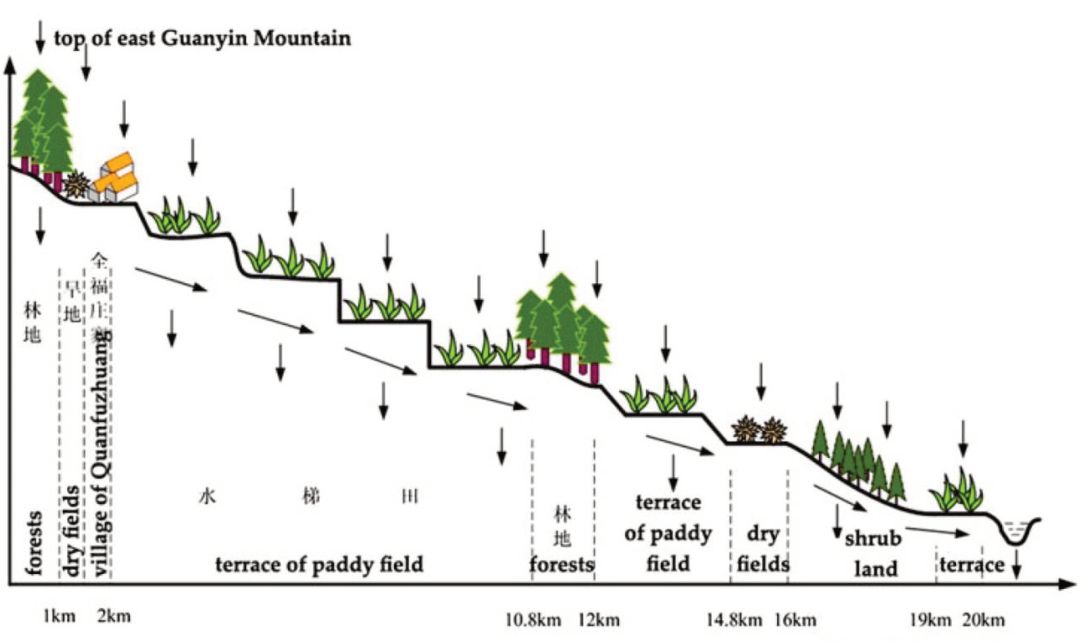
[…] “Eighty-two relatively small villages with between 50 and 100 households are constructed It is interesting to compare this drawing with the following cross section of a typical
above the terraces just below the mountain top forests. The traditional vernacular buildings have Honghe terraced landscape. On the contrary, the section view shows earthy terraces, dry
walls built of rammed earth, of adobe bricks or of earth and stone under a tall, hipped, roof fields, shrub land and forests that occupy at least 90% of the landscape and villages only
thatched with straw that gives the houses a distinctive ‘mushroom’ shape. At least half the houses a very limited area.
in the villages are mainly or partly of traditional materials.” (UNESCO ref 1111). Watching again the Hani drawing, its top strangely shows a dominant urban world instead of the announced mountain top forest. So, what was it about? Any urban expectation? A new reality?
A long buildings’ row along the wide road seems shops (B4). This drawing may also indicate that indigenous people are not too isolated and have significant relationships with the cities, especially because of the huge transformation and modernization of China. Mostly workers in the cities come from the rural areas. They built unavoidable “bridges” between rural and urban worlds. Today, the rural-urban divide is far more complex than the simple analyses suggest. Urban lifestyle is still largely viewed as a unique model of progress, and the city as a powerful marker of modernity, a real hope for a better life for millions of poor peasant-farmers. (see my article : “Eco-cultural” Perspectives for Green Building Design and Built Heritage Conservation”) https://www.linkedin.com/pulse/eco-cultural-perspectives-green-building-design-built-alain-hays/
Looking more closely at the drawing, urban multistoried buildings (B2 and B3) appeared in heart of the village drawing, while the sacred mountaintop forest (H2) is relocated at right, below the urban world, just below the “Highway” (H1). It is what I call “H-to-H
to wear everyday their best traditional clothes as if it were a permanent festival in their Syndrome”.
villages. But what is authenticity exactly in such cases? Only hidden paths protect the holy forest, not highways…
1.3 the “h-To-H” Syndrome
“H-to-H” means “Highway to Holy Place”. The “H-to-H Syndrome” is typical of mass
When an indigenous site is classified as World Heritage, the “H-to-H Syndrome” runs tourism and consumer societies and not the specific situation of China. On the one hand
the risk to have enormous consequences if it has not been properly thought by all the we value ethnic cultures as never before, and on the other we must take share of the blame
stakeholders. Sudden mass-tourism and abrupt changes are hard to deal with. for the disappearance of endangered indigenous people. We are looking for authenticity while just by our massive presence and our requirements we upset existing ecological and
1.4 the Delicate Gentrification Issue
social balances of any autonomous society.
In 2016 (three years after the WHS classification) a group of English and Chinese experts (PhDs) from the Universities of Greenwich, Minzu, Hong Kong and Xi’an Jiaotong made Domestic and foreign tourism is constantly increasing. Numerous tourists want to stay in
a relevant study. Their research on site reveals a triple gentrification process in Honghe traditional dwellings, to have a look at sacred places, to experiment some hours of peasant
WHS: Gentrifier-led gentrification, State-led gentrification and Self-gentrification. hard life as if it were matter of playing. For them, indigenous peoples feel an obligation “Gentrification” can be defined as “the production of space for progressively more affluent
fully to natives) as transportation and guiding, agricultural produce and local crafts selling, users” resulting in the gradual, indirect displacement of long-terra residents.”(Hackworth,
small bars, tea/coffee places and small restaurants providing friendly and comfortable rest 2002, in Jin Hooi Chan & all, 2016, p.4).
areas, etc. could be a better way to achieve long-term sustainability.
Looking again at the symbolic drawing, we can observe that the village area (A) is
“The tension between cultural exoticism and modernity is clearly depicted by the most senior really wide spread, showing a lot of traditional dwellings from the terraces (T) up to the
manager in the state-owned tourist development corporation Shibo-Yuanyang Co. Ltd.5 in “Highway” (H1). Like the holy forest (H2), the traditional Hani village’s gate (H3) is
improving the general living conditions of the villages: “Some experts proposed that the more now directly connected to the urban “Highway”. But, why so many traditional houses?
authentic [the culture is] the better; the more ancient the better... you demand [Indigenous people] Perhaps, because an expectation of high rental value of their traditional dwellings for
to be poor, backward, and remain primitive, but you want to stay in a luxurious hotel room!... touristic purpose. The indigenous houses seemed to be of great economic importance and
Our company position is... we are investing in this place, first and foremost, for conservation. at core of a development strategy.
But if it is merely conservation, and no reasonable development, the people cannot get rich. If local people are not rich, they will destroy [the rice terraces].”” (Jin Hooi Chan & all, 2016, This drawing in 2010 was really premonitory:
p.18). “Government ban on new construction in the WHS for conservation purposes has caused high rental demand for existing Hani dwellings. […] During our 2015 revisit, a gentrifier declared
A fair agreement and balance of profits between all stakeholders is necessary for granting the annual rental he paid to be about US$10,000 — a very high figure in comparison to the
substantial benefits to ethnic natives who know how to maintain “alive” a so complex village’s average annual income of less than US$500 per capita” (Jin Hooi Chan & all, 2016,
agricultural heritage. Government and governmental agencies should play a critical role p.16).
in ensuring balance and regulation.
1.5 “living Heritage” Concept
The study concludes that endogenous gentrification of villages by some of their own
In 1999, invited by the Mexican delegation to the World Congress on the Conservation inhabitants (self-gentrification) for home-stay tourist accommodation is more convenient
of Monumental Heritage3 , Prof. Jorge González Claverán and I, we argued that it is than exogenous gentrification, because this could reduce out-migration compared with
essential to take into account both aspects - tangible and intangible - for any natural or other types of gentrification.
cultural heritage. It is even more valid for World Heritage. Defending that position, we coined together the key concept of “Living Heritage”. This may be true but I would not be so optimistic. To lodge a growing number of tourists in small indigenous villages could have a deep impact on traditional private and community
This concept of Living Heritage is definitely relevant in case of indigenous heritage, life. In other words, tourists will invade ethnic peoples day and night. The number of
in particular for terraces conservation. The tangible heritage of Hani and Yi terraces is traditional dwellings reserved for tourist accommodation is set to increase in the future.
their beauty, complexity, extension, and high quality crops. Intangible heritage consists This “self-gentrification” could also imply significant out-migration involving a risk of
of deep indigenous knowledge and eco-cultural practices, local people involvement and not enough peasants available for rice-terraces cultivation and maintenance. In villages,
appropriate societal organization. These tangible and intangible aspects are totally linked to accept only proper scale tourist groups, to develop economic activities (reserved almost and should be taken into account for any action to ensure maximum protection of such World Living Heritage; in this case the permanency of an amazing World Eco-Cultural Heritage.
2. an International Living Networks Alliance
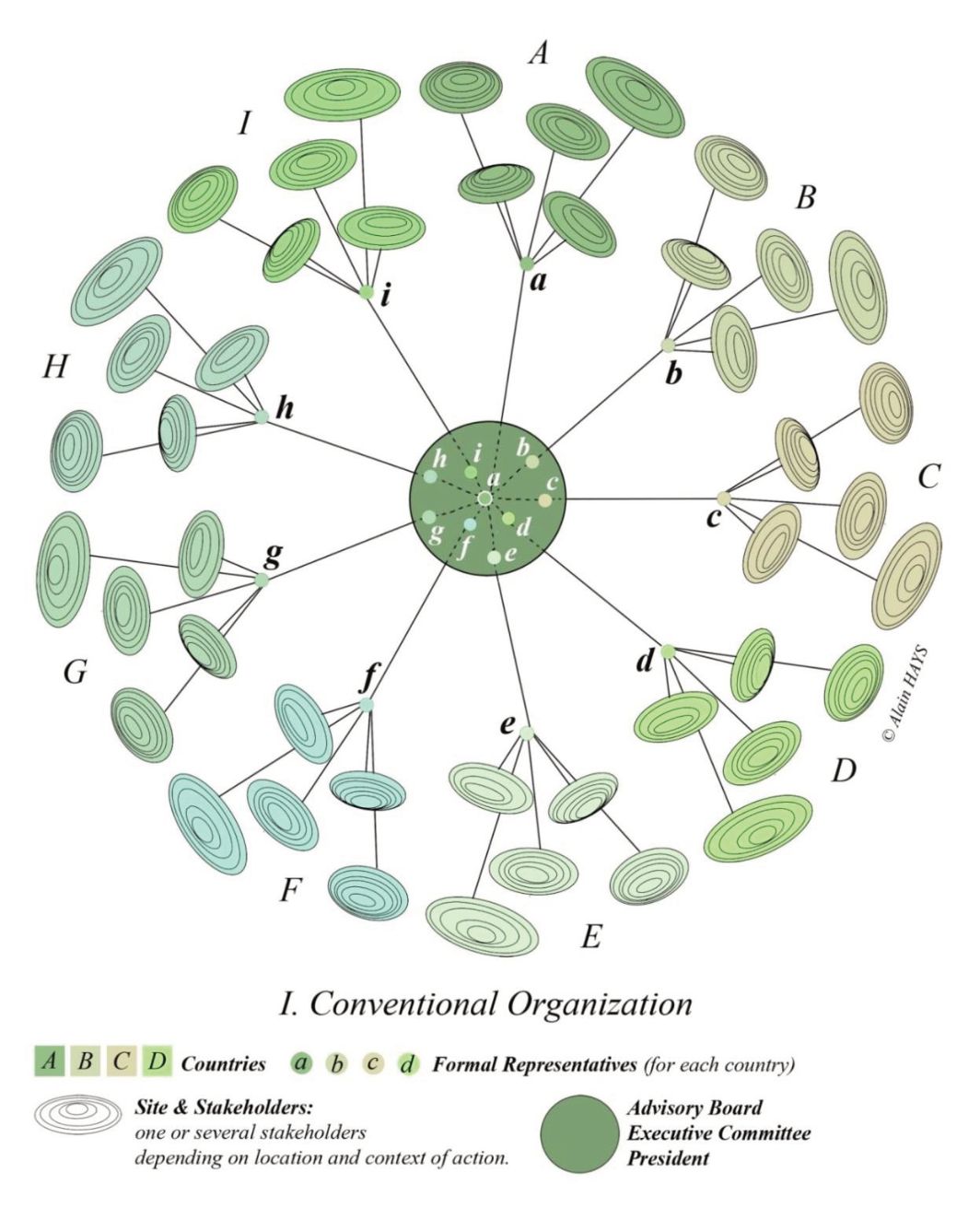
As we noted above, a significant outcome of the First Terraced Landscapes Conference was the International Alliance for Terraced Landscapes. But how to run “properly” an international alliance? I will try to give my views from my long experience in several cultural and sociopolitical contexts (Europe, Latin America, China), managing many projects, working with various institutions: academic, governmental, international, associations and indigenous peoples)4. For development of an international alliance, I think two main possible ways exist. The first one could be the formalization of a “conventional organization”.
2.1 Conventional Organization – the First Way
This conventional organization is, in principle, based on the previous election of one delegate for each country. Then, these elected delegates make up an international advisory board. From this advisory board are elected or designated the members of an executive committee and elected the president of the international organization (unless the president would be elected by all the organization members, which is difficult to achieve between countries that are located far away from each other). In reality, international events organized by this type of international organization are often a unique opportunity of global meetings for the re-election of their leaders and President. I remind some international thematic organizations. During international fora, the representatives of each country seemed to exercise more concern for their re-election as new executive committee member than by the goal of the forum. In other words, the international meetings were often transformed into the theater of innumerable conflicts and intrigues as if the main purpose of the international meeting had become a secondary consideration…
But let us imagine that we are only between fair play persons and very democratic institutions from friendly countries without any envy or ambitions for power, though some are much wealthier and more powerful organizations or countries than others: it would be like wonderland, doesn’t it? Institutions and their leaders (in particular NGOs,
Does it include retired specialists or academics who are no longer engaged in an employed universities, research centers and even charitable organizations…) fortunate enough to
or self-employed activity? Does it really include indigenous people or peasant inhabitants have more resources, always end up benefiting the funds rather than qualified stakeholders
who are experts in terraced landscapes building, cultivation and maintenance? In case on the ground or independent actors that have already proven successful. In other words,
of touristic regions with attractive terraced landscapes (e.g. World Heritage Sites), does consistent funds are granted in most cases to those who demonstrate a long history of
it also mean a person who is working in tourism-related business connected with the large fundraising and financial administration regardless of the actual work done and
terraced landscapes topic? That seems a little confusing. On a global scale, talking about true professional quality of their projects in the past. Nevertheless, this “conventional
“stakeholders”, “actors” or “partners” could better designate any person or institution who organization” system is necessary for intergovernmental organizations (IGOs) and could
is involved in the use, rehabilitation, conservation, improvement and development of be convenient for international organizations (IOs) whose members in each country
terraces, who is committed to the terraced landscapes preservation and who agreed with have the same status at local and global levels, as for example an international network
the founding Honghe Declaration (a copy of this text is attached for ease of reference). of universities. The rules are easier to define when everybody uses them in his own environment and above all when everyone has the same status. But I understand that on
Thus profiles of the members of the Alliance should be much more open: the contrary, the International Alliance for Terraced Landscape, since its creation, does its
• Direct actors & users: Local Inhabitants - Peasant Communities - Indigenous
best for integrating and motivating new actors coming from different backgrounds and
People - Farmers - Agro-food Productors - Rice Growers - Tea Growers - Wine territories. And that is how it should be!
Growers - Local craft producers, etc. • Peasant Associations: Cooperatives - Peasant Federations - Agricultural The Alliance commitment to openness obliges to imagine another organizational scheme.
Producers’ Networks - etc. We do not have to re-invent the wheel but to start from the current reality. So, in my
• Knowers: Growers, Local Specialists, Academics (Universities), Researchers, opinion, the second way would be the own Alliance capacity-building and priorities, what
Experts, Consultants, Governmental or International Cooperants - etc. we can refer to as a “Living Networks Alliance”.
• Scientists: Archaeologists, Historians, Geographers, Ethnographers, Anthropologists, Agronomists, Botanists, etc.
2.2 Concept of “living Networks Alliance” – the Second
• Builders: Local Builders, Materials Producers, Water Engineers, Civil Engineers,
Way
Landscape Designers, Architects, etc. An argument for this second way is the diversity of participants and their location. In
• Promoters: Local Knowers - Activists - Volunteers - NGOs - Students - Teachers various documents the Alliance is presented as a network of professionals and activists.
- Educators – Schoolchildren – Reporters – Film-makers – Photographers – Eco- “Stakeholders” or “actors” would be more appropriate than “professionals and activists”.
museums, etc. Firstly, because these terms are not on an equal footing: a professional can also be an
• Formal Nature Conservation Organizations: Nature Park, Eco-Cultural Park activist when an activist is not necessary a professional. Secondly, because the ambiguity
Managers (local, regional, national.) - etc. of the word “professional”. Does it mean a person who belongs to one of the professions?
• International Nature and Culture Organizations: IGOs (UNESCO - UN Does it mean a person who is expert at his or her work? Does it include for example a
Agencies - FAO), IOs (ICOMOS – IUCN, etc.) PhD student who has not yet graduated but who is doing a useful research about terraces?
• Administrative Authorities: (local, provincial, regional, national, etc.), GO(s) • Indirect actors: Merchants, Businessmen, Tourism officers, Ecotourism actors - Innkeepers, Restaurateurs, Carriers, Tourists. etc. • Investors: Private, Public, Local or External Investors - Banks, etc. • Sponsors: Funding Partners - Donors - Fundations - Development Agencies - Local, Provincial, Regional, National, International Organizations - GOs - IOs - IGOs - etc. This stakeholders’ list is far from to be exhaustive.
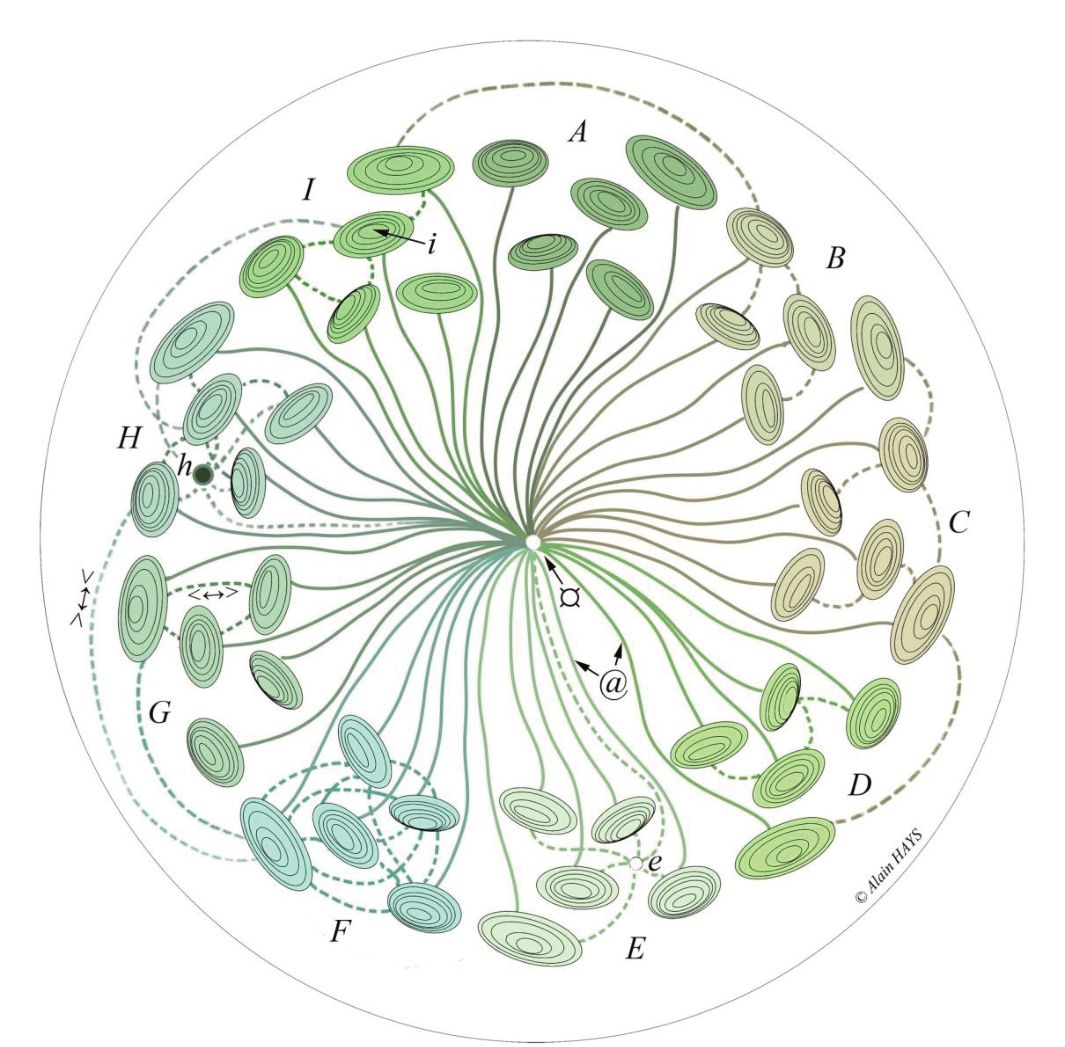
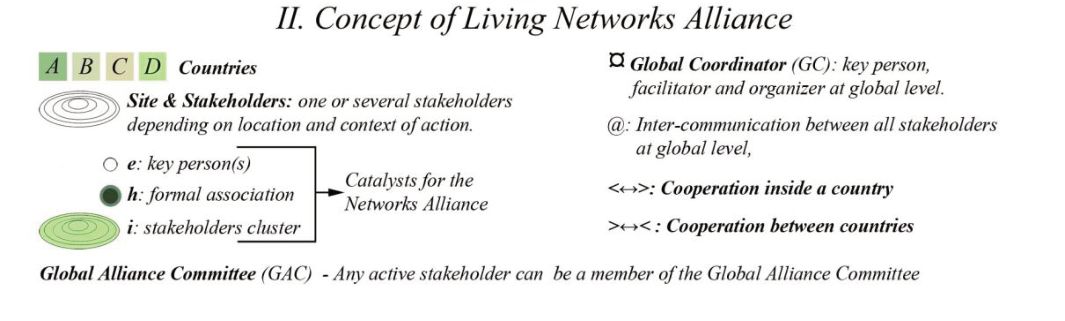
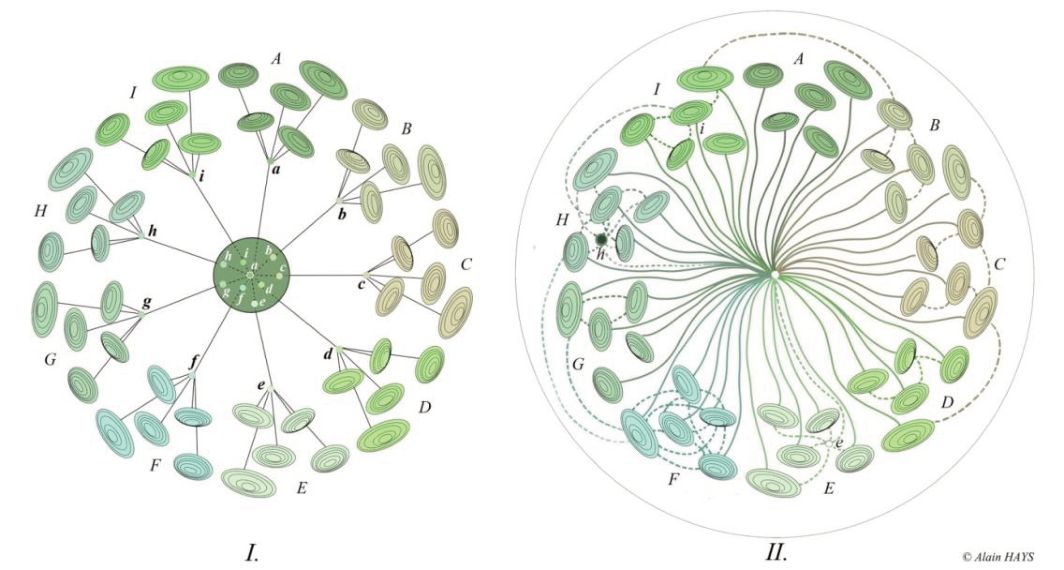
If we take into account all these “Terraces” stakeholders eventually interested in the Alliance, it is almost certain that a conventional organization will never work. Which official delegate could represent so different stakeholders? And how to organize fair and democratic elections ? Only a decentralized organization, an alliance of motivated and independent networks (the plural is ignificant) and key individual persons or groups could really work. It is why I have tried to illustrate the concept of “Living Networks Alliance”, or Alliance of Living Networks (see below, the following illustration).
What can we observe from this second graphic illustration ?
First, each country is unique and the terraced landscapes reality and involvement of people about this topic are different in every country. Stakeholders are also not the same.
Second, in each country, we can find different types of organization, giving power to local stakeholders at all decision-making, planning and implementation levels. e.g.:
• In the country H, Alliance actors have decided to create a formal ITLA national association “h” (e.g. as it is the case in Italy) Why not ? if the establishment of this new association meets the participants’ needs for developing activities in their country or from their country towards other actors at global level. • In the country E, a key person “e” makes great efforts to promote activities of the Alliance and bring together important actors and competencies around the Terraced Landscapes topic. • In the country I, we can imagine a stakeholders cluster “i” which coordinates its activities with different terraced landscapes sites. e.g. It could be a peasant confederation for terraced landscapes agriculture, a terraces builders corporation, it is convenient to use this word in formal events or proceedings) has to be a Global an informal activist movement, or any motivated organization. Coordinator (GC), a key person who has demonstrated capacities for facilitating this • In the country F, we can observe a strong inter-communication or inter-action necessary inter-communication and for organizing the Alliance events at global level. between several terraced sites, maybe because a good agricultural and rural
2.3 Light and Unhierarchical Organization
development policy, maybe because an efficient NGOs coordination (which is no Such a Living Networks Alliance (or Alliance of living networks) has to be decentralized easy matter…), or other historical and social factors. and as light as possible. To think better about it, I have had a fruitful exchange of views • In the country A, terraced sites and their actors look independent. It is a common with our friend Jacques du Guerny5 who has an extensive experience in international situation when the distances are quite great between these sites within a country organizations and was the first to react to this concept of “Living Networks Alliance”: or when the agricultural use of terraces are very different: rice growers, tea growers, “il me parait excellent parce que faisable et a-hiérarchique. Faisabilité: essentiel lorsque l’on etc. a affaire à des unités très diverses de par leur nature, fonction, poids et Weltanschauung6! A-hiérarchique est important comme l’expérience le démontre pour que l’organisation ne devienne Third, dot lines between some of the sites and their actors highlight inter-communication
pas une fin en soi et sans objet autre qu’incantatoire” (J. du Guerny, 2018-08-26). or concrete actions (projects, programs, resources exchange, etc.) between them. Following a process of decentralization, it is important that the Alliance encourages appropriate
“I think that is excellent because feasible and unhierarchical. Feasibility: essential when forms of cooperation at the initiative of its members or prospective members. These could
we are dealing with various units by their very nature, role, influence and world view cover domestic and international cooperation. Alliance members or potential members
(Weltanschauung). Unhierarchical is important, as experience has shown, to ensure that (e.g. national research centers, universities) must be free to develop their own terraced
the organization does not become an end in itself and pointless, remaining basically landscapes programs and their researches at regional, national or international level. The
incantatory.” Alliance should not result in stakeholders substitution. On the contrary, the Alliance has to be a credible promoter for any valuable initiative which contributes, with ethics and
In the first version of this paper, I did not go into details about logistics and operational transparency, in the achievement of its goals.
organization. It would have been impossible to represent everything on a same diagram without becoming illegible. However, in response to concerns expressed by some members Fourth, and perhaps the more striking, the graphic illustration shows that any Alliance
of the Alliance, I have tried to reflect on how best to ensure such a light and unhierarchical actors has to be be directly informed of all activities and projects, new demands and timely
organization. First, we have to listen with the greatest attention to the remarks and news, and no only some representatives as it is too often the case in many conventional
suggestions made by J. du Guerny when he refers to the French notion of “intelligence organizations. Any actor needs to feel engaged as a member of the Global Alliance
des ressources”, which means an “optimal use of resources”. Committee (GAC).
«Ainsi le ‘centre’ ne doit pas essayer de standardiser/universaliser, mais repérer les points forts Fifth, To facilitate inter-communication between all stakeholders at global level is the
des membres dans les pays, certains sont bons en recherche, d’autre en vulgarisation, d’autres en main and difficult task. Internet is a great tool for that but not enough. There must also
formation, etc. Et donc le ‘centre’ doit encourager chacun de faire et développer ce qu’il sait faire le be a real willingness and that needs work. The “president” of the Alliance (sometimes mieux et, s’ils en ont envie ils peuvent former des petites équipes où leurs talents se complètent, se
avec quels financement et pérennité ? La question de la pérennité est cruciale : on obtient souvent renforcent. Ce genre d’approche n’exige pas des moyens importants… La diversité des initiatives
des fonds pour une année ou deux, puis la source tarit et on commence à sauver les postes ou les locales est comme la biodiversité, une richesse, il faut l’encourager et non mettre en place des
contrats plutôt que les activités […] mécanismes qui vont l’étouffer au bout d’un moment» (J. du Guerny, 2018-10-17).
Ce genre de consultation devrait être possible par internet, du moins pour la première partie de l’exercice où il faut établir la liste prioritaire. Puis dans un 2e temps les besoins organisationnels “The ‘center’ should not try to standardize/universalize, but to identify members’ strengths
peuvent être discutés et déterminés en fonction de la liste de 2,3,…6,7 fonctions retenues» (J. du depending on the country, some are good at research, at dissemination, others are good
Guerny, 2018-10-16). at training etc. Thus, the ‘center’ should encourage everyone to do and develop what they do best. If they feel like it, they can form small teams where their talents complement
« In a practical way, I recommend to proceed as follow: If there was only one function, and reinforce each other. Such an approach does not require considerable resources… The
what would it be? Would be the current organization appropriate for that ? diversity of local initiatives, such as biodiversity, is wealth; we should encourage it, and not
Then, using successive iterations: If there was only two functions… to put mechanisms in place that will only serve to stifle it after some time.”
A point is reached where the current organization is overwhelmed. Thus, what options are possible? With what financing and continuity? Sustainability is critical: Funds are often «Mon expérience d’observateur d’ONGs et d’institutions internationales est que dès que
obtained for one or two years, then the source will dry up and we begin by saving jobs or l’on propose trop de fonctions/tâches, la structure informelle se développe, et se transforme en
contracts rather than activities […] This sort of consultation should be possible through secrétariat avec des problèmes de postes et de financements, des querelles d’intérêts géopolitiques,
Internet, in the first instance to draw up a priority list. In a second step, organizational de bureaucratie, etc. et que l’objectif initial est peu à peu perdu de vue. L’organisation devient un
needs may be discussed and determined from the list of 2, 3, …6, 7 functions retained.” fromage» (J. du Guerny, 2018-10-16).
2.4 GLOBAL LEVEL: GLOBAL ALLIANCE COMMITTEE & GLOBAL COORDINATOR
“My experience as an observer for NGOs and international institutions is that as soon as
By following these recommendations, not only a decentralized organization is appropriate too many activities/tasks are planned, the informal structure grows, and will be transformed
but also a light framework where every Alliance member (person or institution) forms part into a secretariat with employment and funding problems, geopolitical power struggles,
of a Global Alliance Committee (GAC). Every Alliance member must feel responsible bureaucracy etc. The original objective tends to be gradually forgotten. The organization
and heard as part of the Global Alliance Committee. becomes a gravy train.”
A Global Coordinator (GC) is necessary to avoid a central Board that could be To avoid this situation, J. du Guerny suggests the following approach:
detached from the reality on the ground and cut off from its roots. When an international «De manière pratique, je suggère de procéder de la manière suivante :
organization begins to grow, I could add that it is frequently the case that the most S’il n’y avait qu’une seule fonction quelle serait-elle ? Est-ce que l’organisation actuelle suffit
motivated and qualified founder members disappear to the advantage of “better-situated” pour cela ?
opportunists who join quickly the Board with a consequent risk of major deviation from Puis par itérations successives, s’il n’y avait que deux fonctions…
goals of the organization. Arrive un point où l’organisation actuelle ne suffit plus. Quelles sont les options possibles alors, The Global Coordinator (GC) is a key for the Global Alliance Committee and the
• Executive Organizing Committee (EOC); activities of the Alliance. One of his main tasks is to be a good facilitator (and it is not
• Fieldwork Organizing Committee (FOC); so easy to be it). In my diagram, it looks like a sort of “hub” able to pass on information
• Organizing Committee for the scientific committee coordination to others. The Global Coordinator has to promote and incentivize actors and actions.
(OCS); Of course, he cannot do everything by himself. If he feels he needs, he can organize and
• Scientific Committee (SCC). work with a Global Liaison Committee (GLC), which could be made of some reliable Alliance members. The trusted members of the Global Liaison Committee may be from
Operations Committees (OPC) (specific committees for programs or projects execution). different countries, institutions or individuals.
If funds are obtained by an institution on behalf of ITLA for a program or a project, an ITLA Operation Committee (OPC) should be established although this funds could be Applications for membership: The Global Coordinator and his Global Liaison Committee
received and used directly by interested parties (this point and financing arrangements should be authorized on behalf of the Global Alliance Committee to receive applications
have to be discussed). for membership by new members and to keep the Alliance members’ register.
Scientific Committees (SCC) – (depending on the events or projects). A Consultative Ethics Committee (CEC), could be comprised, at global level, of trusted and qualified members. It could play an important role in case of deviance or disputes.
Thematic Committees (THC), which would be transversal or specific committees if convenient (eg : Indigenous Terraces Committee, Andean Terraces Committee, Terraced A Global Scientific Committee (GSC), may be comprised, at global level, of qualified
Vineyards Committee, Rice Terraces Committee, Tea Terraces Committee, Water members of different countries (not necessary from each of them). Perhaps, it could be
Management Committee, World Heritage Sites Committee, Eco-cultural Tourism more efficient to establish Scientific Committees (SCC) as “ad hoc committees” for each
Committee etc.). program or project execution.
Continental Committees (COC), transversal committees if convenient (e.g. Asian
2.5 Operational Level: “ad Hoc Committees”
Terraced Landscapes Committee, Latin-American Terraced Landscapes Committee, At the operational level, it may be created as many Ad Hoc Committees (AHC) as
African Terraced Landscapes Committee, European Terraced Landscapes Committee, necessary. Some should be permanent, other circumstantial depending the goals to be
etc.). reached; e.g. some ITLA “ad hoc committees” could be the following:
Logistic Committees (LOC): (decentralized, depending on the events or projects). Events Committees (EVC), (e.g. this is the current case for the IV World Congress in Spain):
Promotion Committees (PRC) (decentralized, depending on the events or projects). • Honorary Committee (HOC); These Committees should have an important role not only for promoting the name • Executive Committee (EXC); and objectives of the Alliance, but also to communicate its activities (events, projects, • Organizing Committees (ORC); programs, local initiatives etc.) inside and outside the Alliance. They are not limited to a global Internet communication, but have to encourage and support the exchange of local, national, regional and international experience.
This Ad Hoc Committees (AHC) list is not exhaustive but widely opened. Of course, all these committees should not be established at the same time. This codified list is just to indicate their possibility according to the necessity of the Alliance.
• The “Ad Hoc Committees” (AHC) concept has to fit in well with the reality and tasks to accomplish. • Every Ad Hoc Committee may comprise one or more institutions and/or individuals from one or more countries. In other words, individuals or institutions who are members of ITLA can establish an ITLA Ad Hoc Committee according to their projects and activities. • The Ad Hoc Committees should not be multiplied beyond necessity, just in order to legitimize funds, useless bureaucracy or any unsatisfactory process, giving a false impression of the Alliance or creating a white elephant that exceeds the Alliance’s means and capacity. • The Ad Hoc Committees could be as numerous as the diversity of local initiatives.
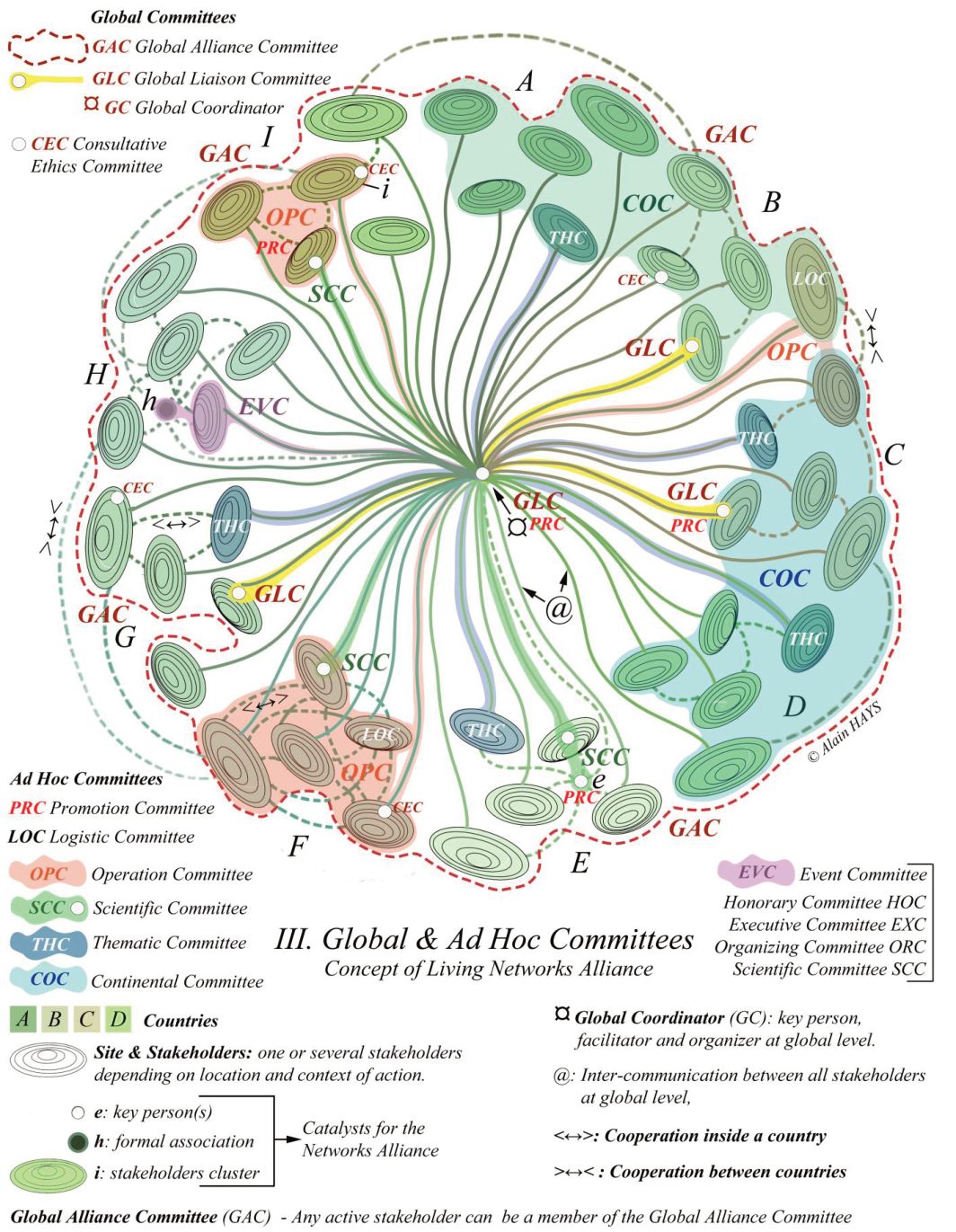
2.6 Concept Chart of Living Networks Alliance and Its Global and Ad-Hoc Committees
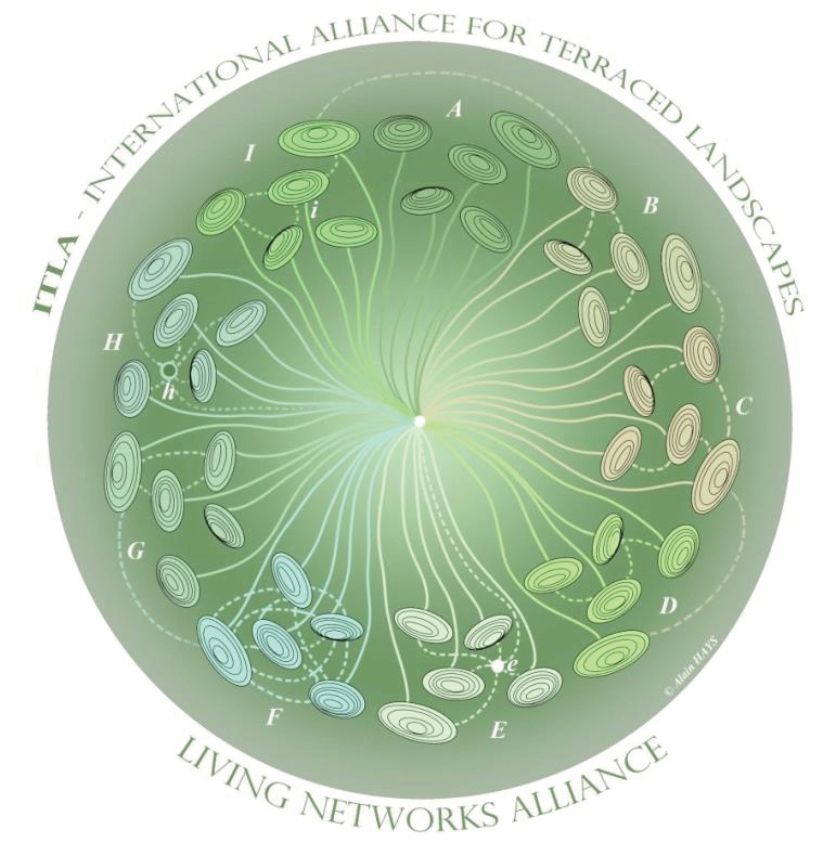
In the same manner as above, using my concept chart of “Living Networks Alliance” I have tried to illustrate a possible organization based on very few Global Committees and Ad-Hoc Committees as numerous as necessary. In my Global and Ad Hoc Committees Chart the first thing that can be noticed is its coherence and consistency with the “Living Networks Alliance” concept. In particular, a Central Board does not exist. The Global Alliance Committee (GAC) is symbolically represented by a red dashed line which includes all the ITLA members and the Global Liaison Committees consists of trusted key persons from different countries (e.g. B, C ,G).
Ad Hoc Committees (AHC) and Key persons: The Alliance organization depends entirely on Ad Hoc Committees and Key persons especially: • for the Global Liaison Committee (GLC) which has to help the Global
3. the Two Ways…
Coordinator (GC), • for the Consultative Ethics Committee (CEC), • for every Promotion Committee (PRC) and • for any action to facilitate the Alliance projects or events.
Operations Committees (OPC): For the execution of any concrete project, on initiative
of ITLA members, a specific Operation Committee (OPC) could be created. An OPC can include individuals and/or one or more institutions; e.g. an international cooperation project between the countries B y C (from two continents) creates an OPC which can also be a bridge between the respective Continental Committees (COC) if they exist. The concept chart shows also an Operation Committee (OPC) at national level (country “F”) with a Logistic Operation Committee (LOC) established in one of the terraced landscapes’ sites. Another Operation Committee (OPC) for a project developed by three sites is shown in the country “I”. We can also observe that a Promotion Committee (PRC) has been also established for this So having a last look at these two illustrations and it is not only a visual impression: the inter-sites project. first one seems geometrically and perfectly organized but it can also be seen as the top view of a dry-tree which risks to lose quickly its leaves while it has a solid trunk at least Thematic Committees (THC): The concept chart shows a transversal Terraced Landscapes
in appearances. Thematic Committee (THC) (e.g. a Water Management Committee) established between five countries A, C, D, E, G, across continents. The second illustration looks organic and complex. It is not fully symmetric. It seems a nice living plant with only a thin stem but showing many seeds able to germinate in the Event Committee (EVC): The concept chart shows an Event Committee (EVC),
future. established by a formal ITLA national association (as it is the case in Italy) for congress, conference, seminary etc.. Appropriate working-level sub-committees This light organic scheme fit in well with the present and future of the International can be struck as needed to handle different tasks. (e.g. Honorary Committee, Alliance for Terraced Landscape: an International Living Networks Alliance born in the Executive Committee, Organizing Committee, Scientific Committee. etc.) Hani and Yi region, at the same time of a wonderful Eco-Cultural World Heritage.
Relevant remark by J. du Guerny: “Providing translations in other languages is a heavy and costly process. There is no doubt a need to be satisfied with automated and rough translations... After all, they are not legal documents involving billions. To just understand the content of the texts is enough.” HONGHE DECLARATION Global declaration on protection and development of terraces
Drafted by Professor Shi Junchao
From November 11th to 15th, the most beautiful season for Hani terraces in Honghe Prefecture, we, the representatives and scholars from 16 countries, terrace farmers and representatives from international organizations including UNESCO, FAO, and the Ramsar Convention , as well as a representative from the US Environmental Protection Agency , have gathered together in the capital city of Honghe Hani and Yi People’s Autonomous Prefecture, China, to hold the First Terraced Landscapes Conference, in order to explore ways and methods to protect and develop terraced cultures worldwide. All participants including scholars, farmers and representatives of the international organizations jointly declare that: 1. Terraces are agricultural, ecological systems which are found around the world. They represent an agricultural system created by numerous cultures over thousands of years of history. The terraces embody the creative wisdom and the labor of mankind. They further illustrate the close integration of humans and nature, and the need to safeguard biodiversity and cultural diversity. For thousands of years, the terraces were not only the cornerstone on which many cultures were built, but they also nourished large populations around the world. However, the terraces not only satisfied people’s material needs, but also served as repositories of culture. 2. For the last half century, globalization and economic integration have severely impacted on the terraces, and imposed challenges for the people who farm them. Many terraces have been abandoned, and many cultures linked with the terraces are endangered – with some close to extinction. At such a critical moment, the question of how to protect the tradition of the terraces, and how to develop terraces for the future is a priority. 3.
we must combine a respect for tradition and indigenous knowledge with modern methods The protection and development of terraces is the common responsibility of all of
and expertise. It is only in this way that we can guarantee a healthy future for the terraces society, including governments; scholars and researchers; farmers; businessmen and other
and the unique human contribution that they represent. members of society. All must share the responsibility of managing , protecting, and caring for the terraces.
What will be the future of terraces rests upon our understanding and awareness of what 4.
we will do now. To protect and develop the terraces, you first have to address what is valued. We believe that the value of terraces is not based upon a monetary value. The culture of terraces
We wish, through our joint efforts, that the terraces will last forever, benefiting future embodies a system of values. In addition to providing food for survival, the terraces have
generations. scientific, cultural, historical, philosophical, religious, ecological and aesthetic value. As such, they cannot be replaced by any other agricultural system.
15 November 2010 5.
Mengzi, Honghe Prefecture, Yunnan, China What is particularly noteworthy is that the nature of terrace cultures embodies harmoniousness, namely a harmonious coexistence between man and nature; a harmonious coexistence between man and god7 (as a cultural symbol of nature); and a harmonious coexistence among humans themselves. The harmoniousness of terrace cultures is sufficiently strong to moderate conflicts and contradictions that occur between different ethnic groups, different cultures and different countries8. This is why the ancient cultures of terraces possess significance for today, and bear importance for the future. 6. The preservation and well being of the terraces requires the bringing together the resources and expertise of government, experts and scholars, local people and agencies. All policies applied to terraces should prioritize protection, and secondly appropriate development based upon science which underpins sustainability. Any approach should must take into account not only present impacts, but also effects on later generations.
From planning to implementation, we must heed the voices of both scientists and practical experts, namely the farmers who are the stewards of the land.
At present, the most urgent task is to develop a truly sensitive scientific understanding of terrace culture, and neither abandon nor exploit them. In order for the terraces to survive,
References
- FAO (2014) Distinction between GIAHS and UNESCO'Cultural Landscape categories (GIAHS/STC/15/3add.1) (Discussion Paper), GIAHS Globally Important Agricultural Heritage Systems.
- Guo, Z.; Zhang, J. (2015) Hani Rice Terraces of Honghe – The Harmonious Landscape of Nature and Humans, Landscape Research 40/6, pp. 655–667.
- Hays, A.; Matuk, S. (2000) Indigenous Knowledge and Sustainable Use of Biodiversity in the Vernacular Chinese Habitat, GEOdomus International (Links between Cultures and Biodiversity – Proceedings of the Cultures and Biodiversity Congress 2000 – CUBIC, Kunming, Xishuangbanna, Zhongdian), pp. 154–173.
- Hays, A. (2011) De la géo-architecture au patrimoine mondial de l'humanité : les dimensions de l'habitat humain, GEOdomus International. https://www.china-europa-forum.net/IMG/pdf/alain_hays_dimensions_de_l_ habitat_humain-systeme_ntfs_.pdf
- Hays, A. (2016) Xishuangbanna World Botanical and Eco-Cultural Heritage. http://english.xtbg.cas.cn/ic/icn/201608/t20160817_166549.html
- Hays, A. (2017) Menglun Eco-Cultural Development and Dai Building Heritage. http://english.xtbg.cas.cn/ns/es/201702/t20170216_174057.html
- 海丝•阿兰 (Hays, A.) (2017) 勐仑生态文化发展及傣族民居传承 (The development of ecological culture in Menglunand the inheritance of Dai folk houses). http://www.xtbg.cas.cn/xwzx/zhxw/201702/t20170217_4746066.html
- 海丝•阿兰 (Hays, A.) (2017) "生态文化"在绿色建筑设计与建筑遗产保护上的展望 (Prospects of "EcologicalCulture" in Green Building Design and Architectural Heritage Protection). http://m.xtbg.cas.cn/zhxw/201707/P020170718368047615220.pdf
- 海丝•阿兰 (Hays, A.) (2018) "生态文化"在绿色建筑设计与建筑遗产保护上的展望,延申版 (Prospects of "Ecological Culture" in Green Building Design and Architectural Heritage Protection). https://www.linkedin.com/e/%E7%94%9F%E6%80%81%E6%96%87%E5%8C%96%E5%9C%A8%E7%BB%BF%E8%89%B2%E5%BB%BA%E7%AD%91%E8%AE%BE%E8%AE%A1%E4%B8%8E%E5%BB%BA%E7%AD%91%E9%81%97%E4%BA%A7%E4%BF%9D%E6%8A%A4%E4%B8%8A%E7%9A%84%E5%B1%95%E6%9C%9Balain-hays/?originalSubdomain=cn
- Hays, A. (2018) "Eco-cultural" Perspectives f or Green Building Design and Built Heritage Conservation. http://en.xtbg.ac.cn/ns/es/201707/t20170718_179781.html
- Herath, S.; Jiao, Y.; Castro, P.M.; Diwa, J.; Soriano, M.; Liang, L.; Wang, Y.; Dulawan, L. (2013) Developing ecosystembased adaptation strategies for enhancing resilience of rice terrace farming systems against climate change (Final Report), Asia-Pacific Network for Global Change Research -APN.
- Hooi Chan, J.; Iankova, K.; Zhuang, Y.;, Mcdonald, T.; Qi, X. (2016) The role of self-gentrification in sustainable tourism: Indigenous entrepreneurship at Honghe Hani Rice Terraces World Heritage Site, China, Journal of Sustainable Tourism 24/8-9, pp. 1262–279.
- Hua, H.; Zhou, S. (2015) Human-Environment System Boundaries: A Case Study of the Honghe Hani Rice Terraces as a World Heritage Cultural Landscape, Sustainability 7, pp. 10733–10755.
- ICOMOS (2013) Honghe Hani Rice Terraces (China) N°1111, in: Evaluations of Nominations of Cultural and Mixed Properties to the World Heritage List (ICOMOS Report for the World Heritage Committee, 37th ordinary session, Phnom Penh). http://whc.unesco.org/archive/2013/whc13-37com-8B1inf-en.pdf
- S.A.C.H.-P.R.C. (2013) Cultural Landscape of Honghe Hani Rice Terraces (World Heritage Convention - Cultural Heritage Nominated by People's Republic of China), State Administration of Cultural Heritage of People's Republic of China.
- Shi, J. (2012) Honghe Declaration - Global declaration on protection and development of terraces, in: First Terraced Landscape Conference: (Honghe China) paper collection. Kunming: Yunnan People's Publishing House.
- Tian, M.; Min, Q.; Tao, H.; Yuan, Z; He, L.; Lun, F. (2014) Progress and Prospects in Tourism Research on Agricultural Heritage Sites, Journal of Resources and Ecology 5/4, pp. 381–389.
Rights and permissions
Open Access. This article is licensed under a Creative Commons CC BY 4.0 license, which permits use, sharing, adaptation, distribution and reproduction in any medium or format, as long as you give appropriate credit to the original author(s) and the source and indicate if changes were made.
About this article
Cite this article
Hays, A. (2020). From world heritage to an international living networks alliance. International Terraced Landscapes Alliance Journal, 1(1). https://doi.org/10.5281/zenodo.5205429
- Published
- October 2020
- Issue
- Volume 1, Number 1
- Journal
- International Terraced Landscapes Alliance Journal, ISSN 2754-7639 (Online)
- Archive
- Zenodo record 5205429
- World Living Heritage
- Hani Terraces WHS Issue
- ITLA Organization
- Living Networks Alliance Concept
